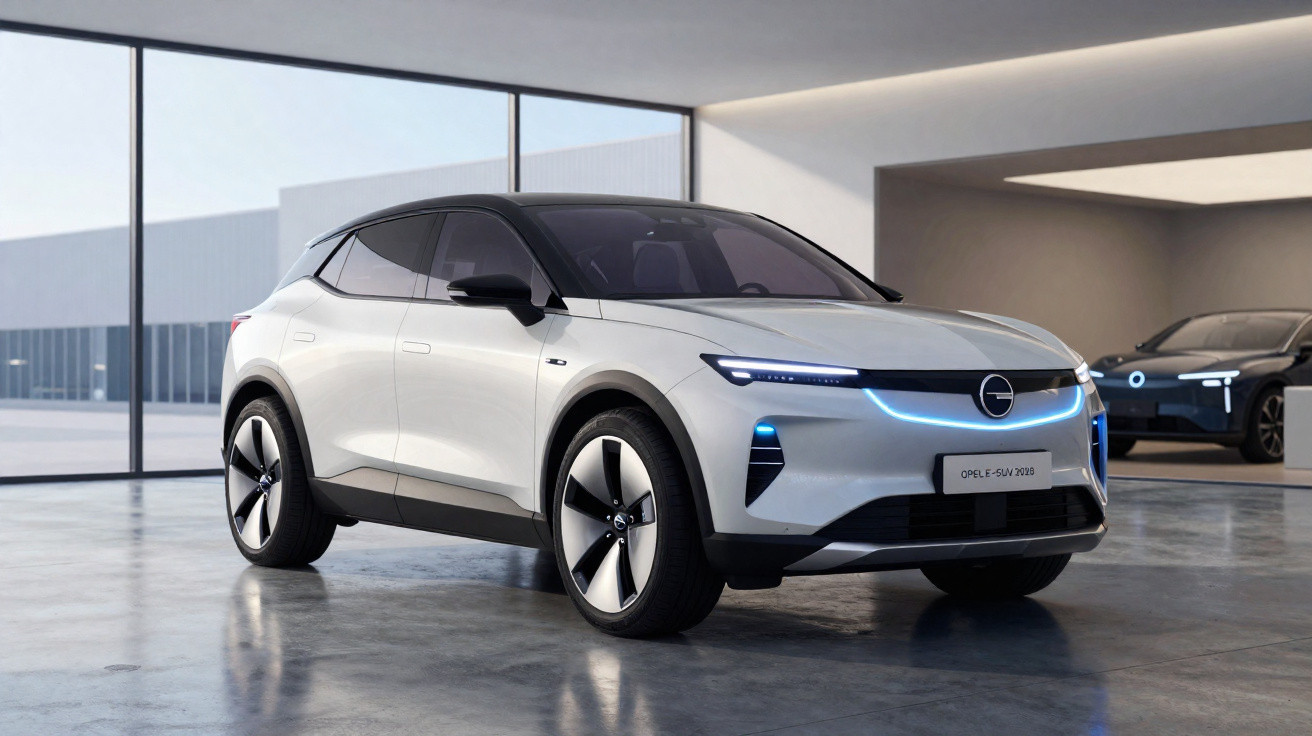
“If you can’t beat them, join them.” Opel is preparing to introduce a new electric C-segment SUV, aimed at compact family-car buyers, using the technical underpinnings of China’s Leapmotor in under two years.
The new vehicle is expected to reach showrooms in early 2028, expanding an SUV line-up that already includes the B-segment Mokka and Frontera, plus the C-segment Grandland. Although this has not yet been officially confirmed, the model is likely to sit between the Frontera and Grandland.
Designed and engineered by Opel in Rüsselsheim, the SUV will use Leapmotor technology, including its electrical architecture, batteries and other key components. Opel will be responsible for the design, in-car experience, chassis engineering, and the lighting and seat technologies that set its models apart.
This German model with Chinese origins will be built in Spain at Stellantis’s Zaragoza plant. The site currently manufactures the Corsa and, from this year, will also produce the Leapmotor B10 - an important indication of what may be expected from Opel’s forthcoming SUV.
Opel and the race for China speed
Development is therefore expected to be exceptionally rapid - taking less than two years - in line with Western carmakers’ aim of matching the pace at which Chinese manufacturers develop vehicles.
Known as China speed, this approach has given Chinese brands a competitive edge over their Western rivals. Developing a new model has traditionally required 3-4 years, whereas Chinese manufacturers have reduced the process to between 18 and 24 months.
That is possible for several reasons: greater vertical integration, which reduces reliance on suppliers; parallel rather than linear development stages; digitalisation and AI-assisted simulation, limiting the need for physical prototypes; a focus on software; and a work culture that differs from that of the West.
These methods have already been applied in practice with the new Renault Twingo, for example. The French manufacturer established a development centre in China specifically to speed up the process. The result? Just two years from the start of the project to the Twingo’s launch.
“The partnership with Leapmotor should enable a development time of less than two years. In doing so, Opel is planning to take another important step in the development of cutting-edge, affordable electric vehicles for our customers,” said Florian Huettl, Opel’s chief executive, in a statement.
Xavier Chéreau, chairman of Opel’s Supervisory Board, placed the project within a broader ambition: “With this project, Opel combines the excellence of German engineering with the speed of global technological innovation. This innovative spirit defines the next chapter of our global collaboration with Leapmotor.”
Still subject to approval
For now, the project has not been formally finalised. The parties are conducting feasibility studies and pre-development work under their existing agreements, while negotiations remain subject to definitive contracts and the usual regulatory approvals.
No further information about the new model has been disclosed so far. It is still unclear which platform it will use, or what its price and name will be. However, the chief executive made clear that it will not simply be a Leapmotor carrying an Opel badge, but a jointly developed model.
Stellantis, Opel’s parent group, and Leapmotor formally established Leapmotor International in May 2024. This is a Stellantis-led joint venture, in which it holds a 51% stake, with exclusive rights to manufacture, export and sell Leapmotor products outside China.


Comments
No comments yet. Be the first to comment!
Leave a Comment