The Renault Scenic is now an electric crossover, yet it has not forgotten about families. It is a dependable choice, although this version comes with one major drawback.
During the 1990s, the Renault Scenic helped shape the idea of the family car. Long before the SUV craze took hold, larger families needing room and versatility would almost invariably choose an MPV. That body style enjoyed a golden era, but has now all but vanished.
Times have changed, and Renault has recognised that. As a result, it has turned both the Espace and Scenic into crossovers. The former is an extended Austral that retains combustion-engine powertrains; the latter - the focus of this review - has undergone a much more radical transformation and is now fully electric.
Even so, the Scenic has retained key elements of its DNA: at heart, it is still a family car, with space for everyone and everything. At least, that is Renault’s claim. Does the new Scenic really deliver everything the French brand promises? We set out to find out.
Dressed for the occasion
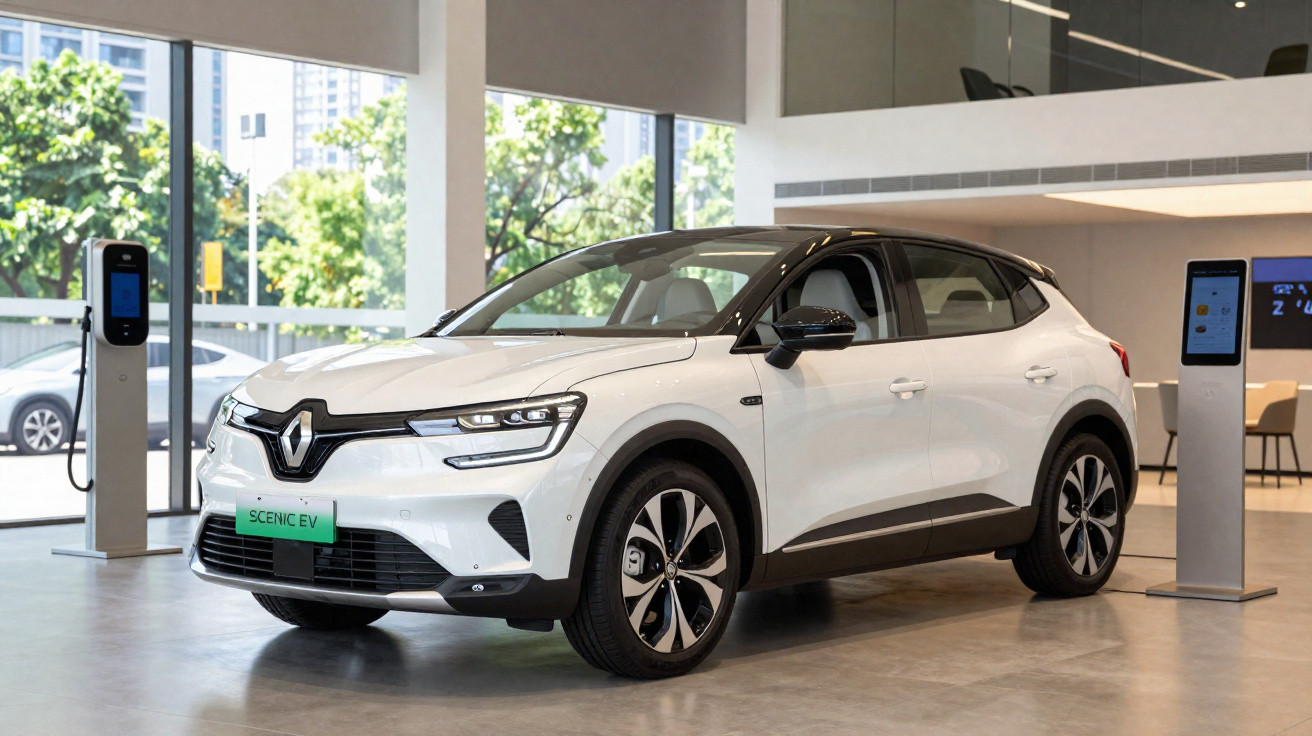
Having abandoned its MPV proportions, the Scenic now adopts a clearly defined two-box shape and wears Renault’s latest design language, characterised by a sharp lighting signature and more angular detailing.
The outcome is a more assertive-looking model, an effect made even stronger by the esprit Alpine trim fitted to the test car, finished here in Star Black with darkened 20-inch alloy wheels.
Add the fact that the new Scenic is 10 cm wider than the Megane E-Tech and it becomes clear that this crossover has a more commanding stance and a considerably more dynamic appearance than the model ever had before.
Renault Scenic interior conceals an important advantage
While the Scenic aims to make an impression on the outside, one of its biggest strengths lies inside: the Google-based infotainment system. The vertically arranged 12-inch central display is among the best examples in the industry and remains one of the strongest systems available.
It is straightforward to use, with menus sharing much of the DNA found on Android smartphones. It is impressively smooth, very quick and, above all, highly convenient.
That is because it offers native integration with apps most drivers use every day, including Google Maps, Waze and Spotify, while everything can also be operated through Google Assistant.
Despite this level of digitalisation, Renault has avoided the trap of creating an excessively minimalist cabin, retaining physical controls for the climate system as well as several quick-access buttons on the steering wheel.
Renault also deserves praise for the quality of the cabin assembly and finishes, which are several steps above those found in this model’s smaller “brother”, the Megane E-Tech.
My main criticism concerns the number of stalks around the steering wheel, particularly the gear selector, which ends up obscuring part of the digital instrument display.
What about space?
I began this review by questioning whether, after all these changes, the Scenic could still be considered a benchmark family car. When it comes to interior room, the answer is yes.
There is plenty of space in the second row, the rear doors open wide - something anyone fitting child seats in the back will appreciate - and, despite the low roofline, getting in and out is easy.
Rear passengers also benefit from several thoughtful features: the centre armrest is something of a Transformer, concealing a holder for tablets and smartphones; the centre console provides two USB-C ports; and the optional Solarbay panoramic roof can switch from transparent to opaque at the touch of a button.
The boot also deserves recognition, offering 545 litres of capacity, expandable to around 1600 litres with the rear seats folded down.
For a closer look at the new Renault Scenic E-Tech’s cabin, you can watch - or watch again - the video we made during the model’s international launch in southern Spain:
Range-anxiety proof
The tested version - 220 hp long range - is the most powerful and longest-range model in the Renault Scenic E-Tech line-up. It therefore gets the largest battery, with 87 kWh, alongside an electric motor producing 160 kW (218 hp) and 300 Nm.
But let us get to the figure that matters most: in this specification, the fully electric Scenic can travel up to 603 kilometres on a single charge. That places it among the leading models in its segment. With smaller wheels, that figure can rise to 625 kilometres.
Just as importantly, it supports alternating-current (AC) charging at up to 22 kW as an option, although direct-current (DC) charging is limited to 150 kW. In addition, every version comes fitted with a heat pump, regardless of trim level.
Driving without any major concerns about range and covering roughly 100 kilometres of motorway travel each day, I ended this test with an average consumption of 17.9 kWh/100 km, which theoretically equates to 486 kilometres from a full charge.
It is worth noting, however, that I also recorded consumption below 16.5 kWh/100 km, which would take the range beyond 527 kilometres per charge. For most people, that is enough to complete a week of home-to-work commuting on one charge.
Positive driving impressions
My view has not changed since I drove the Scenic at its first presentation. It remains convincing because of how easy it is to drive and the progressive way in which its power and torque are delivered.
Perhaps most impressive is that it is also very capable dynamically: the steering offers excellent feel, body movements are kept well under control, and the chassis feels very secure on the road.
That sharpness comes at a cost. The independent four-wheel suspension is set up on the firm side, which is noticeable over rougher surfaces, particularly with this test car’s 20-inch wheels and low-profile tyres.
Overall, the Scenic delivers very positive driving impressions. I would only like the brake pedal to provide a response that is easier to judge. Most of the time, its feel is slightly spongy.
How much does the Renault Scenic cost?
The Renault Scenic is available in its domestic market from €40,690 for the 170 hp version with a 60 kWh battery - view all prices.
The 218 hp version with the 87 kWh battery starts at €46,500, placing this Scenic E-Tech around €2,500 above its main rival, the Peugeot E-3008. In 213 hp form, with a 73 kWh battery and 529 km of range, the Peugeot starts at €44,150. With its larger battery, the Scenic counters with greater range: up to 625 km, compared with up to 527 km.
Even so, the entry-level Scenic is competitively priced, as it comes very close to several fully electric offerings from the segment below.
On the other hand, while acknowledging that esprit Alpine trim adds a further touch of refinement to the model, I find it difficult to justify the €57,426 Renault asks for the tested car.
Especially as the trim below, techno - starting at €49,300 - already includes a very comprehensive equipment list: the openR link system with integrated Google, dual-zone automatic climate control, 19-inch wheels, a heat pump and an electrically operated tailgate are among the features.


Comments
No comments yet. Be the first to comment!
Leave a Comment