A bargain used car can become expensive very quickly when it needs tyres, brakes, a battery or suspension work soon after purchase. That is why drivers looking for dependable transport should look beyond fuel economy and the badge on the bonnet.
No car virtually “never needs repairs”, and no responsible mechanic could promise that. However, the Toyota Yaris Hybrid is often worth considering for drivers who want a compact, economical automatic with a generally uncomplicated ownership proposition. The real trick is not to buy a reputation alone: choose the right individual car, with evidence of proper maintenance.
Reliability is not a badge on the bonnet. It comes from a sound design, a clear service record and dealing with small faults before they become expensive ones.
Why reliability matters more than the advertised price
A low asking price can conceal maintenance that has been postponed. A car may look tidy on a forecourt yet be approaching a major service, or need tyres, brake discs, suspension repairs, a clutch or a replacement battery.
For many UK motorists, reliable motoring means:
- fewer unexpected breakdowns on a cold or wet morning;
- less chance of an MOT failure becoming a long repair list;
- more predictable servicing costs;
- less time without a car while repairs are arranged;
- a better prospect of retaining value when it is time to sell.
This does not automatically mean buying the newest or most expensive car. A well-maintained small hatchback or family car with modest equipment can be a more sensible long-term choice than a neglected premium vehicle with costly electronics and optional extras.
Why the Toyota Yaris Hybrid is often shortlisted
The Yaris Hybrid is a familiar choice for town drivers, commuters and anyone who wants an automatic without the feel of a conventional geared automatic. Its hybrid system is designed to switch between petrol and electric power as conditions allow, which can suit stop-start driving particularly well.
That does not make every Yaris Hybrid fault-free. Age, mileage, servicing standards, driving conditions and previous repairs all matter. A neglected example can still need expensive work, while an older car from another manufacturer may give years of trouble-free service.
A compact hybrid may be a practical fit if your driving involves:
- congested urban roads;
- regular stop-start journeys;
- commuting where an automatic is appealing;
- modest annual mileage;
- a preference for low fuel use rather than outright performance.
It may be less suitable if you regularly carry several adults, need a large boot, tow a trailer, or spend much of your time on long motorway journeys. Those buyers may be better served by a larger hatchback, estate or SUV with a strong maintenance record.
A badge is not a buying strategy
Toyota is not the only sensible choice. Brand-wide reliability claims are always limited because engines, gearboxes, model years and ownership histories differ.
The Honda Jazz, for example, is commonly considered a practical used-car option, while Mazda has produced several popular small and medium-sized cars. Premium manufacturers should not be dismissed either: a carefully maintained Audi, BMW or Mercedes-Benz can be a perfectly sensible purchase.
The difference is often the cost of putting faults right. Older premium cars may use more complex electrical systems, specialist diagnostic equipment and expensive parts. A minor issue can therefore cost more than it would on a simpler vehicle.
A dependable car is not necessarily one that never develops a fault. It is often one whose faults are easier to identify and affordable to repair.
Do not overlook the 12-volt battery
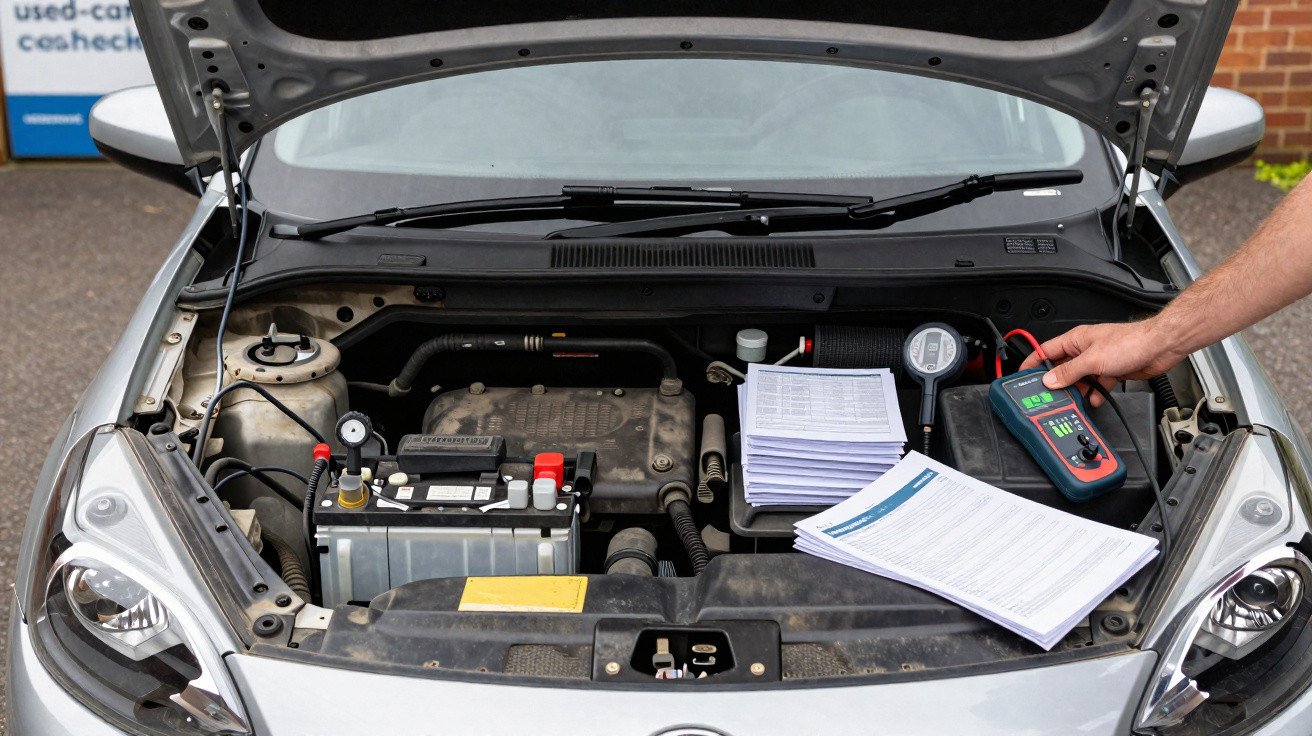
A weak 12-volt battery can immobilise almost any modern car, including a hybrid. It may trigger warning messages, prevent the vehicle from entering its ready-to-drive mode, or leave central locking and other electrical systems behaving erratically.
The 12-volt battery in a hybrid is separate from the high-voltage traction battery. Do not assume that a healthy hybrid system means the ordinary battery is in good condition.
When viewing a used car, ask:
- how old is the 12-volt battery?
- has the car needed a jump-start recently?
- has it mainly been used for very short journeys?
- are there intermittent warning lights or electrical faults?
- is there an invoice for a recent battery replacement or test?
A garage can test battery condition and charging performance. If a jump-start is necessary, follow the handbook exactly. Hybrid vehicles have high-voltage components and designated jump points; do not improvise.
How to buy reliability rather than a reputation
1. Check the exact registration
Use the free GOV.UK MOT history service before travelling to view a car. Look for repeated advisories relating to corrosion, tyres, brakes, suspension, oil leaks and emissions.
One advisory is not necessarily a reason to walk away. The important point is whether the same problems appear repeatedly, or whether the car has had long periods with little recorded mileage. Ask the seller for a straightforward explanation and assess whether the paperwork supports it.
2. Match the history to the service schedule
Ask for service invoices where possible, not just a stamped booklet. Invoices can show what was actually done, including brake fluid changes, spark plugs, coolant, tyres, auxiliary battery replacement and other scheduled work.
Check the manufacturer’s servicing requirements for the precise model, engine and year. With a hybrid, ask whether it has received the relevant hybrid-system checks, if offered for that vehicle. An MOT pass does not confirm that the hybrid battery has been assessed.
3. See it cold and take a proper test drive
Try to inspect the vehicle before it has been warmed up. Look for dashboard warning lights, uneven running, unusual rattles and signs of smoke or fluid leaks.
During the test drive, assess:
- steering and braking response;
- suspension knocks over rough roads;
- vibration through the wheel or pedals;
- operation of heating, air conditioning and infotainment;
- smooth operation of the transmission;
- tyre noise and uneven wear.
On a hybrid, warning messages, harsh mechanical noises or difficulty entering ready mode should not be ignored. If anything seems wrong, pause the purchase and have the car checked independently.
4. Pay for an inspection when it makes sense
An independent pre-purchase inspection can identify corrosion, poor accident repairs, worn tyres, leaking fluids and stored fault codes that may not be apparent during a short viewing.
It cannot predict every future repair, but it can provide useful evidence before you commit to a costly purchase. This is particularly worthwhile for higher-value cars or any vehicle with incomplete history.
Common mistakes when choosing a “reliable” used car
- Buying on mileage alone. A low-mileage car used only for short trips may have battery, brake or moisture-related problems.
- Treating an MOT pass as a clean bill of health. An MOT is a roadworthiness test, not a detailed mechanical inspection.
- Assuming every version has the same record. Engines, transmissions and model years can vary significantly.
- Ignoring tyres. Replacing four worn tyres can remove a seemingly attractive saving at once.
- Skipping paperwork because the seller appears trustworthy. A service history should be checked, not taken on trust.
- Focusing only on the engine. Air conditioning, suspension, emissions equipment and electrical faults can all produce sizeable bills.
- Using unsuitable parts or fluids. The wrong oil or delayed servicing can undermine an otherwise dependable car.
Keeping a reliable car reliable
Once you have bought the car, regular care is straightforward. Follow the servicing schedule, check tyre pressures and fluid levels, and investigate new warning lights or noises promptly.
British winters are hard on cars. Washing road salt from wheel arches and the underside when practical can help reduce corrosion over time. If the vehicle is mostly used for short trips, make sure its battery is checked as part of routine maintenance. Use only a charger or battery conditioner approved for the vehicle, and follow the handbook instructions.
Never touch orange high-voltage cables or attempt repairs to hybrid electrical components yourself. If there is accident damage, a burning smell, suspected fluid leakage around the battery area or a serious hybrid-system warning, stop safely and seek professional assistance.
The practical verdict
The Toyota Yaris Hybrid deserves a place on a shortlist for drivers who want compact, economical and low-fuss transport. It is not, however, a car that “never needs repairs”, and neither is any Audi, BMW or alternative model.
The best used car is the particular example in front of you: one with a clear service record, sound tyres, sensible MOT history, no unresolved warning lights and evidence of careful ownership. Start with reliable models, but buy on condition and history first - then choose the badge.
















Comments
No comments yet. Be the first to comment!
Leave a Comment