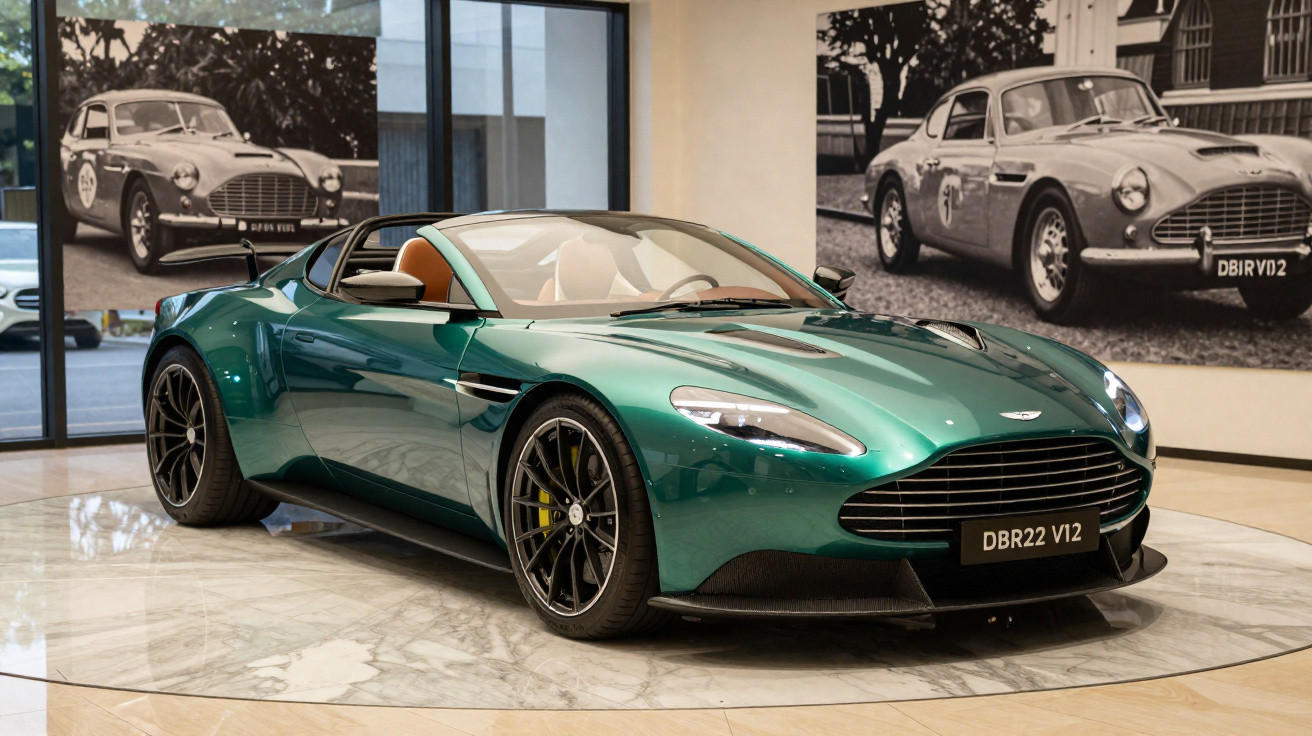
Aston Martin has unveiled the DBR22, a two-seat V12 roadster concept created to mark the tenth anniversary of “Q by Aston Martin”, the division behind projects such as the Vulcan and Victor.
Drawing inspiration from Gaydon’s historic DBR1 and DB3S racing cars, the new DBR22 combines the approach traditionally used for Aston Martin’s limited-run models - with much of the assembly completed by hand - with highly precise engineering.
It also introduces a rear subframe produced through additive manufacturing, better known as 3D printing, a first for an Aston Martin creation. More on that shortly.
At first glance, the prototype’s muscular yet refined bodywork stands out. Every detail has been designed to deliver aerodynamic efficiency while keeping the number of body panels to a minimum.
Inspired by Aston Martin’s past
At the front, the carbon-fibre grille echoes the British manufacturer’s current production range, although the influence of the classic models mentioned above is unmistakable.
From the side, attention is drawn to the long bonnet, which features a huge central air intake, as well as the compact windscreen, 21-inch wheels and the two humps positioned immediately behind the head restraints.
However, the rear is where this Aston Martin DBR22 makes its strongest statement. Alongside a lighting signature extending across the full width of the car, the DBR22 features a sizeable air diffuser and an imposing centrally mounted twin exhaust outlet.
Inside, there are several hallmarks of Q by Aston Martin projects, including the use of a specific type of leather and extensive carbon fibre. The material forms the structure of the sports seats and is used for almost every trim panel on the dashboard and centre console.
What engine does the Aston Martin DBR22 use?
Beneath the bonnet sits a potent 5.2-litre twin-turbo V12 producing 715 bhp and 753 Nm of peak torque - the same engine used in models including the DBS Superleggera. Paired with an eight-speed automatic gearbox, these figures enable the DBR22 to accelerate from 0 to 100 km/h in 3.5 seconds and reach a top speed of 319 km/h.
Power and outright pace are clearly not an issue, and neither, apparently, is road behaviour. According to the Gaydon marque, the chassis has been tuned to provide the purest possible driving experience, which Aston Martin says results in agile, highly communicative steering.
As well as the work carried out on the chassis and steering, the DBR22 has specially calibrated adaptive dampers. The brand also claims very high torsional rigidity despite the car’s open-top layout.
The first Aston Martin to use 3D printing
As mentioned earlier, it is the first Aston Martin to feature a rear subframe made using 3D printing, assembled from several aluminium sections.
According to the Gaydon-based manufacturer, this technological approach reduces the weight of the entire assembly without compromising the model’s torsional stiffness. It also makes it possible to develop and manufacture bespoke components for “ultra-low-volume models”, as the company explains.
Public debut date confirmed
The Aston Martin DBR22 will make its public debut at the Pebble Beach Concours d’Elegance in California, United States, where it will be displayed from 19 to 21 August.




Comments
No comments yet. Be the first to comment!
Leave a Comment