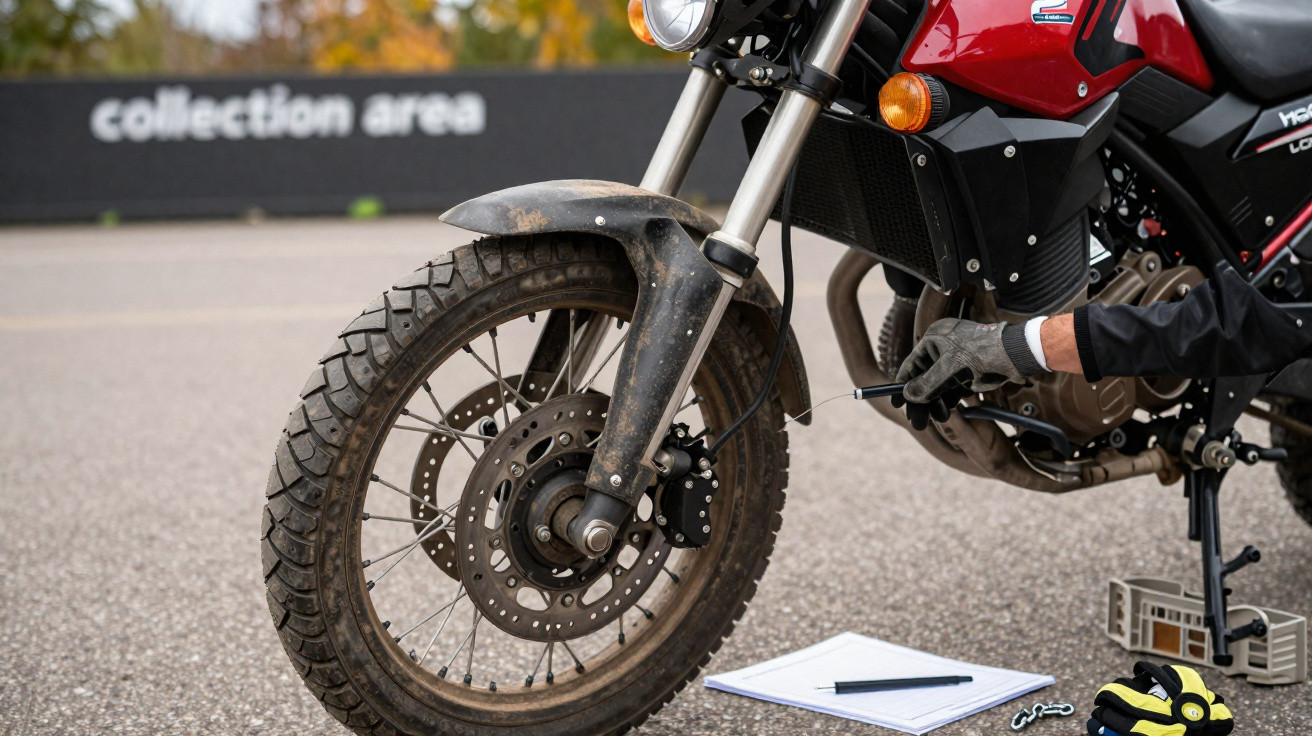
A supermarket-style price tag can make a 125cc motorcycle look like an easy route into commuting and weekend rides. The useful trick is to look beyond the headline figure: before you order, establish whether the bike can be delivered, registered, insured and supported in the UK.
The listing described in Lidl’s online channels is for a Prike PXA Adventure, a 125cc adventure-styled motorcycle shown in black and red. It has been advertised at €2,899, with €45.90 for delivery and freight, but that does not automatically make it a UK bargain. An overseas price, unfamiliar model and unclear after-sales arrangements can all alter the value considerably.
What appears to be offered
The PXA Adventure is presented as a small-capacity road motorcycle with adventure-bike looks, rather than as a dedicated off-road machine. The published specification should always be checked against the current product page and the documents supplied with the actual bike, but the listing mentions:
- A 125cc air-cooled, single-cylinder four-stroke engine
- Claimed output of about 10PS, or 7.4kW
- Electronic fuel injection
- Six-speed manual gearbox
- LED lighting and a digital display
- Combined braking system (CBS)
- 17-inch wheels
- A claimed 15.5-litre fuel tank
- A listed kerb weight of 152kg
Its claimed power is below the 11kW limit relevant to A1-category motorcycles and learner-legal 125s. That figure alone, however, does not prove that this exact model meets every UK registration requirement.
A cheap motorcycle is only genuinely cheap if it can be put on the road, insured and maintained without expensive surprises.
Start with the UK availability question
Lidl’s ranges, online ordering systems and delivery arrangements differ between countries. A bike listed on a European Lidl website may not be offered by Lidl GB, and an overseas retailer may not dispatch a motorcycle to a British address.
Check the seller’s terms before treating the euro price as a meaningful comparison. Ask whether the motorcycle is supplied for Great Britain, whether the seller arranges registration, and exactly where any warranty claim would be handled.
If the bike must be imported privately, include more than the purchase price in your budget:
- Transport, collection or crating charges
- Currency conversion and card charges
- Import VAT, customs duty or handling charges where applicable
- Registration fees and a number plate
- Any inspection, approval or documentation costs
- Insurance, vehicle tax, security and servicing
- Riding equipment and training
Rules and charges can vary according to where the vehicle is shipped from, where it was manufactured and the precise sales arrangement. For a current answer, use HMRC and GOV.UK guidance, rather than relying on a retailer’s general description.
Registration paperwork is not an optional extra
A motorcycle used on public roads in Great Britain must be registered, taxed and insured. For a new imported motorcycle, the DVLA will need appropriate evidence before issuing a registration mark.
Ask for the Vehicle Identification Number (VIN) before paying a deposit, and ask precisely which documents are included. A Certificate of Conformity may be important, but do not assume that any European document will settle every UK requirement. The relevant approval route depends on the vehicle and its paperwork.
Checks to make before payment
Request the approval documents in writing. Ask whether the bike has documentation accepted for registration in Great Britain and whether the seller has previously registered this exact model here.
Check the instruments and road equipment. It needs suitable lights, mirrors, tyres, reflectors and other required equipment. A speedometer that can show mph is the sensible choice for UK road use; do not rely on a small km/h-only display.
Ask about any approval inspection. If acceptable type-approval evidence is unavailable, an Individual Vehicle Approval process may be required. Confirm this before the bike is shipped, not once it is in your garage.
Get a written total cost. Clarify whether delivery, customs handling, registration work and number plates are included or left to the buyer.
Read the returns terms. Returning a crated motorcycle to another country is very different from returning household goods to a local branch.
Do not alter lights, exhausts, reflectors or number-plate fittings in an attempt to make a bike comply. Modifications can create safety, insurance and registration problems.
The licence rules for a 125cc bike
A 125cc engine does not mean that anyone with a car licence can ride it on the road. In Great Britain, a rider aged 17 or over can ride a motorcycle up to 125cc and 11kW after completing Compulsory Basic Training (CBT), provided they follow learner rules.
That normally means displaying L-plates, not carrying a pillion passenger and not using motorways. CBT certificates last for two years unless the rider gains the relevant full motorcycle licence first.
Passing an A1 practical test gives entitlement to ride a motorcycle up to 125cc and 11kW without L-plates, with a pillion passenger and on motorways. A rider should check their driving licence categories and current GOV.UK guidance rather than relying on rules quoted in an overseas advert.
The German B196 training arrangement sometimes associated with 125cc bikes is not a UK entitlement. A UK car licence by itself is not enough.
CBS is useful, but it is not ABS
The listing refers to a combined braking system. CBS distributes some braking effort between the wheels when one brake control is used. It can be helpful, especially for newer riders, but it does not perform the same function as anti-lock braking system.
ABS is designed to reduce wheel lock during hard braking. On wet leaves, diesel-contaminated junctions, cold roads and rain-slick surfaces, that can be a worthwhile safety feature. It is sensible to compare this bike with UK-market alternatives fitted with ABS.
The absence of ABS from a product listing does not by itself prove the motorcycle cannot be road legal: smaller motorcycles may be approved with CBS rather than ABS under the applicable rules. But the seller should be able to confirm the exact equipment fitted and the approval status of the model being sold.
CBS can assist with brake balance; it cannot replace smooth braking, good tyres, forward planning or proper rider training.
The listed 152kg kerb weight also deserves attention. That is not extreme, but it may feel substantial while pushing the bike on gravel, wheeling it out of a tight shed or stopping on a cambered road. If you cannot see the model in person, be especially cautious about buying unseen.
Adventure styling is not off-road capability
An upright riding position, broad handlebars and extra ground clearance can be useful on broken tarmac, rural lanes and rough car parks. They do not turn a 125 into a trail bike.
Before taking any adventure-styled machine onto unsurfaced ground, check its tyres, suspension travel, sump protection and manufacturer guidance. Loose mud, deep ruts and steep slopes can overwhelm a road-focused lightweight motorcycle very quickly.
For normal road riding, practical details matter more. A fuel-injected 125 may suit commuting, and a 15.5-litre tank is generous on paper, but real fuel use depends on speed, wind, luggage, servicing, tyre pressures and how the bike is ridden.
Parts, warranty and insurance can decide the bargain
A low purchase price is less attractive if routine parts are hard to obtain. Before ordering, identify who will supply filters, brake pads, chain-and-sprocket kits, tyres, levers, bodywork and electrical components in the UK.
Also ask who carries out warranty work. A warranty based overseas may involve transport costs, long delays or a requirement to use a distant repairer. Keep copies of the order confirmation, VIN, service schedule and all correspondence.
Contact insurers using the exact make, model and VIN if possible. Some insurers may have limited information on uncommon imports, and cover can be difficult or costly to arrange. Never ride the motorcycle home, even from a collection point, without valid insurance and the correct licence entitlement.
Common mistakes when chasing a motorcycle bargain
- Assuming the euro price is the final UK cost. Import, delivery and registration costs can remove an apparent saving.
- Paying before seeing the documents. Approval paperwork should be confirmed before money changes hands.
- Confusing CBS with ABS. Both can be valuable, but they work differently.
- Skipping the insurance check. An unusual import can be harder to insure than a familiar UK-supplied model.
- Ignoring after-sales support. A delayed replacement lever or sensor can leave a motorcycle unusable.
- Under-budgeting for security. Consider a suitable lock, a ground anchor where appropriate, secure parking and the insurer’s security requirements.
- Treating protective kit as an add-on. A legal, correctly fitted motorcycle helmet is essential; gloves, jacket, trousers and boots are strongly recommended.
Make the final comparison properly
If Lidl GB offers this exact motorcycle with UK delivery, registration support, clear approval documentation and a workable warranty, it may be worth closer examination. If the offer is available only through another country’s website, approach it as a private import project rather than a straightforward supermarket purchase.
Compare the all-in figure with UK-supplied 125cc motorcycles, especially models with established dealer networks and ABS. A slightly higher upfront price can be better value if it brings simpler registration, accessible servicing and dependable parts support.
Before committing, check the documents, insurance, licence position and total landed cost. Then arrange proper training, suitable protective clothing and secure storage. Those steps will do more for a safe, enjoyable first season of riding than the headline bargain price ever can.



Comments
No comments yet. Be the first to comment!
Leave a Comment