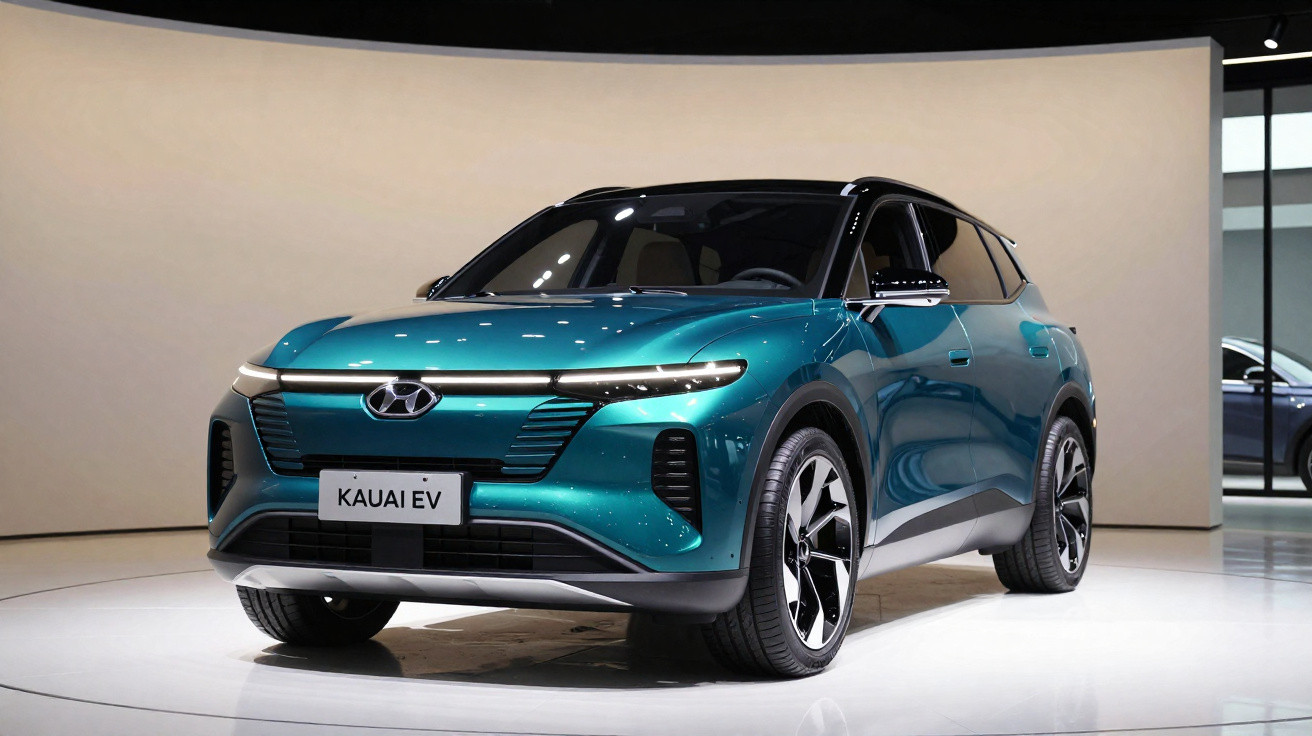
Hyundai’s electrification may have entered a new phase with the unveiling of the IONIQ 5, but the Hyundai Kauai EV still plays a vital role in the South Korean brand’s electric range.
After all, in 2020 it became Europe’s fourth best-selling electric vehicle, with 47,796 units sold - a figure representing a 112% increase on the previous year.
To ensure its electric crossover remains competitive, Hyundai has updated it, and we have now had the chance to test it in its most affordable form.
Change without revolution
The exterior is where the “new” Hyundai Kauai EV differs most from its predecessor. The front end has been completely reworked and, I must admit, I am particularly fond of the cleaner approach with fewer styling details. It even brings to mind Tesla’s grille-less front ends.
At the rear, the revised light clusters are the key update. In my view, the facelift has “done it good”, giving the model a fresher, more appealing appearance while once again allowing it to stand apart from its rivals.
An interior that is (almost) unchanged
Changes inside are far less extensive. As a result, the praise I gave the pre-facelift version remains valid, whether in terms of ergonomics, space or the quality of the materials and assembly.
Among the updates are the comprehensive and easy-to-read 10.25-inch digital instrument panel, along with the new AVN infotainment system.
Speaking of the latter, it is well equipped and straightforward to use, even with this “small” 8-inch display; the 10.25-inch unit is optional. Indeed, this screen is a reminder that choosing the largest available display is not always necessary, as it performs its duties perfectly well.
Less battery capacity, but sufficient range
The last time I tested the Kauai EV, it had not yet received this update and I drove the more powerful 64 kWh, 204 hp version. This return to the South Korean brand’s electric crossover offered the opportunity to try the lower-powered model with the smaller battery.
Fitted with a 39 kWh battery and “just” 136 hp, this version completes 0–100 km/h in 9.9 seconds and reaches 155 km/h. The more powerful 64 kWh Hyundai Kauai EV takes 7.9 seconds and tops out at 167 km/h. Although this Kauai EV’s figures are less striking, the difference tends to fade away in everyday driving.
Naturally, its performance is not quite as impressive, but pulling away from traffic lights still feels pleasingly brisk as soon as you press the accelerator, thanks to the 395 Nm of torque delivered instantly - the same output as the more powerful version.
Out on open roads, performance remains convincing, and even the “small” battery proves surprising, allowing journeys to stretch further than you might initially expect.
The claimed 305 km range appears easily achievable, without having to confine driving to urban routes. The driving modes, which I had already praised in the previous test, make a major contribution, as do the four regenerative braking settings selected using the paddles behind the steering wheel.
As for energy consumption, the test included many kilometres across the Ribatejo plains and returned 10.7 kWh/100 km. In town, it stayed close to 13 kWh/100 km, while at higher speeds it rose to between 16 and 17 kWh/100 km. These are very good figures, better than those of most rivals.
Finally, dynamically, the Kauai EV continues to justify the praise its chassis has repeatedly received with a variety of powertrains. Its direct, precise and communicative steering, combined with suspension that balances comfort and handling very effectively, makes it safe, predictable and even enjoyable.
Is the Hyundai Kauai EV the right car for you?
The Hyundai Kauai EV remains one of the strongest choices for anyone looking for an electric SUV/crossover, thanks to the efficiency of its electric powertrain - which enables use without too much concern about range - and its comprehensive equipment levels.
In this specification, it trades range and power for a more accessible price. It starts at €36,005, while the more powerful version rises to €40,775, and the truth is that this “trade-off” does not appear to involve giving up very much.
Of course, for those intending to undertake longer trips more regularly, the 64 kWh version, with its claimed 484 km range, remains the better choice.



Comments
No comments yet. Be the first to comment!
Leave a Comment