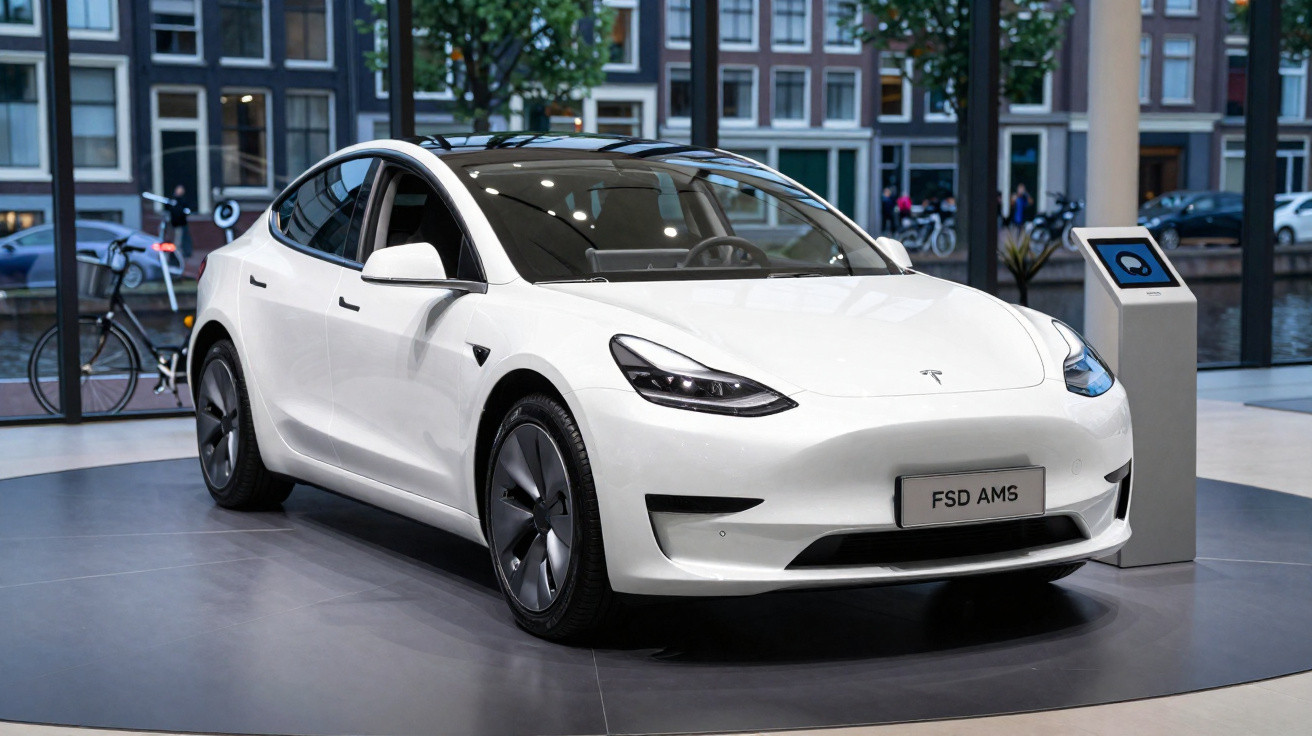
Tesla FSD Supervised is strikingly natural and, although it still demands the driver’s constant supervision, it is almost flawless.
Amsterdam was the setting for our first encounter with Tesla Full-Self Driving Supervised, and there could hardly have been a more demanding place. There are more cyclists here than in the Tour of Portugal, while pedestrians seem to have temporarily impaired cognitive abilities, unable to tell the road from the pavement.
The car we used was the new Tesla Model Y Long Range Dual Motor, although the system is not restricted to the latest Tesla models. According to the manufacturer, new Teslas are already equipped to receive FSD Supervised, while several models from recent years can also use it through a software update, provided they have compatible hardware and are in a country where the feature is legally permitted.
Portugal is not yet on that list. The European rollout began in the Netherlands, the first country to approve FSD Supervised, and has since been followed by Lithuania, Estonia, Denmark and Belgium.
How much does it cost?
In countries where it is already available, FSD Supervised is offered as a subscription.
Owners who bought a Tesla with the basic Autopilot pay €99 per month to access the system. Those who chose Enhanced Autopilot pay €49 per month. Customers who bought FSD outright, when Tesla still offered that option, face no additional monthly charge for its use.
However, the full purchase option is no longer available. Access is now provided through a subscription, apart from customers who had already paid for the complete package. It is admittedly another subscription in a world where everything is already subscription-based, but buying the system outright was not cheap. If you subscribe and do not like it, you can simply cancel. There are advantages and disadvantages.
What FSD Supervised is - and is not
FSD Supervised is an advanced driver-assistance system. It can follow navigation instructions, drive in towns and beyond them, turn at junctions, change lanes, adapt its speed to traffic, stop at traffic lights, interpret pedestrian crossings, and deal with pedestrians and cyclists, among other things.
It does not turn a Tesla into an autonomous vehicle, despite being capable of driving entirely on its own. The driver remains responsible and must keep their attention on the road. At the wheel, we are continuously monitored by a camera, allowing the system to assess whether the driver is ready to intervene at any moment.
Tesla FSD Supervised sees and hears its surroundings
Tesla continues to rely on a vision-based approach, a choice that has attracted criticism but is proving to have been the most sensible route. It is an approach that has pulled the industry along with it: Volvo, for example, is abandoning Lidar radar systems and following the same path.
FSD Supervised uses eight external cameras, the same cameras the car already employs for parking, driver assistance, viewing the environment around it and judging the distance to obstacles.
These cameras enable the car to identify lanes, vehicles, pedestrians, cyclists, traffic lights, signs, verges, pavements, obstacles and unpredictable movements.
It also relies on microphones to interpret specific situations. One example is detecting emergency vehicles. If it identifies an ambulance, police car or fire engine responding to an emergency through audible signals, it can combine sound and image to understand where it is coming from, pull over, let it pass and then continue the journey.
Behind all this is Tesla’s major advantage: scale. The brand’s global fleet covers more than 320 million kilometres every day, generating anonymous, aggregated real-world driving data that helps train artificial-intelligence models. In practical terms, every Tesla on the road contributes to improving this system. Every kilometre driven by humans may help teach the car to drive better in the future.
A difficult approval process
FSD Supervised did not reach the Netherlands through a fast-track process. The Dutch RDW authority assessed the system for more than 3000 hours, both on track and on public roads, across complex urban traffic, different road types and varied weather conditions. The process included data from 1.8 million kilometres of European test driving with FSD Supervised activated.
The RDW also made several important points. It says that this system is not autonomous driving, that the driver remains responsible and must always be in control, ready to take over. The Dutch authority also stressed that it did not rely solely on Tesla-supplied data and has begun monitoring the system every month.
Even so, resistance to adopting the system is considerably stronger in some European countries. At the end of April, Sweden sent a letter to the European Union’s Technical Committee on Motor Vehicles, recommending that the system should not be approved for use on European roads unless Tesla disables one specific function: the possibility of allowing the vehicle to travel above legal speed limits.
Other Nordic countries, including Finland and Norway, have voiced similar concerns, although they have not taken such a categorical position.
First step: learning the rules
Before activating the system for the first time, the driver must watch a compulsory tutorial.
In our case, Tesla created an Automotive Reason profile and we had to watch a video lasting around seven minutes. At the end, two straightforward questions appeared to confirm that we understood the system’s limits. An incorrect answer means repeating the process, which then produces different final questions.
The procedure makes it clear that FSD Supervised is not permission to stop driving, but rather a system designed to assist the driver.
An unrestricted experience
Our test was not carried out on a closed, rehearsed route or one predefined by Tesla.
We chose the destinations, entered the locations into the navigation system and went wherever we wanted. The car was not set up to repeat a particular route, nor was the experience designed to display only the most favourable scenarios.
Over roughly 100 km, we drove through the city, suburban areas, faster roads and routes with varying levels of complexity. The result was more impressive than we had expected.
Simple to use
Activation could scarcely be easier. Once the destination has been set in the navigation system, the system is enabled through the infotainment display or a button on the steering wheel, and the car begins driving. If no destination is entered, the car simply follows the road without a destination.
From that point, the vehicle takes control of steering, acceleration and braking, interprets its surroundings and attempts to follow the route to the destination. The central display shows the world being constructed by the car: lanes, vehicles, pedestrians, cyclists, traffic lights and obstacles, with the planned route marked in blue.
Switching it off is equally straightforward. Simply intervene using the steering wheel or pedals to regain control. Following an intervention, reactivating the system is just as easy.
This handover between human and machine is one of the strongest qualities I found in FSD Supervised. The driver can take over, correct a situation and return driving duties to the system almost immediately.
Two interventions over around 100 km
Across approximately 100 km, we needed to intervene twice. The first occasion came in a very tight car park. We wanted to stop in a particular space with little room, and the system was unable to complete the manoeuvre. We took control to park and also had to leave that same space manually.
The second occurred in central Amsterdam, at an unsignalised junction with pedestrians, traffic travelling in both directions and a great deal of information unfolding at once. The car was taking too long to decide when to move forward and turn left. It did nothing dangerous, but it was too slow. We took over, completed the manoeuvre and reactivated the system immediately afterwards.
Tesla promises to update the system frequently, using data collected from its use alongside data from models driven by people behind the wheel. Therefore, if I return to Amsterdam in a month’s time, I will find a system which, according to Tesla, will no longer be exactly the same.
According to Tesla, based on data from its fleet, using FSD Supervised is associated with seven times fewer serious and minor collisions, as well as five times fewer collisions away from motorways.
The manufacturer also estimates that, if this technology were deployed at scale, it could improve road safety in the United States by more than 80%, potentially preventing more than 32,000 deaths and more than 1.9 million injuries every year.
Strong uptake
The response from Dutch customers has been strong. In less than a month, Teslas in the Netherlands covered more than 10 million kilometres with FSD Supervised active. Shortly afterwards, Dutch authorities pointed to around 40,000 Teslas using the system and approximately 24 million kilometres travelled since approval.
This shows that customers have welcomed the feature and are genuinely using it.
Is it ready for Portugal?
From a technical standpoint, the system already does far more than we expected. It drives naturally, interprets complex urban situations, handles difficult scenarios and makes it possible to cover long distances with few or no interventions.
Its arrival in Portugal depends on legal approval. The fact that it is already active in five European countries shows that the process has begun, but it does not yet guarantee widespread availability throughout the European Union.
There is also a harder question: are drivers ready to use a system like this correctly?
FSD Supervised requires a different mindset. It is not manual driving, but neither is it complete autonomy. It occupies an intermediate space, where the car does a great deal but the human remains at the heart of responsibility.
Our verdict
For me, testing Tesla FSD Supervised was one of this year’s most impressive experiences. I have already said so here at Automotive Reason, and everyone knows how much I enjoy driving, but I believe it is impossible to remain indifferent to this.
The system is not perfect. It needs supervision for legal reasons, but also for functional ones, as it demonstrated that there are circumstances in which a human may be called upon to intervene. Yet that is acceptable because the driver is never told that they are unnecessary.
At the pace at which this and other systems are developing, it will not be long before a driver is no longer needed behind the wheel in urban centres. Even if that means facing a city where you need to be careful when ordering a cake.

Comments
No comments yet. Be the first to comment!
Leave a Comment