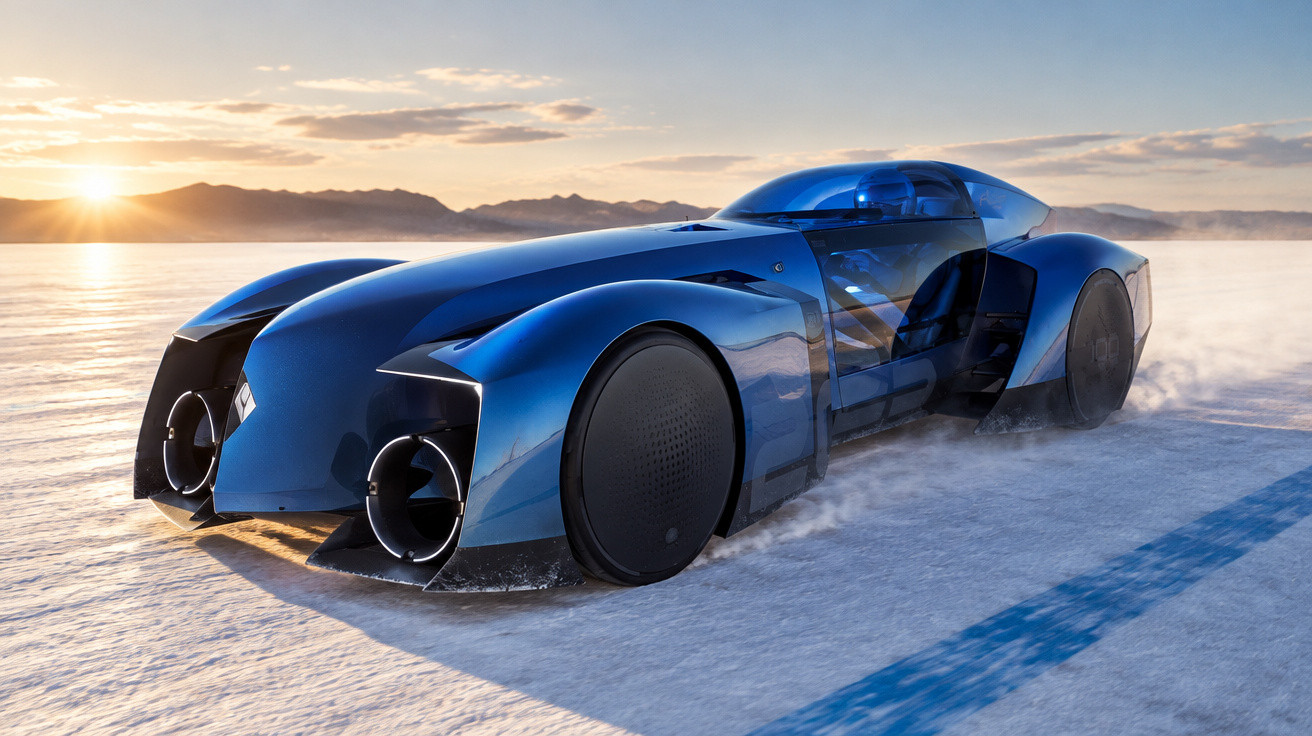
The Renault Filante Record 2025 is as far removed from an everyday Clio as it is possible to imagine. With styling that resembles a blend of the Michael Keaton-era Batmobile and a Star Wars Podracer, Renault calls it “a laboratory on wheels for testing new technologies, materials and innovations”.
This radical single-seater will not merely serve as a mobile test bed. As its name indicates, Renault intends to use it to pursue world records for ‘power consumption and range with an 87kWh battery’. Yes, it is fully electric, with the first record attempts scheduled for the first half of this year.
Renault Filante Record 2025 and its record-breaking heritage
Renault says it has “always seen motorsports and records as a way to validate its innovations, before applying them to production models”, so the concept takes inspiration from several historic Renault record cars: the 1925 40 CV des Records, the distinctive straight-eight 1934 Nervasport des Records, and the 1956 Étoile Filante.
The first of those cars used a 9.0-litre straight-six producing roughly 140bhp, setting numerous speed and endurance records during the 1920s. At the other end of the timeline, the Étoile Filante was an exceptionally streamlined 270bhp, jet-powered single-seater which broke four world records in a single outing at the Bonneville Salt Flats.
As with the Étoile Filante of the 1950s, aeronautical influences have shaped the new Filante Record 2025. Its cockpit is intended to appear as though it came directly from a fighter jet, while the visible bodywork screws are said to draw on aircraft construction methods.
“We designed this vehicle as a sculpture in motion,” says Sandeep Bhambra, director of advanced design for Renault. “Inspired by fighter planes and the speed records of the nineteenth century, it reflects both performance and timeless elegance.”
Renault’s design team reportedly aimed for a ‘monolithic’ appearance. Its overall form, cockpit placement, highly theatrical circular LED headlamps and wheels set apart from the main body all nod clearly to the 40 CV des Records and Nervasport des Records. Meanwhile, the wheel fairings reference the Étoile Filante while also benefiting aerodynamic performance.
Aerodynamics and lightweight construction
And aerodynamic performance certainly deserves attention. Renault has not yet published an official drag coefficient, although wind-tunnel testing was due to take place in spring 2025 to validate the current simulation findings. Some refinements could follow, but the key point is that Renault developed the Filante Record 2025 with prototype racing-car specialist Ligier Automotive to make it as aerodynamically efficient as possible. The goal, after all, is to secure a place in the record books.
It is also a substantial machine. At 5.12m long, it is only marginally shorter than a Mercedes-Benz S-Class, yet it measures just 1.71m wide and 1.19m high, with a kerb weight below 1,000kg. That figure becomes still more remarkable given that the battery alone weighs 600kg, despite its carbon-fibre casing and a new construction method that integrates cells directly into the battery pack without intermediate modules.
The Filante Record 2025 uses a chassis made from aluminium, carbon and steel alloys, while carbon fibre forms most of the bodywork. Renault has additionally 3D-printed complex components from Scalmalloy, a high-strength aluminium alloy. It also employed ‘topology optimisation’ to minimise material in areas not subjected to particular mechanical loads, a process said to have significantly lowered the total weight.
Renault Filante Record 2025 cabin and controls
Renault has not disclosed the motor powering this prospective record-breaker. However, it is known to use specially developed 48cm Michelin tyres to maximise range, alongside steer-by-wire and brake-by-wire systems.
The driver will not accelerate or brake conventionally, either. Instead of pedals, every control is operated through the unusual grab handles on the steering ‘wheel’. At its centre is a flexible display wrapped around a cylinder, providing speed, range and other essential information. It is a rather clever setup.
The cabin as a whole also takes cues from space travel. Its seat is fashioned from stretched canvas, which Renault describes as “similar in style to a hammock”. It certainly sounds exceptionally comfortable. Keep an eye out for those in the next-generation Clio.
All that remains is to start placing bets. How far might this machine travel on a single charge? And will it better the Mercedes Vision EQXX efficiency record of 13.5km per kWh?




Comments
No comments yet. Be the first to comment!
Leave a Comment