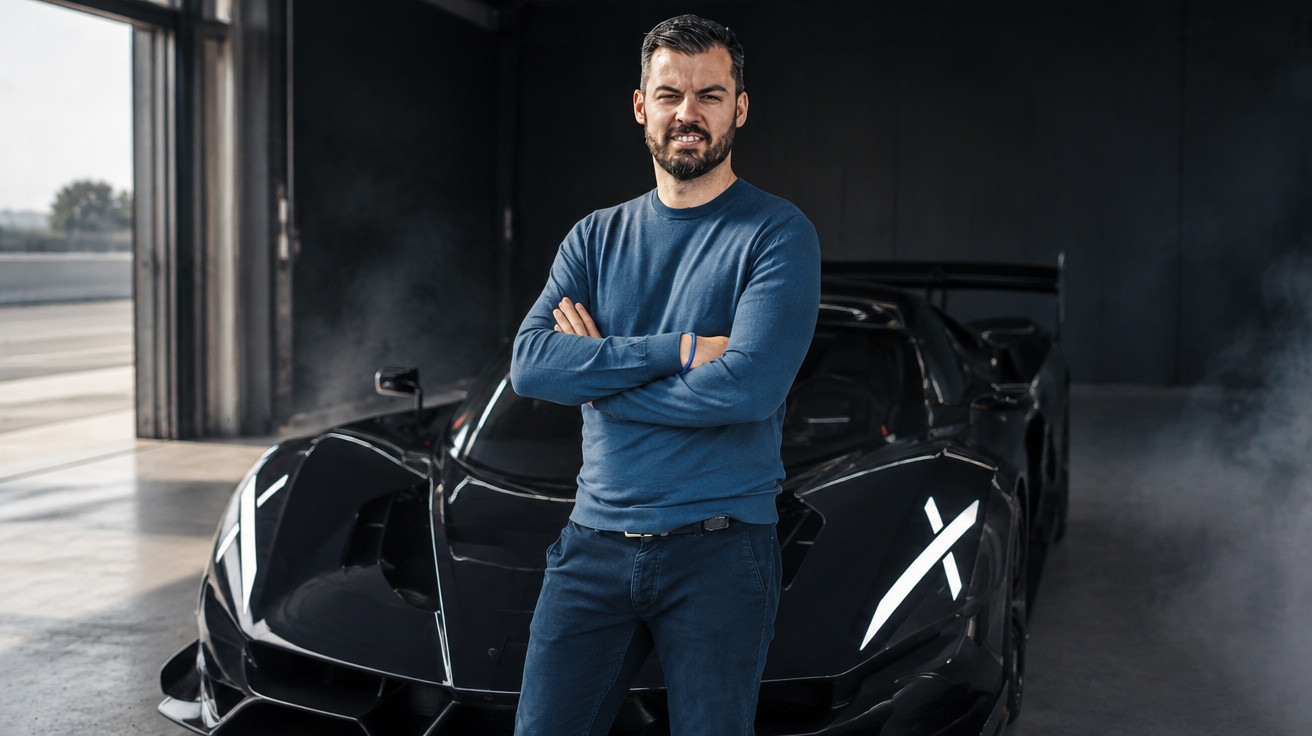
On a bitterly cold day at Paul Ricard, Mate Rimac stands on the pit wall in a bomber jacket, holding up his phone as the Bolide blasts past at full volume. He smiles, glances across and says, “pretty cool, huh?”
When he assumed control of Bugatti three and a half years ago, Rimac could have cancelled the Bolide programme. Yet that was never likely, was it? He is a genuine car enthusiast. He is standing on the pit wall, recording the moment for posterity because his wife is riding in the passenger seat.
Incidentally, Rimac has still not driven a Bolide himself. Considering his reputation, his enjoyment of driving and drifting, and his ambition eventually to create “a proper, proper E30 restomod, with a V10. Not just the technical stuff, but also design. I don’t know when I will get round to that – it might be my retirement project”, why has he not got behind the wheel of the Bolide?
Photography: Mark Riccioni
“I’m always super detailed about testing and driving cars, about everydetail, and when I drive our cars I come back with a long list of things I want improved or changed. But with this car it’s just so far outside my level of competence. It’s a racecar, a track car and I’m a road car user. I can’t come anywhere near what this car can do.”
That is understandable, especially as he hardly lacks other commitments. He now oversees three projects, with Bugatti accounting for only half of one branch: the Bugatti-Rimac car division. Rimac Technology supplies solutions to other automotive manufacturers, while Verne, a robotaxi business, was launched last year. “We showed it in June last year, a few months before Tesla showed theirs – and just three weeks after we introduced the Tourbillon.
“Last June,” he admits, “almost killed me.”
Bugatti Tourbillon development and production
Two weeks earlier, he had been at Nardò driving the Tourbillon that will replace the Chiron. Taking out his phone, he plays a video clip: “Look how fast it revs, that noise. I was blown away by how good the car is. I’m so, so proud of it. You are in this car, you have this steering wheel with a fixed hub, you have analogue instruments, you have the performance of 800 electric horsepower with 1,000 combustion horsepower. There is nothing like it.
“And you don’t need the engine to accelerate fast. That’s the advantage. In the Tourbillon if you’re lazy and don’t want to shift down, or just wanna go ahead, there’s so much electric power that you don’t have to. Like why else carry around all that weight and complexity?”
He makes a pointed observation about other hybrid supercars. “I have driven them all and I don’t get it really. Why would you have a hybrid powertrain with a turbo engine? Like, a turbo engine is a compromise on its own, right? By going from turbo to naturally aspirated we lost 600bhp. I knew we could more than make up for it with the electric powertrain. So the electric powertrain enabled the cool combustion engine. In the Tourbillon, you have 70km of all electric range while others in electric mode are super limited.”
The development work is advancing strongly. Bugatti will construct 35 prototypes in all before the first customer cars are produced. “We are basically done with the development and now we do the homologation and testing. The goal is to be lighter than Chiron. It’ll be the first hybrid that’s lighter than its combustion only variant. We have a big battery – 25kWh – we have three electric motors and we are lighter. Just one example, the suspension is 45 per cent lighter compared with the Chiron because of 3D printing.”
There is some Chiron hardware carried over to the Tourbillon, however. “We have decided to take over one part, which is the switch for the interior lights.”
The first Tourbillon deliveries are planned for 2026. They will be assembled in Molsheim, in a new building beside the established factory, called the Atelier. Remarkably, 2025 will be Molsheim’s busiest year to date, as it completes the remaining Bolides - 14 have been delivered so far - alongside 99 Mistrals. The next production model will be the 250 Tourbillon coupés, followed by a roadster? “You can assume,” Mate says with a smile, “but also there are many things you can do with this hybrid powertrain. You can make a version without hybrid, or with it minimised, or without the [driven] front axle, whatever.”
Would he make a non-hybrid Tourbillon? “Uh, well, it’s pretty difficult because the starter is the hybrid motor. So you don’t have belt drive. You don’t have an alternator, you don’t have an air conditioning compressor, but you could do a very reduced system.”
Rimac will not reveal anything further about future products. Still, it is widely rumoured that he wants Bugatti to develop a second model line. That idea is not new: during an interview with the previous chief, Stephan Winkelmann, in 2019, he expressed the same view.
With Rimac leading the company, could that mean a four-door with the V16 mounted at the front? Perhaps something able to revive the attraction of the iconic 1927 Royale, which reaches its centenary in two years’ time. It used a straight-eight engine too, effectively half a V16. For now, there is no comment.
Bugatti legacy, reliability and ownership
The pit garages are loud, as the Bolide roars in and out amid the clatter of wheel guns, so we head to the foyer, where Bugatti has placed a Type 35. Does seeing such cars give him a feeling of legacy? “It’s really important. It makes me think about some of the small things, like what Ettore said, ‘if it’s comparable it’s no longer a Bugatti’, or when Piëch described the Veyron by saying ‘it’s a car to do over 400kph and the same day go with your wife to the opera’.
It’s a little bit of craziness that I have, when you look at where I came from to where I am now
“It’s just a few words, but there’s so much depth and meaning [to those phrases]. We repeat that often to the engineers, telling them this car will still be driving around in a hundred years. How do you make sure this seal will last 50–60 years, how do we make sure these electronics can be serviced in 50, 60 years?
“I won’t say much because we haven’t decided yet, but I think warranties for these kind of cars need to be very different. I’ll give an example. So Chiron is now four years carefree warranty with service included and that’s pretty good. Why are people not using the Veyron so much? They would use it more if the tyres and wheels weren’t so expensive, so we are trying to make a new set of wheels and tyres.
“Look at the LaFerrari and P1 and 918, people get a bad battery and it costs hundreds of thousands to replace. We want to make sure this is never the case with Tourbillon. A Bugatti has to be super reliable and worry free, because that also ensures resale value.”
Rimac on batteries, Tesla, China and Verne
I ask Rimac about what comes next technologically - solid-state batteries, for example. “I feel like a fossil in this industry although I’m just 37. But I’ve been making batteries for 16 years and I’ve been reading about solid state and breakthroughs in the fundamental technology for 16 years, and it always seems like it’s just there, but it’s not. What has happened is the price [of conventional batteries] has come down 90 per cent – it used to be €1,500 per kWh, now it’s like €100 per kWh.”
Then there is Elon Musk: hero or villain? “So for me, before this whole thing with the elections and all that stuff, he was the most exciting person in the world. I mean, sending reusable rockets into space, preparing to launch rockets to Mars, send people to Mars. I know how the [auto] industry works and how much Tesla has driven the change in all of these car companies. And I know that the only difference between Tesla and all of the other car companies is just Elon, nothing else. He has really changed the world, really had a huge impact.”
Is China a threat, or an opportunity? “Europeans have been shipping cars there and producing cars there for decades and shipping, like, containers of money out, so it seems a bit hypocritical now the Chinese want to do the same here. If they can offer a better product at a more competitive price, why wouldn’t they? They seem to have good products and the growth trajectory is crazy. Look where they’ve come in 10, 15 years.”
What is the plan for Verne? “You will have two battlefields for self driving, which is the US and China, and Verne is mainly focused on Europe. We’re not selling the car, it’s like a service. We come to a city, we come with hundreds or thousands of cars and we offer a service to... people who just don’t give a damn about cars. They just want to get from point A to point B and don’t want to own a two tonne piece of machinery that you have to service more often than you go to the doctor, spend months learning to drive, clean and take care of and so on. It’s just not the most efficient way.”
What is preventing self-driving cars from advancing? Is legislation the problem? “No. Well, actually yes, but that’s not the one blocking it. It’s a technology problem. It’s difficult to solve the one per cent of issues. We have been driving around cities testing for a couple of years and for the majority of time everything is fine, but then you have a surprising situation where the car doesn’t know what to do. And then you have to intervene. So you need to resolve this one per cent of situations. But I think with improvements in AI, it is coming. And it will have a major impact.”
Mate shakes his head, then lets out a deep sigh. “I don’t have megalomaniac ambitions. Really. I just love what I do. Do I need to send rockets to space? No. This is already enough. It’s a little bit of craziness that I have, when you look at where I came from to where I am now, it’s like a big, big gap. But, you know, we are still this little company and we try to go against people like Google and Tesla when it comes to self driving and so on. I guess we have to be a bit crazy to do it.”
Comments
No comments yet. Be the first to comment!
Leave a Comment