“I think I will name him after you.” That feels rather premature. For one thing, I doubt Ollie the reindeer is destined to become a named pet. And his recent affectionate streak probably has less to do with any Sami qualities I may possess than with an odd fascination with the colour of my jacket. Once again, I find myself wondering whether Rickard is having me on.
Rickard Länta is a Sami reindeer herder. Life is hard this far north, beyond the Arctic Circle. Yes, it is beautiful and bright: an apparently welcoming wilderness of snow and trees that surely provides enough shelter and food to keep someone alive if you know what you’re doing. That is the crucial part. I have approached this place armed only with technology: GPS mapping, technical clothing, electric motors, mobile signal and the rest. What I do not have is knowledge. Rickard, meanwhile, seems to rely on no technology beyond the three knives hanging from the waist of his heavy-duty clothing. His knowledge, I suspect, is in no short supply.
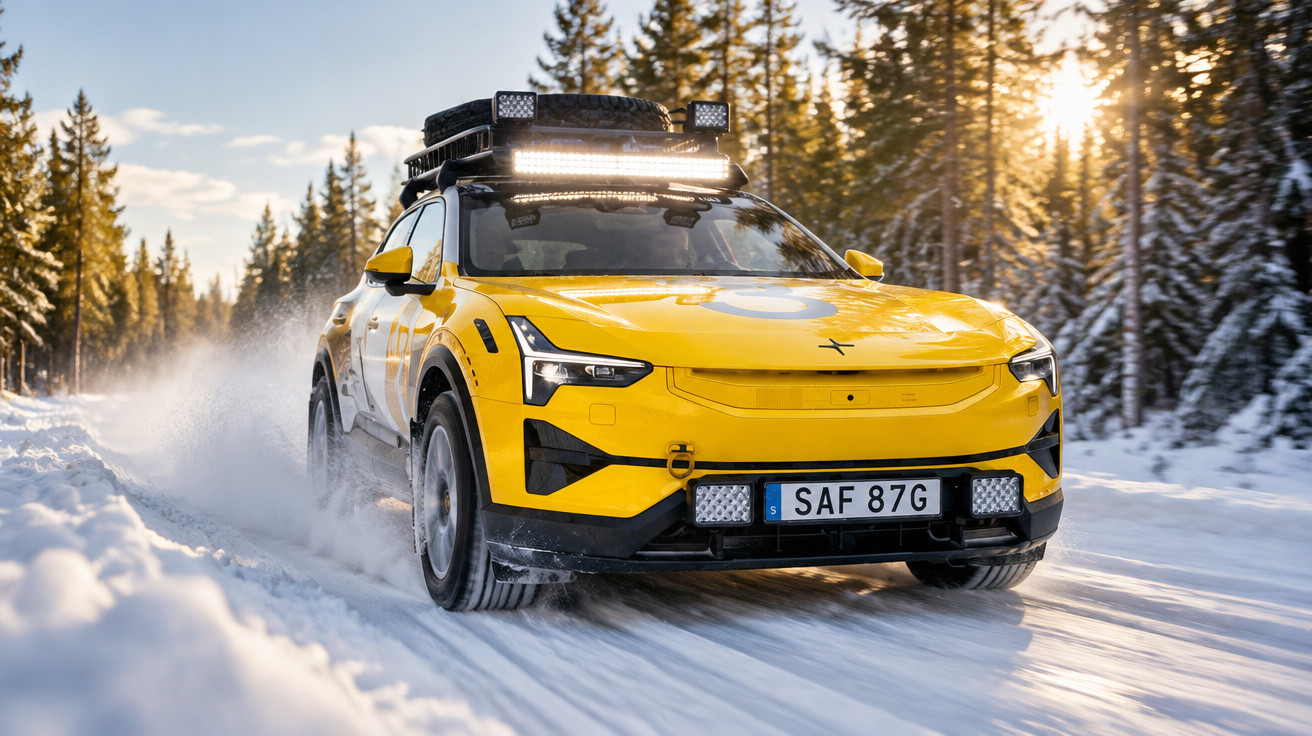
The regular Polestar 3 represents technology dialled up to 10. It is a connected car that makes excellent use of cutting-edge systems, while remaining a handsome, clean-driving and genuinely practical SUV. That is why we have named it EV SUV of the Year. Up here, however, I need something more. Presumably that is why Polestar built the 3 Arctic Circle, fitting studded tyres, snow ladders, a shovel and additional spotlights to turn it into something closer to a survival pod. Those additions may prove extremely useful.
Photography: Jonny Fleetwood
Polestar 3 Arctic Circle on Sami land
The intention is to herd reindeer within the Arctic Circle using the ‘Arctic Circle’. It need not have been this particular Arctic Circle: Polestar has made three Arctic Circle cars, with the other two, predictably, based on the 2 and 4. Each has received raised suspension, OZ rally wheels on studded tyres, bespoke Öhlins dampers, Recaro bucket seats, mud flaps, tow hooks and more. Like me, you might assume they are empty gestures: show ponies with no real purpose.
That would overlook the contribution of Joakim Rydholm, Polestar’s gently obsessive but relentlessly cheerful head of driving dynamics. He is known to have travelled around test circuits strapped into car boots while hunting down squeaks and vibrations, “and sometimes sat in the frunk too, touching damper mounts and bushings with my fingers”. A rally driver since childhood, he is entirely responsible for Polestar’s reputation for tidy, precise handling.
When the time came to create the Arctic Circle one-offs, then, he brought his rallying expertise to the project. Although Polestar’s CEO expressly told him not to interfere with metalwork in ways that might compromise practicality, the 2 has a strut brace spanning its boot, while the frunks in all three cars are bisected by strengthening bars that connect the damper mounts to the crash structure. Their suspension has been recalibrated, the 4 now features a hydraulic handbrake and, conveniently, I have three cars and a frozen lake at my disposal.
My task is to select one for this expedition. Before arriving, I already know that the 3 will win, but there are few greater automotive pleasures than skidding across an ice lake. I therefore spend the morning pretending that the decision is difficult, laughing loudly as I throw up rooster tails and nudge snowbanks. Better still, the cars are enjoyable to drive. There is a moment in mid-morning when Stig Blomqvist arrives in a scruffy old 3 Series, and that appears to be absolute heaven, but the Polestars are unexpectedly nimble despite their mass. They are balanced, responsive and remarkably adept at deciding where the torque-vectoring system should send power. Four-wheel drifts are plentiful.
Reluctantly, I leave the lake, where the ice is a metre thick, and go in search of Rickard. Other than the faint crackle of the studs against the surface at low speeds, which becomes a mild whistle from the roof rack once we reach the main roads, the journey is exceptionally smooth. Snow has a way of absorbing sound. The ride is magnificent: the 3 feels plush and composed, with more relaxed movement than the standard road car as it settles deeper into its suspension travel along forest tracks. Sunlight flickers through the trees.
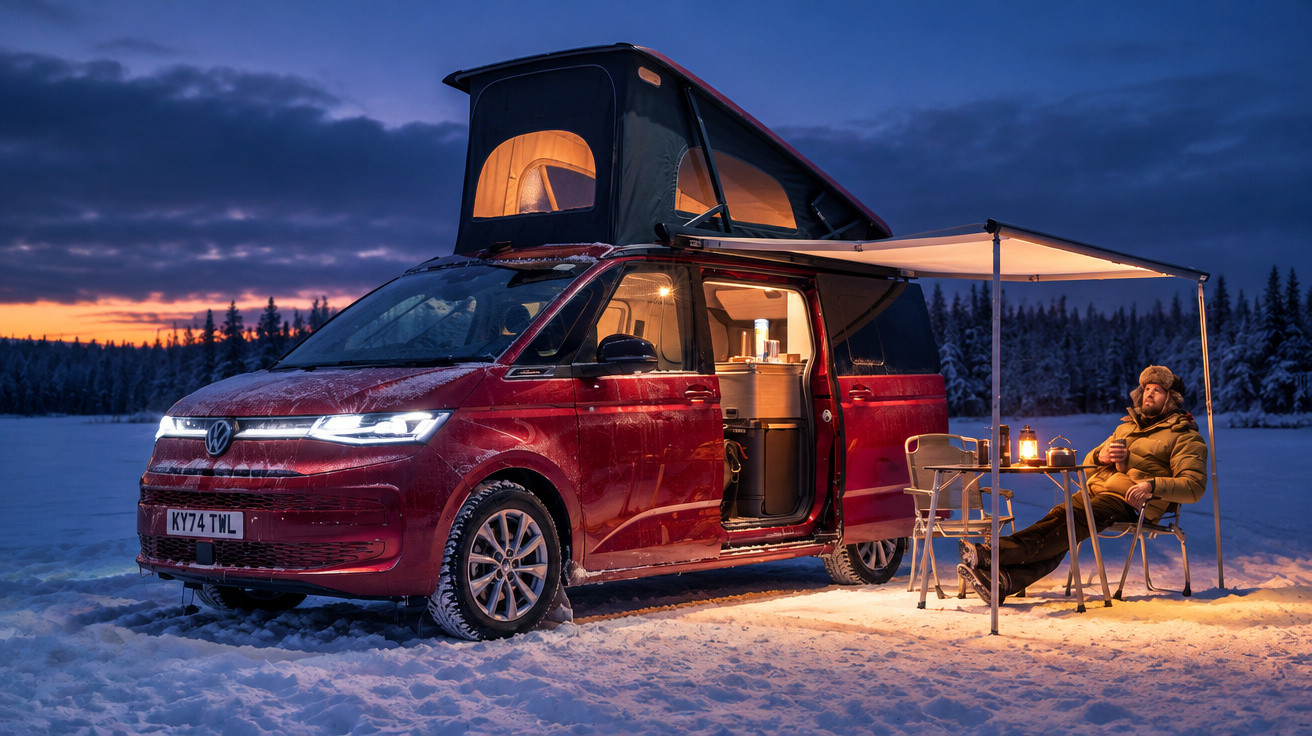
We pause several times. I cannot resist launching into a snowdrift, nor taking out the binoculars to establish whether a branch is actually a set of antlers. We drive uphill for a view across the landscape. Nothing below us moves as far as I can see. It is so silent and still that the land itself appears to be hibernating. Electric power suits this setting perfectly: no unpleasant, polluting hydrocarbons are released into the pristine air, there are no plumes of vapour and no noise. The Polestar belongs here.
Reindeer herding beyond the Arctic Circle
There are, though, a couple of flaws in my scheme. First, at this time of year the reindeer largely herd themselves. Second, when herding does take place, it is done on Ski-Doos rather than in cars. Reindeer, it turns out, do not follow roads. In effect, I have driven as far as possible towards the rough location of some reindeer, which must then be brought towards the car so Jonny can photograph them together. It is not quite the plan I had imagined.
During winter, Rickard, his son Jovva-Anta and the rest of their family are only semi-nomadic. The reindeer neither travel very far nor very quickly, because they need to dig through the snow for the lichen and fungi that feed them. There are no borders or fences here, yet every herder is expected to keep their animals within their own territory: “each day we have to patrol the edge to keep track of the animals and make sure they haven’t strayed and that’s a big job... my area is 60km around”.
The 3 Arctic Circle – and the regular 3 we rate highly enough to give this award to – are each perfectly in tune with this still, silent landscape
I would like to ask Rickard how many reindeer he owns, but the one thing I know about the Sami is that such a question is impolite. The reason is simple: it is equivalent to asking somebody how much money sits in their bank account. In many respects, reindeer remain their currency. I approach the subject indirectly, asking how many animals are required to make a living. “One person needs about 300 reindeer to survive,” says Rickard. “Because each year you need to slaughter 75 or 100 to earn enough money to live. A family needs 500–600.”
Why, then, not breed more? “The grazing won’t be good enough for all of them, and then you don’t have good quality reindeer, which aren’t worth as much and then you get a reputation...” His voice fades away. Reindeer meat is valuable, selling for roughly £8 per kilo, while a complete carcass brings in about £600 because every part is put to use. The antlers are milled down – “in Asia they think it’s an aphrodisiac”, Rickard says with an amused smile – and the skins, fur, bones, feet and even the velvet shed from the antlers are all used.
Herding takes place between March and May, and it is a communal activity. Families gather to move their animals to mountain pastures some 300km away. I assume the destination is chosen for better grazing, but Rickard corrects me. “Mosquitos. The reindeer hate them like we do, so we get them away from the lakes and water where they breed.” Calves arrive in early summer, marking the beginning of the Sami year. In September, the bull males – around 14–18 of them in a family herd – battle for dominance. The herds then return to the lowlands for winter, before the cycle begins anew.
Ollie and the reality of Sami reindeer herding
Ollie is large: eight years old and weighing 80–90kg. Reindeer are generally slaughtered when smaller and younger, but his status as a dominant bull has granted him a reprieve. He appears placid and gentle, seemingly content to be led about. “Yeah, he’s castrated, it makes them much calmer.” Rickard pulls up his trousers and my attention shifts instinctively to his knives. “We use the knife for everything,” he says, correctly reading my look. And they do: for notching ears as identification, cutting firewood and, well, yes, invasive surgery.
It is a calm and isolated life in what remains of Europe’s last wilderness, but the wider world still makes itself felt. Rickard has fought against inadequately regulated forestry that has disrupted the ecosystem, while tensions persist between Sweden and Sápmi, the Sami name for this land.
The herders’ way of life is in decline. “Only, I think, 15 or 20 per cent of Sami want this,” he says, motioning towards the woodland. “Do you know where the biggest Sami population is now? Stockholm.” Rickard’s son is among the small number carrying the tradition forward. “I tell you how I knew he would follow me. I gave him a mobile phone, because, you know, he’s a teenager, and two weeks later he lost the stupid thing and came to me and asked for another. And I said, ‘Well, I can’t afford to buy you one now, but what I can do is go into the woods, slaughter two of the reindeer and then use that money to buy you a phone.’ He went away, and came back 10 minutes later and said, ‘No Daddy don’t slaughter the reindeer, we need them.’ That was very encouraging for me.”
Rickard admires the Polestar, though he understands it in much the same way that I understand his reindeer. Unless one has a red nose, I have no real idea how to judge or value it. To me, the 3 Arctic Circle – along with the regular 3, which we think highly enough of to give it this award – is perfectly suited to this quiet, motionless landscape. Yet for Rickard this is not a playground but a workplace. There is no space for romantic notions. Nor is there space for a reindeer with a name.


Comments
No comments yet. Be the first to comment!
Leave a Comment