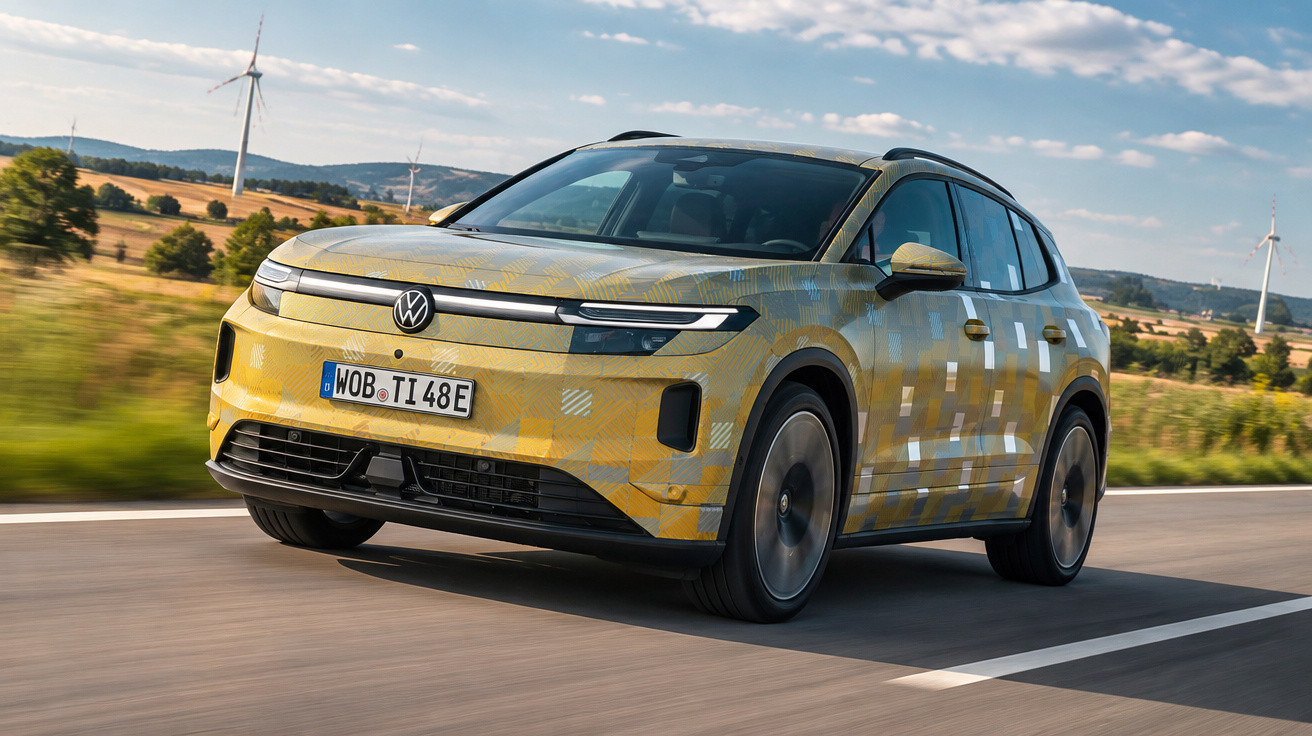
Volkswagen’s number-led naming convention has occasionally been bewildering, but it is about to become a little clearer. Following the ID.2’s transformation into the ID. Polo, the successor to the ID.4 will arrive on the road as the ID. Tiguan.
This is a mid-sized, fully electric SUV built on Volkswagen’s MEB+ architecture, with a choice of batteries and trim levels intended to cover a broad range of buyers. Regard it as a rival to the Tesla Model Y, and other similarly SUV-shaped EVs, and you will be broadly on the right track.
We have driven it, too – or, more precisely, a ‘late-stage prototype’. That seemingly means a production-ready vehicle wearing a colourful disguise, with its cabin obscured by carpet offcuts. The covering makes the dashboard difficult to inspect, although it presumably does wonders for suppressing cabin noise.
Volkswagen ID. Tiguan ride and driving impressions
Starting with how it drives, the ID. Tiguan is quieter, softer-riding and more luxurious than the ID.4 it replaces. Despite the test car’s 21-inch alloy wheels, its ride felt polished and composed, while the steering stayed settled even when we intentionally aimed it at potholes and uneven stretches of tarmac. Its handling is assured, though clearly tuned for passenger comfort rather than outright agility – entirely appropriate for a family SUV. It is also impressively hushed, smooth and largely free of fuss.
The version we sampled delivered ample performance, with a pleasantly progressive throttle response that avoided both sudden surges and unnecessary neck strain. It stopped effectively and offered genuinely useful regenerative braking. Overall, it represents a comprehensive improvement on the ID.4 in the way it travels along the road.
Two battery options will be offered. The smaller is a 58kWh lithium-iron-phosphate (LFP) unit with 280 miles of range, while the larger 77kWh nickel-manganese-cobalt (NMC) battery will be fitted to the Pro and dual-motor Pro 4Motion models. The Pro achieves the model’s maximum WLTP range of 373 miles. That is respectable beside the competition, if not exceptional.
Power figures are unchanged from the outgoing ID.4. The rear-wheel-drive 58kWh version produces 188bhp, the rear-wheel-drive 77kWh Pro makes 282bhp, and the all-wheel-drive 4Motion develops 295bhp. They should therefore feel brisk rather than genuinely rapid. The prototype seemed to be a rear-drive Pro, and it felt like a roughly seven-second car to 62mph – although that assessment is based solely on human dyno senses.
The 4Motion is likely to appeal to those who frequently encounter slippery conditions, or who need to tow, with the ID. Tiguan now expected to handle 2,000kg.
ID. Tiguan interior, space and practicality
There was not much of the interior we could properly examine, but we did spot a physical button/switch strip similar to that in the ID. Polo, which is no great surprise. There also appeared to be steering-wheel buttons and a generously sized display visible beneath the stuck-on carpet tiles. The overall refinement made the cabin feel upmarket, continuing the more premium direction established by the ID. Polo. It may not be the sharpest SUV to drive, but Volkswagen appears to have prioritised comfort over sportiness in the ID. Tiguan, and there is nothing wrong with that.
Volkswagen’s Dynamic Chassis Control will be optional, although it is probably not worth the extra outlay if the car will mainly carry children, dogs and the usual assorted clutter. Apex-to-apex driving is not especially vital when the family is aboard.
For carrying belongings, the rear seats certainly seem roomier than those of the ID4, something suggested by the ID Tiguan’s 44mm growth. It also gets a sizeable boot and a frunk, although Volkswagen would not allow us to take measurements or fill either with water to establish their exact litre capacities.
UK equipment and expected pricing
It is not difficult to predict how the car will appear on the configurator. Britain will not receive the entry-level European specification, known as ‘Trend’, so even the least expensive UK model should come with a healthy standard equipment list. Expect sensibly sized alloy wheels, heated seats and steering wheel, wireless phone charging, a decent display and dual-zone climate control.
In that sense, the approach closely mirrors the Polo: it may not be the most fashionable choice, but it should perform its role very well. It ought to bring a more unified ID range appearance, increased cabin room and practicality, exceptional comfort and generous equipment.
What it does not feel, however, is inexpensive. Given Volkswagen’s usual approach, that will probably mean a price premium over the current ID.4’s £37k starting point. Still, we would be pleased to be proved wrong. The full reveal is due in October…


Comments
No comments yet. Be the first to comment!
Leave a Comment