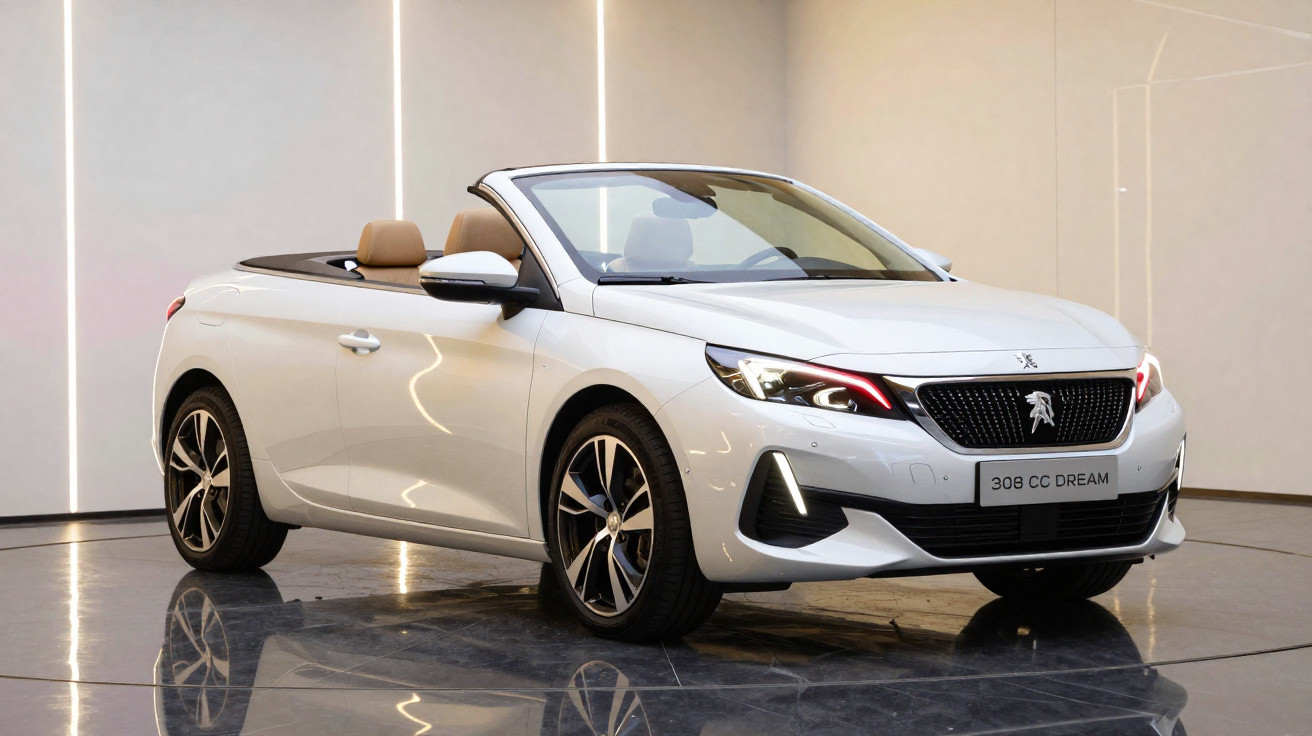
The old 307 CC sold by the transporter-load: 27,807 found homes in Britain altogether, more than 400 a year ahead of its nearest competitor, the Megane CC. It was dreadful to drive and notoriously unreliable (how does 150th out of 152 in the Top Gear Survey '06 sound?). Yet Peugeot had brought affordable folding hard-tops to the masses with the earlier 206 CC and, because we game Brits adore cabrios, early buyers simply could not resist its offering despite the shoddy execution.
Peugeot 308 CC: quality and equipment
That history meant we came to this new 308 CC with some caution. Our scepticism soon disappeared, though: it feels genuinely well made, from the reassuring thud of the doors closing to the leather-trimmed dashboard in GT versions. Several other features stand out, too. Headrest-mounted airbags are a world first, reaching your head faster than conventional airbags in the B-pillar. There is also a Mercedes-style ‘airscarf’, which directs warm air around your neck to keep you snug with the roof lowered; none of the 308's close competitors offers one. The basic model will cost £19,495 and, while entry-level Megane CC, Focus CC and Astra Twin Top models cost less, they do not come with as much standard equipment.
Roof-up refinement and roof-down compromises
It is impressively refined as well. Raise the roof and it is easy to forget that you are driving a convertible. There is the faintest trace of wind noise, but the turbocharged 1.6-litre petrol engine remained quiet on the smooth roads of our test route, while tyre noise was absent.
There are a couple of issues, however. With the roof lowered, front-seat occupants still do not really feel as though they are in a drop-top: the windscreen arcs so far back above your head that you must crane your neck to see the sky. Still, that is a familiar coupe-cabriolet compromise. A shorter windscreen requires a longer roof, making it more difficult to fold into the boot. Greater rear legroom also leaves less room in which to store the roof, necessitating a substantial rear end to house it once folded. In short, folding hard-tops are a packaging nightmare.
Rear passengers will get more of the cabrio experience, as long as they are not tall; legroom is limited, and someone 1.83 m tall would struggle to sit behind themselves. Occupy the rear seats, though, and the optional wind deflector cannot be fitted, leaving everybody with windswept hair.
Weight and handling
CCs are invariably heavier than the equivalent hatchbacks - by 170kg in the 308's case - and that can ruin their driving manners; the 307 CC was a wallowing pig. Although the 308 CC uses broadly the same chassis, it handles more effectively thanks to a wider track, revised spring rates and a strengthened body that reduces flex. Even so, there is no hiding its 1.5 tonnes once the pace rises. Its target buyers want to be seen rather than chase performance, so it does not need to feel especially sporty.
It is an odd-looking thing, though, isn't it? Some people will adore it: the type who consider snuffling, pug-faced dogs “cute”. That means the entire population of France, then. The rest of us will loathe it. Whichever camp you fall into, it is impossible to deny that it will make people take a second look - and, since nothing is worse than going unnoticed, that has to be A Good Thing.


Comments
No comments yet. Be the first to comment!
Leave a Comment