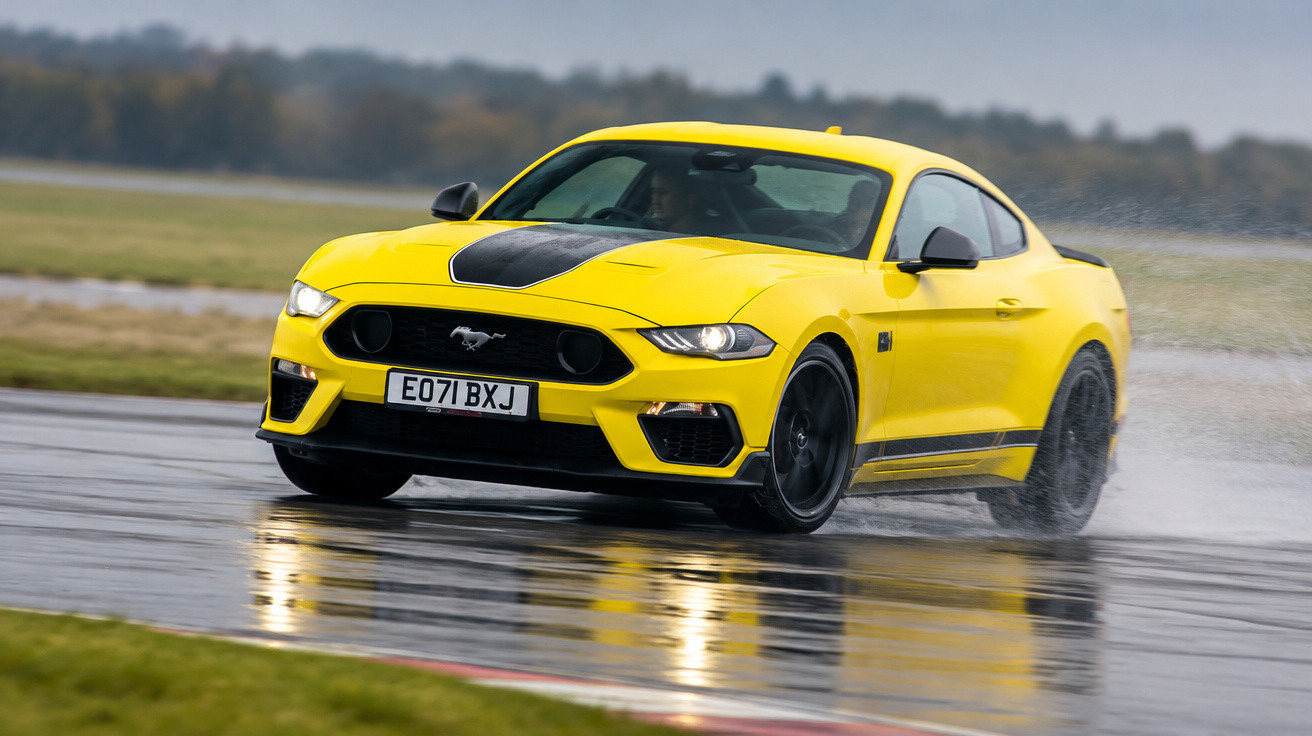
A yellow Mustang with a black stripe. It has to mean business, surely?
Naturally. You should definitely choose the £850 Grabber Yellow paint option as well. The Mach 1 is the hardest-core Mustang that Ford has officially sold in the UK. That is rather like calling something the hottest chilli in a supermarket korma. American buyers can get the Shelby GT500 instead, powered by a 5.2-litre supercharged V8 producing 760bhp and 625lb ft. It delivers McLaren-like output for the same money as the Mach 1 sold here.
So, what does it cost?
It is priced at £55,255, for which you get 454bhp and 390lb ft from a naturally aspirated 5.0-litre V8.
Wait, isn’t that only slightly more than a standard Mustang?
The power increase is modest, whereas the price rise is rather less so. The entry-level Mustang GT – which retains the V8 now that the 2.3 has been dropped – costs £11,000 less yet makes 444bhp from an almost identical V8.
What exactly is the Mach 1’s proposition?
It aims to be more focused for the driver, and Ford has made a substantial number of detailed changes to achieve that. A revised intake manifold, oil filter and cooler help the V8 find its additional 11bhp, but the more significant revisions lie elsewhere. There are fresh front and rear subframes, firmer front springs and anti-roll bars, plus dedicated settings for the MagneRide dampers and electrically assisted steering.
All of that sounds persuasive, but Ford has not stopped there. It says the reshaped front splitter, undertray and rear diffuser work together to raise downforce by 25 per cent. Yet 25 per cent more than very little remains... very little. This is not a cut-price 911 GT3, so let us not pretend otherwise.
Can the Mustang Mach 1 cope on a circuit?
In comparison with what, exactly? It appeared in our vast Speed Week event, where it did not feel as keen on track or as playful as the BMW M5 CS and Alfa Giulia GTAm driven back-to-back with it. It offered more connection than the remaining cars in its group, although those were an electric Audi RS e-tron GT and an apple-green Bentley Conti GT Speed. Both were more than half a tonne heavier than the Mustang and designed for an entirely different purpose.
Right, but how does it stack up against an ordinary Mustang?
It feels a touch more precise and more willing. Its engine reacts more eagerly and sheds inertia sooner, while the car is lighter on its feet through bends, with clearly faster responses and stronger body control.
The steering carries more heft and needs less twirling, while the overall impression is of a car that answers your inputs with greater accuracy. That makes it less of a GT, although it is not especially convincing as a sports car when placed beside an Alpine A110 or Porsche Cayman. They cost the same, but weigh half a tonne less and possess a level of finely honed athleticism that the Mustang lacks.
This still is not a machine to fling blindly at a bend. It has too much mass and insufficient agility for that approach. It works best when eased into a corner, avoiding overloading the front tyres, before applying the throttle and leaning on the rear rubber. The intrusive traction control is a disappointment, and it continues to intervene even after being relaxed – it’s like a comic interpretation of “you know that side-slip control that Ferrari and McLaren bang on about, well, we’ve had a look and you know what, it’s bloody difficult, so we’ve just persuaded the traction control to sort of hiccup through the corner”.
That is unfortunate, because the rear-wheel-drive Mach 1 ought to have been made for sliding. You can sense the mass shifting rearwards along the lengthy wheelbase, the differential locking up and the rear tyres beginning to scrub wide, only for the fun to be abruptly stopped. A real pity.
At least it comes with a manual gearbox.
It immediately reminds you how much more effort and concentration a manual demands. That is particularly true when the gearshift is as weighty and decisive as this one: it is a wrench, not a flick. Ford also offers a 10-speed automatic, but anyone fond of using paddle shifts will do so frequently enough to develop RSI.
Is it sufficiently different to attract fresh Mustang buyers?
I do not think so. It is difficult to imagine Cayman or TT owners seeing enough progress here to push them into buying one. It will probably appeal to a handful of people looking to give electric a final two-fingered salute. Some existing owners may also exchange their cars for a Mach 1, but there are likely to be just as many who decide that £11,000 spent on aftermarket upgrades would represent better value.
The Mach 1 does not substantially advance the Mustang narrative. I am pleased Ford has brought it here, because it demonstrates that the firm still has faith in the product in Europe, but for how long? This Mustang generation has existed since 2014 and has been sold in the UK for five years. It has performed well commercially, but its place in a soon-to-be heavily electrified product plan centred on the Mustang Mach-E is unclear.
It also highlights the regular Mustang’s strong value.
That is a worthwhile observation. At £44k, the standard Mustang delivers 100 per cent of the Mustang experience – and could arguably be more authentic because it is slightly less taut and tightly controlled. Nor does £44k seem like an enormous sum any more; it depends entirely on what you regard as justified. Could this be one final, thirsty celebration of petrol?



Comments
No comments yet. Be the first to comment!
Leave a Comment