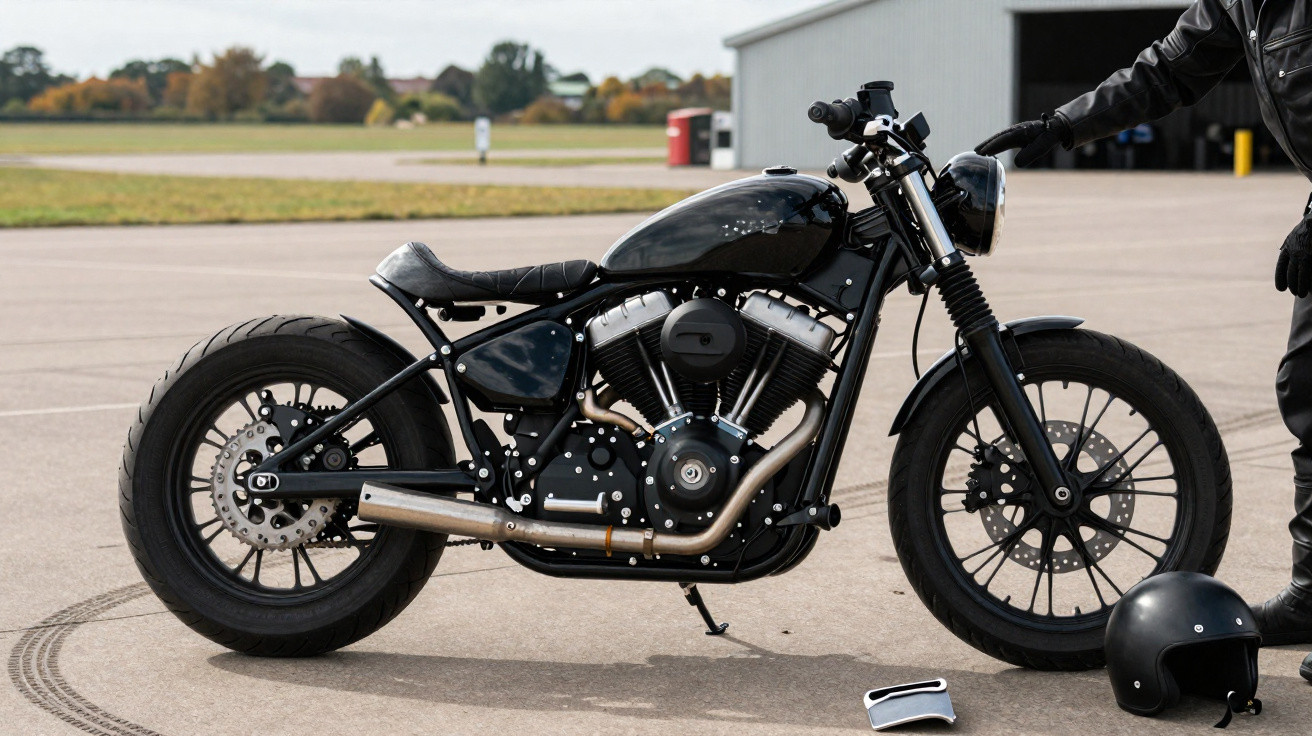
For most motorcycles, a change of ownership means paperwork, a cautious ride home and space cleared in the garage. The handover of Allen Millyard’s Viper V10 was always going to be rather different. Built around an 8.0-litre Dodge Viper V10 engine, this extraordinary British special is large, powerful and entirely unlike a conventional production bike.
Its new owner, Tim Whittaker, has taken the machine out for an initial run at a UK airfield with Millyard present. That is the important story here: not an attempt to prove what the motorcycle can do, but a careful transfer of knowledge between the person who built it and the person now responsible for using and preserving it.
Why the first outing matters
The Viper V10 is a one-off build, not a production motorcycle with a handbook, dealership network and shelves of readily available replacement parts. Millyard completed it in 2009, adapting the enormous V10 engine from the Dodge Viper sports car into a fully functioning motorcycle.
That makes any change of ownership more significant than it would be for an ordinary bike. The new keeper is taking on a machine with its own operating habits, maintenance needs and engineering compromises, all of which are best understood through direct familiarity rather than assumptions.
The motorcycle was sold at auction by H&H Classics at the National Motorcycle Museum in Solihull, where it achieved a hammer price of £130,000. With the buyer’s premium and fees included, the reported total was £149,500.
The first ride after buying an unfamiliar motorcycle should be about understanding it, not showing what it can do.
Why an airfield was the sensible choice
An airfield is not automatically safe, but a properly arranged private venue offers more room than a public road. For a machine of this scale, that matters. There is space to become familiar with the clutch, throttle, brakes and steering without junctions, parked cars, pedestrians or changing traffic conditions adding further pressure.
A controlled surface also gives the rider time to understand how the bike behaves at low speed. This is particularly important with a long, heavy motorcycle carrying a car-derived engine. Balancing, turning and stopping at walking pace can demand as much attention as acceleration.
Millyard’s presence for the early runs was valuable because a builder can explain the details that an inspection cannot reveal. That may include starting procedure, cooling requirements, unusual control feel, expected mechanical noise and the checks worth making before and after a ride.
Private land is not a free-for-all, however. Anyone using an airfield or similar site needs the owner’s permission, suitable insurance and a clear plan for access, fuel, fire safety and emergency support.
What makes the Viper V10 so unusual
The defining feature is obvious: an 8.0-litre V10 engine intended for a sports car rather than a two-wheeled vehicle. Its reported output of around 500bhp is striking, but the figure alone does not explain the challenge of the bike.
An engine of that capacity produces substantial torque, and torque affects how sharply a motorcycle can respond to small throttle inputs. The engine’s size and weight also influence the wheelbase, overall mass, packaging and low-speed balance of the finished machine.
The achievement is therefore not simply fitting a large engine into a frame. It is creating a complete, rideable motorcycle around it, with workable steering, braking, cooling, transmission and controls.
The Viper V10 is among Millyard’s best-known creations, alongside the Flying Millyard. Both show what skilled individual engineering can achieve outside mainstream motorcycle manufacturing.
Its appeal is not just the engine, but the work required to make the whole motorcycle function around it.
Responsible ownership of a one-off motorcycle
Whittaker has indicated that he intends to ride the Viper V10 rather than keep it permanently out of use. For enthusiasts, that is encouraging: rare machinery is often most meaningful when it can still be seen, heard and operated with care.
That does not mean frequent or casual riding. A unique motorcycle deserves cautious preparation, conservative use and detailed records. Long periods without use can bring problems of their own, including degraded fuel, moisture, ageing seals and corrosion, but running an unusual machine without proper checks can create equally serious issues.
The sensible approach is controlled exercise in appropriate conditions, followed by inspection and maintenance.
Three priorities before an outing
- Inspect rather than assume
Check fluid levels, tyre condition and pressures, brake operation, steering movement, visible hoses, fasteners and the final-drive system. A bespoke machine may have unfamiliar access points and non-standard service procedures.
- Choose the surface and weather carefully
A clean, dry surface with generous run-off is preferable to public roads, gravel, diesel spills or busy traffic. In a British autumn and winter, wet leaves, cold tyres, standing water and sudden showers can quickly reduce grip.
- Build up slowly
Start by learning the clutch engagement, brake feel, throttle response, turning circle and heat behaviour. Speed is not a useful test until the rider understands how the motorcycle behaves at modest speeds.
What visitors may be able to see in Solihull
The Viper V10 is expected to spend time on display at the National Motorcycle Museum in Solihull, although visitors should check directly with the museum before making a special journey. Display arrangements can change, particularly where a privately owned machine is concerned.
Seeing the motorcycle in person gives a clearer sense of its physical scale than photographs can provide. Images show the V10 engine, but they can flatten the relationship between the engine, frame, controls and rider position.
For engineering enthusiasts, the value is in the details: the routing of pipes and cables, the packaging of major components and the practical decisions needed to turn an ambitious concept into a working vehicle.
Common mistakes when discussing extreme motorcycles
Unusual motorcycles attract dramatic claims, but the Viper V10 does not need exaggeration.
- Focusing only on horsepower. Power matters, but chassis design, tyre condition, brakes, throttle control and rider judgement matter just as much.
- Assuming big power means easy speed. A rider needs space, grip, familiarity and restraint before any machine can be used safely.
- Comparing it directly with a showroom superbike. This is a highly individual engineering project, designed to solve very different problems.
- Treating museum display as permanent retirement. A carefully managed display can coexist with conscientious ownership and occasional controlled use.
- Confusing the hammer price with the amount paid. Auction premiums, VAT where applicable and other charges can alter the final cost considerably.
Safety comes before spectacle
No one should attempt to recreate a build of this kind without specialist engineering knowledge, suitable facilities and a proper understanding of inspection, testing and applicable vehicle requirements. Changes to a motorcycle’s frame, steering, brakes, fuel system, cooling or electrics can have serious consequences if they are not properly designed and checked.
For riders, the wider lesson is straightforward. Treat any unfamiliar motorcycle with patience, wear appropriate protective equipment and do not explore its limits on public roads. A car park, industrial estate or quiet roadside is not an adequate substitute for a properly controlled area.
A careful handover, not an ending
Millyard’s sale of the Viper V10 creates room for future projects, while putting this celebrated machine in the hands of an owner who intends to understand it properly. That makes the airfield outing more than a first ride: it is the beginning of a new period of custodianship.
For everyone watching, the encouraging part is that the motorcycle appears set to remain both preserved and used with care. That is the right future for a remarkable British-built machine: not treated as disposable spectacle, but respected as a demanding piece of working engineering.





Comments
No comments yet. Be the first to comment!
Leave a Comment