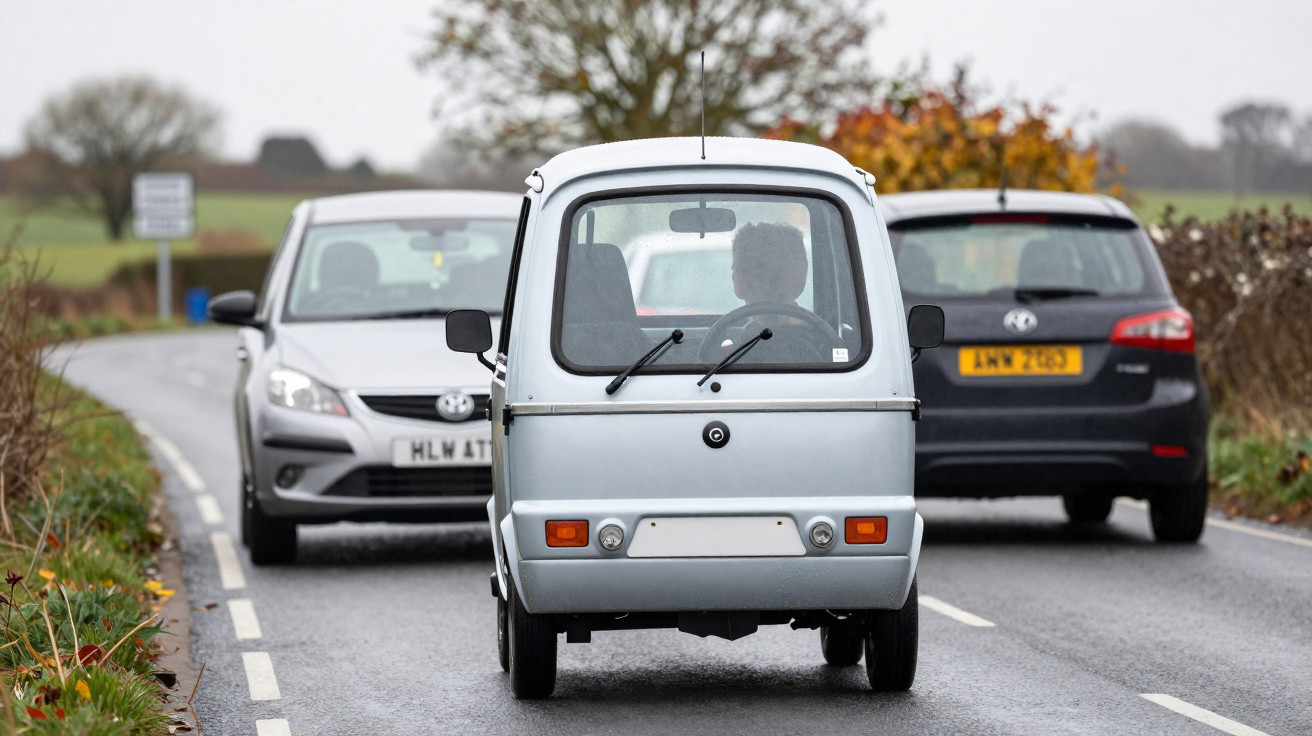
For teenagers and families in rural areas, a moped car can seem like a practical answer to a familiar problem: buses are infrequent, lifts are not always available and a conventional car may be out of reach. With a roof, doors and four wheels, these compact vehicles offer more shelter from British weather than a scooter or moped.
The crucial point is not to treat one as a small conventional car. A light quadricycle is normally limited to 45 km/h, or roughly 28 mph. Its low speed and light construction affect where it works best, how it handles and the protection it may offer in a collision. The safest approach is to plan journeys around its limits, rather than expecting it to keep pace with ordinary traffic.
What is a moped car?
“Moped car” is an informal term commonly used for a light quadricycle: a small enclosed four-wheeled vehicle with a restricted maximum design speed. Many have two seats, a compact petrol engine or electric motor, and modest luggage space.
They can be useful for short local trips because they offer:
- protection from rain, wind and cold;
- an enclosed cabin with seatbelts;
- space for a school bag or a small shop;
- easier parking than a full-sized car;
- a less exposed alternative to a two-wheeler.
However, the car-like bodywork can give a false impression of protection. Light quadricycles are generally far lighter than hatchbacks, and equipment such as airbags, crash structures, braking systems and stability aids varies greatly between models.
A moped car has doors and a steering wheel, but it still needs to be driven with the awareness you would apply to a slow, vulnerable road user.
Licence and legal checks in the UK
The rules depend on the vehicle’s approval category, its power, weight and maximum speed. Many 45 km/h light quadricycles may be driven from age 16 with the appropriate AM entitlement, but do not assume that every vehicle advertised as a “moped car” qualifies.
Before buying, insuring or arranging a test drive, check the exact vehicle and your own entitlement.
Four checks to make first
- Read the V5C registration certificate. This should help identify the vehicle’s category and other relevant details.
- Check your driving licence categories. A provisional licence, CBT, theory test and practical test requirements may apply depending on the vehicle and the driver’s circumstances.
- Use current GOV.UK guidance. Requirements can differ for light quadricycles and faster quadricycles.
- Speak to an insurer before purchase. Age, postcode, overnight parking, security and previous driving experience can affect whether cover is available and what it costs.
A faster, heavier quadricycle can look very similar to a 45 km/h model but fall under different licensing rules. Always verify the individual registration and approval details rather than relying on a seller’s description.
Why country roads can be challenging
On a quiet lane through a village, 28 mph may be entirely appropriate. On an open rural road where traffic is travelling at 50 or 60 mph, however, other vehicles can close the gap quickly. Drivers approaching a bend, brow of a hill or patch of low sun may not immediately appreciate how slowly the moped car is travelling.
That creates predictable risks:
- a following driver braking too late;
- unsafe or impatient overtakes;
- road users pulling out and misjudging the moped car’s speed;
- pressure to drive faster than weather or road conditions allow;
- long queues on roads with few safe overtaking opportunities.
The Highway Code advises drivers not to hold up a long queue of traffic, particularly when driving a large or slow-moving vehicle. That does not mean stopping somewhere hazardous or speeding up beyond what is safe. It means using mirrors, recognising a queue early and pulling in only where there is a genuinely safe opportunity.
A safer country-road routine
- Plan the route before setting off. Prefer lower-speed roads with good sightlines and places where traffic can pass safely.
- Avoid the busiest times if you can. School-run and commuter traffic can make a slow vehicle more stressful to use.
- Check mirrors frequently. Do this well before braking, turning or approaching a lay-by.
- Signal early. Give following traffic time to understand your intention.
- Let traffic pass only in a suitable place. A lay-by, wide entrance or passing place needs enough visibility, a firm surface and a safe way back into the traffic flow.
- Do not wave another driver into an overtake. A gesture can be misunderstood, especially if you cannot see around a bend or beyond a crest.
Make the vehicle easy to see
A small vehicle can blend into hedgerows, farm entrances and the glare from a low winter sun. At a distance, other drivers may also assume it is travelling at normal car speed.
Keep the lights, reflectors, windows, mirrors and registration plates clean. During autumn and winter, mud, salt spray and condensation can build up quickly. Before every journey, make sure all exterior lights work and that you can see clearly through every window.
Do not set off with just a small clear patch on the windscreen. Demist the glass properly, including side windows where possible, before joining traffic. Good tyres and effective wipers are equally important: lightweight vehicles may feel more affected by standing water and crosswinds than a heavier car.
A longer route on quieter, slower roads can be the safer and less stressful choice.
Safety limits compared with an ordinary car
A moped car may be useful transport, but it cannot offer the same physical protection as a typical modern hatchback simply because of its size and weight. This matters particularly in a collision involving a van, SUV, tractor or lorry.
Inspect the specification of the exact model rather than assuming all quadricycles are equipped alike. Ask about:
- seatbelts and head restraints;
- brakes, tyres and replacement-tyre availability;
- heating and demisting performance;
- door locks and child-lock arrangements, where relevant;
- independent safety or crash-test information, if available;
- battery protection, charging instructions and emergency procedures for electric models.
Be realistic about passenger and luggage loads. Two occupants, bags and wet coats can fill a compact cabin quickly, while additional weight may affect acceleration and stopping distances. Secure loose items so that they cannot slide into the driver’s footwell or become hazardous in sudden braking.
Registration, insurance and maintenance
A road-going moped car in the UK will normally need DVLA registration, registration plates, vehicle tax where applicable and valid motor insurance. It will also need an MOT once it reaches the relevant test age, unless a specific exemption applies.
Third-party insurance is the legal minimum for road use. It covers injury or damage caused to other people and their property, but it does not normally pay to repair your own vehicle after an at-fault collision. Third-party, fire and theft or comprehensive cover may provide wider protection, subject to the policy terms.
When comparing policies, look beyond the headline price. Check:
- the excess for younger drivers;
- theft cover and any security conditions;
- cover for fire, vandalism and weather damage;
- restrictions on named drivers;
- requirements for overnight parking;
- whether a courtesy vehicle is included.
Maintenance is not optional because the vehicle is small. Follow the manufacturer’s service schedule and check tyre condition, pressures, lights, brakes, wipers and washer fluid regularly. For electric versions, use the correct charging equipment and do not use damaged cables or unsuitable extension leads.
Common mistakes to avoid
The most frequent mistake is buying on appearance alone. A colourful, car-shaped body can distract from the practical questions that matter every day.
Avoid these errors:
- Treating 45 km/h as a target. It is a maximum design speed, not a safe speed for every hill, bend or wet road.
- Choosing unsuitable fast routes. A road may be legal to use yet still be a poor fit because of traffic volume, bends, heavy vehicles or limited opportunities to pull in.
- Skipping a meaningful test drive. Try hill starts, reversing, demisting, visibility at junctions and joining normal traffic. Follow any licence or supervision rules that apply.
- Ignoring theft protection. Lock the vehicle, remove valuables and consider secure overnight parking.
- Neglecting weather checks. Strong winds, flooded lanes, ice and poor visibility can be especially demanding in a light vehicle.
A practical choice for the right journeys
For local trips to college, an apprenticeship, a village shop or a railway station, a moped car can provide useful independence where public transport is limited. It is not a substitute for an ordinary car on every route.
Before committing, drive or assess your regular journeys in realistic conditions. Think about dark winter evenings, rain, farm traffic, faster A-roads and safe places to allow queues to pass. Confirm the licence position, insurance, maintenance arrangements and safety equipment for the exact vehicle.
Used thoughtfully and on suitable roads, a moped car can make rural travel more manageable. Treated like a full-sized car, or used on roads where its low speed is a poor match for surrounding traffic, its limitations quickly become more important than its convenience.



Comments
No comments yet. Be the first to comment!
Leave a Comment