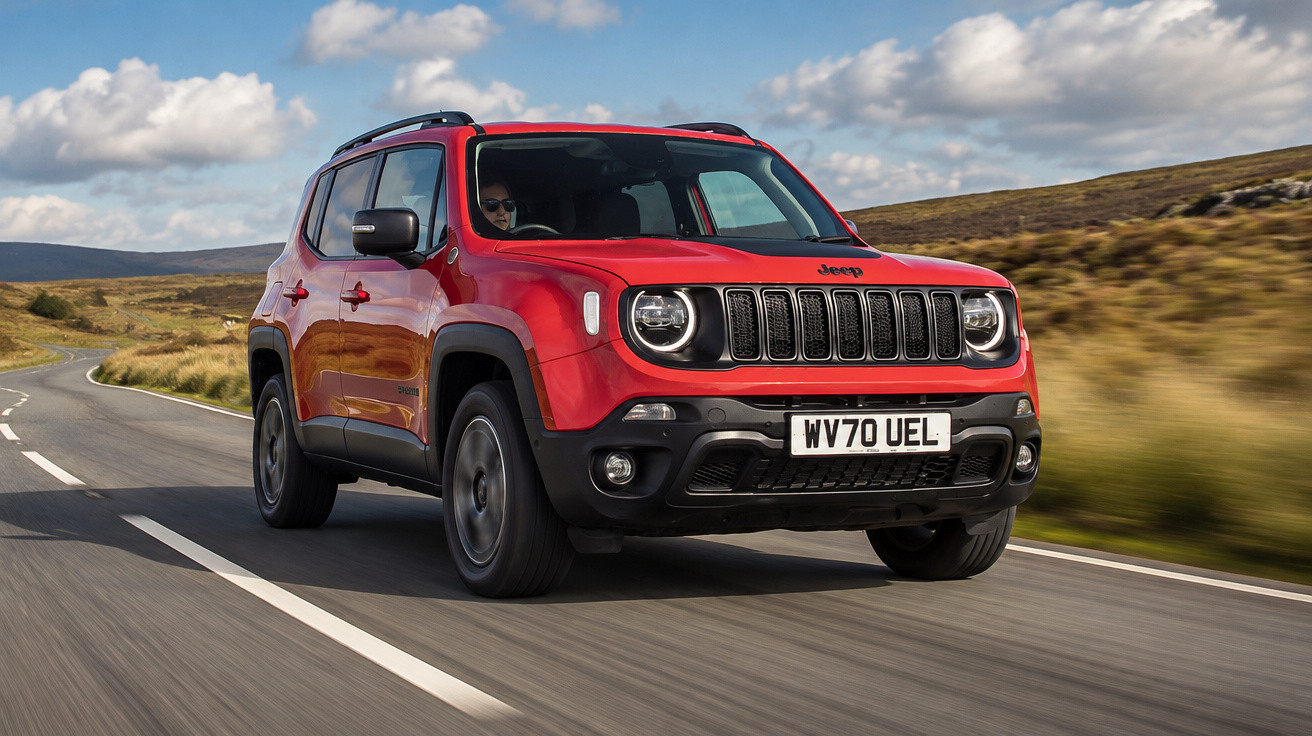
A new plug-in hybrid from Jeep?
It may be a stretch to call a new plug-in hybrid exciting, yet Jeep’s first PHEV is bound to generate some interest in certain quarters – particularly among company-car drivers who enjoy green-laning at weekends.
Every model in Jeep’s range is due to receive an electric assist within the next two years. Leading the charge is the Renegade 4xe, pronounced four-by-e. It is offered in three trims – Longitude, Limited and Trailhawk – and every version has four-wheel drive plus a six-speed automatic gearbox.
Jeep Renegade 4xe powertrain and hybrid modes
Beneath the bonnet sits a 60bhp electric motor and an 11.4kWh battery, driving the rear wheels, alongside a turbocharged 1.3-litre four-cylinder petrol engine at the front. Its output depends on the trim. We tested the range-topping Trailhawk, which produces 238bhp and 199lb ft; the two lesser versions make 188bhp.
Although it is a 4WD vehicle, there is no physical link between the front and rear axles: electronics handle everything. The system is seamlessly integrated, and the car preserves sufficient battery charge to run the rear wheels whenever four-wheel drive is needed.
The hybrid set-up provides three drive modes: Hybrid, Electric and E-Save. Hybrid leaves the decision to the car, Electric prioritises battery power, and E-Save holds the charge for use later on, perhaps once you arrive in town. E-Save can also use the petrol engine to replenish the battery.
How does the plug-in Renegade drive?
A 0–62mph time of 7.1secs and a 123mph maximum speed appear reasonably lively on paper, though they do not entirely translate to the road. Still, anyone considering an electrified, rock-clambering, 1.8-tonne compact SUV is unlikely to be buying it for outright performance.
The PHEV Renegade is happier when driven gently. Throttle responses are leisurely, while the automatic gearbox is best not rushed, as it can become confused. Ride quality is generally supple and composed, although it rolls in bends when pressed. At seven-tenths it is comfortable, and it feels much more like a compact off-roader than a raised supermini.
Refinement is not faultless. The steering feels slightly vague around the straight-ahead position before gaining weight, and the engine bursts noisily into action once the battery charge falls or the accelerator is floored. Selecting Sport mode is like tasering a donkey – the formerly calm throttle becomes jumpy, the automatic starts swapping ratios relentlessly, and the engine begins to howl.
A calmer approach in Auto mode is much preferable, letting the electric system smooth things over. If you feel the urge to hurry, leave 10 minutes sooner.
Is the Jeep Renegade 4xe genuinely capable off road?
Jeep has clearly invested serious effort here: few plug-in hybrids can take you quite so far from a power socket. In fact, a Jeep earns the highly regarded Trailhawk badge only after successfully tackling the Rubicon Trail, an exercise that largely amounts to suffering in the desert. This punishing 17-mile course begins close to Lake Tahoe and features ledges, rock holes, rivers and obstacles that would be difficult even to cross on foot.
The Renegade 4xe copes with virtually anything placed beneath it without fuss – which is a pity, as hardly anybody will use it that way. Jeep says committed trail drivers will welcome it, but who wants to delay a green-laning group while the battery is recharged? Even so, with the Suzuki Jimny disappearing from sale in 2021, there is space for a retro mountain goat.
For those who prefer traditional off-roading, the diesel Renegade Trailhawk remains available from £32,695, complete with a mechanical propshaft. Its 37.7mpg and 196g/km CO2 figures, however, are unlikely to impress the person managing your company fleet.
Will it save me money?
This is the difficult point with PHEVs. Carmakers occasionally agonise over them, especially brands such as Jeep that appreciate these developments may not appeal to purists. Nevertheless, every manufacturer will need to embrace electrification in some form eventually.
Buying the Trailhawk 4xe certainly will not be cheap. Starting at £36,500, it costs nearly £4k more than the diesel and over £13k more than the entry-level 1.0-litre three-cylinder Longitude. Equipment is generous, including heated front seats and steering wheel, an 8.6-inch Uconnect centre touchscreen, rear parking camera, keyless go and the customary collection of driver-assistance systems.
The Trailhawk emits 51g/km CO2, though, placing it in favourable company-car tax bands. Benefit-in-kind tax for company cars is based on CO2 emissions, with drivers paying a percentage of the vehicle’s value annually. The Trailhawk’s 51g/km results in a 13% BIK rate. Longitude and Limited 4xe models slip beneath 50g/km, dropping to a 12% BIK rate and making them especially attractive value. By comparison, the diesel Trailhawk’s 196g/km brings a painful 37% BIK rate. Plug-in alternatives include the Mini Countryman PHEV, or the fully electric Hyundai Kona and Kia e-Niro.
Plug-in cars will not suit every buyer, but they can be a sensible introduction to zero-emission driving, especially if your commute is 10 miles in each direction and you can charge at home. The 4xe needs five hours from a three-pin socket; install a wallbox and you can get the Renegade ready again more quickly.
Official WLTP figures, with the battery charged, are 128mpg and 51g/km CO2. A full charge provides up to 26 miles, after which the car operates like a conventional hybrid, recovering electricity while braking and using the electric motor whenever possible. During a 51-mile route through the hilly Welsh borders, our test car returned 60.9mpg, with 31.6 miles completed in electric mode.
Should I buy one?
Several factors would have to fall into place for the Renegade PHEV to represent a rational purchase, but, as with any Jeep, this is a car chosen with the heart rather than the head. The smallest Jeep has a charm missing from its bigger relatives, and if the realities of the electric powertrain fit your lifestyle, the 4xe could be an excellent first move into zero-emission motoring.
Score: 6/10






Comments
No comments yet. Be the first to comment!
Leave a Comment