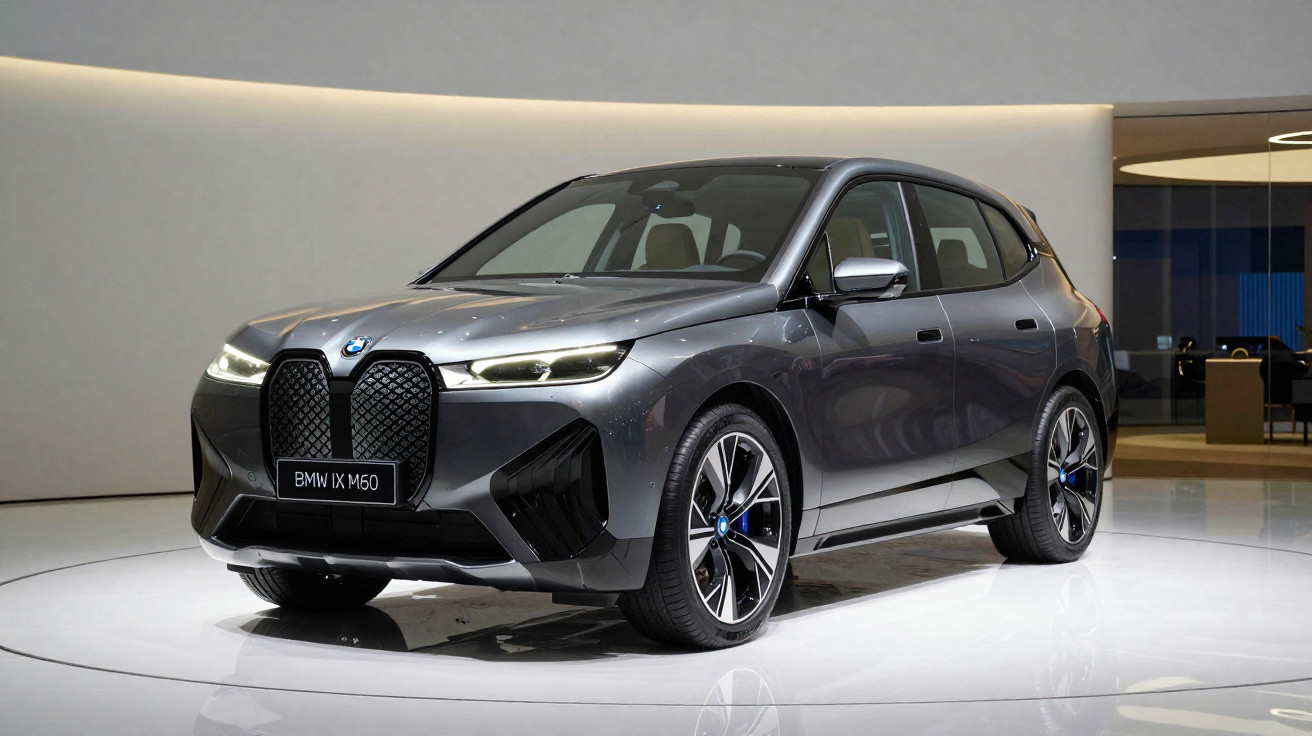
Following the BMW i4, the iX has now received the “M treatment”, resulting in the BMW iX M60. With a peak output of 619 hp, it is Munich’s most powerful fully electric model - at least for the time being.
This iX version sits at the top of BMW’s largest dedicated electric SUV range, standing out both for the power it delivers and the performance figures it claims.
Thanks to the chassis changes introduced by BMW M, the iX M60 also manages an effective blend of agility and comfort. Naturally, that comes at a price, as this article will explain.
The model before the M version
BMW’s electric line-up already includes saloons, in the form of the i4 and forthcoming i7, plus SUVs such as the iX3, iX and new iX1. Its largest electric SUV now gains this more powerful M-badged powertrain, from the Bavarian manufacturer’s performance division, which celebrates its 50th anniversary this year.
The iX is clearly a hugely important car for BMW: it has the fashionable body style, it is electric, and it debuted a new platform. Although it started from the CLAR architecture used by the 5, 6, 7 and 8 Series as well as BMW’s larger SUVs, it has been extensively revised. Key changes include carbon-fibre construction around the battery pack, at the rear of the vehicle and in the roof.
Concept-car-inspired interior
Its dimensions are close to those of an X5. It is just 3 cm longer, at 4.95 m, but almost 4 cm narrower at 1.97 m and 5 cm lower at 1.69 m. Its wheelbase is virtually identical, with the iX only 0.8 cm longer and its axles separated by exactly three metres.
Despite measuring almost five metres long, it seats only five occupants. This differs from the X5, which can be specified with a third row containing two small additional rear seats.
Even so, five people are accommodated in considerable comfort and with ample room, particularly headroom, largely thanks to the generously sized seats. Front-seat massage is also available, although it works only on the backrests rather than the seat cushions, unlike the system offered in the Mercedes-Benz EQS, for example.
The boot is less impressive for space. Its shape is very regular, albeit without features to make it more versatile, but its 500-litre capacity is modest beside the 660 litres of an Audi e-tron or even the 650 litres available in a BMW X5.
There are very few physical controls, while the front row has plenty of open space because the centre console and dashboard are not connected. Ahead of the armrest sit the transmission selector, the rotary iDrive controller - thankfully retained - and the drive-mode selector.
Rearward and side visibility is very good, while the forward view is especially strong thanks in part to the low dashboard. It reinforces the sense of an interior closer to that of a premium limousine than an SUV pumped full of anabolic steroids, such as the Lamborghini Urus.
Aside from the cheaper plastic securing the tablet-style display to the dashboard structure and the hard plastic on the lower section of the centre console, the materials and build quality feel reassuring. They arguably ought to do so more consistently, given that the test car’s specification brought its price to around €150,000.
The wooden trim in the middle of the dashboard improves the perceived quality, although the markings on the haptic sensors on the centre bridge are difficult to read in direct sunlight.
BMW iX M60: figures to savour
Before assessing how the BMW iX M60 drives, its total mass must be considered. It weighs slightly more than 2.5 tonnes - 2,584 kg, to be precise - with much of that attributable to its enormous 111.5 kWh battery, of which 105.2 kWh is usable. BMW says this is enough for a maximum range of 564 km, though the final figure after our test was no higher than 489 km.
As in the iX xDrive50 - which we have also driven; see the video below - there are two electric motors, one on each axle. The front motor is slightly less powerful, producing 258 hp rather than the xDrive50’s 272 hp, but the rear unit is considerably stronger, with 489 hp versus 340 hp. Together, they produce a maximum of 619 hp, although only for 10 seconds and with Sport drive mode selected. In Personal or Efficiency modes, maximum output is 540 hp.
The rear motor uses a six-phase inverter, rather than the usual three-phase arrangement, and features a rotor that is 20 mm larger, enhanced cooling and larger magnets. To enable this electric SUV to reach 250 km/h - compared with 200 km/h for the iX xDrive50 - the rear motor has a longer operating ratio, while the front motor spins at higher speeds.
These exceptional figures translate into genuine sports-car performance, not merely a high top speed.
With Launch Control, it needs only 3.8 seconds to accelerate from 0 to 100 km/h. The system briefly raises the already remarkable maximum torque from 1,015 Nm to 1,100 Nm. That gives it a sizeable advantage over the Audi e-tron S, which takes 4.5 seconds and reaches 210 km/h, as well as a marginal edge over the 670 hp Tesla Model X, at 3.9 seconds and the same 250 km/h top speed.
Not only are the accelerative forces enough to turn anyone’s stomach after a substantial meal, but the thrust also does not fade. As project director Johann Kistler explains: “we did not want to push the electric motors to their limit, so that the iX M60 would not start running out of ‘puff’ after the first dozen bends on a mountain road”.
Naturally, during this kind of very fast driving - and later on an unrestricted motorway - BMW’s claimed average consumption appears optimistic. Even so, the 24.4 kWh/100 km average shown by the trip computer at this point in the route sat at the upper end of the officially approved 21.7–24.7 kWh/100 km range.
A BMW at heart
At BMW, dynamic behaviour is always a priority, whether the car is powered by petrol or electricity. “We did more than merely adjust the software so the electronic dampers would respond more firmly,” Kistler adds.
Accordingly, the hollow rear anti-roll bar has been replaced by a solid one, increasing stiffness by around 20%. At the front wheels, the principal change comes from firmer dampers.
The air springs receive a firmer calibration and the steering gains more weight. However, it is not entirely satisfying because it feels overly filtered. The excessively thick steering-wheel rim - for many hands - is more of an issue than its unconventional hexagonal shape.
Rear-wheel steering provides valuable assistance in making this electric SUV feel more agile, helping to disguise its “feet of clay” - in other words, the hundreds of kilograms concentrated at its base because the huge energy storage unit is mounted in the floor.
The substantially more powerful rear motor also makes its cornering behaviour more oversteer-biased, but only when the driver wants it to be.
Provoking the BMW iX M60 mid-corner for a little extra fun is carefully overseen by electronic assistance systems. They are not overly intrusive, even though their intervention varies according to the selected drive mode, and are ready to prevent unwanted consequences from an over-enthusiastic driver.
Braking is one of its strongest areas: it is powerful, with a well-modulated pedal that feels more progressive than those of a large proportion of the electric and hybrid cars currently on sale.
How much does it cost?
Speaking of the market, the BMW iX M60 will not arrive until autumn 2022, with prices in Portugal starting from €144,960.


Comments
No comments yet. Be the first to comment!
Leave a Comment