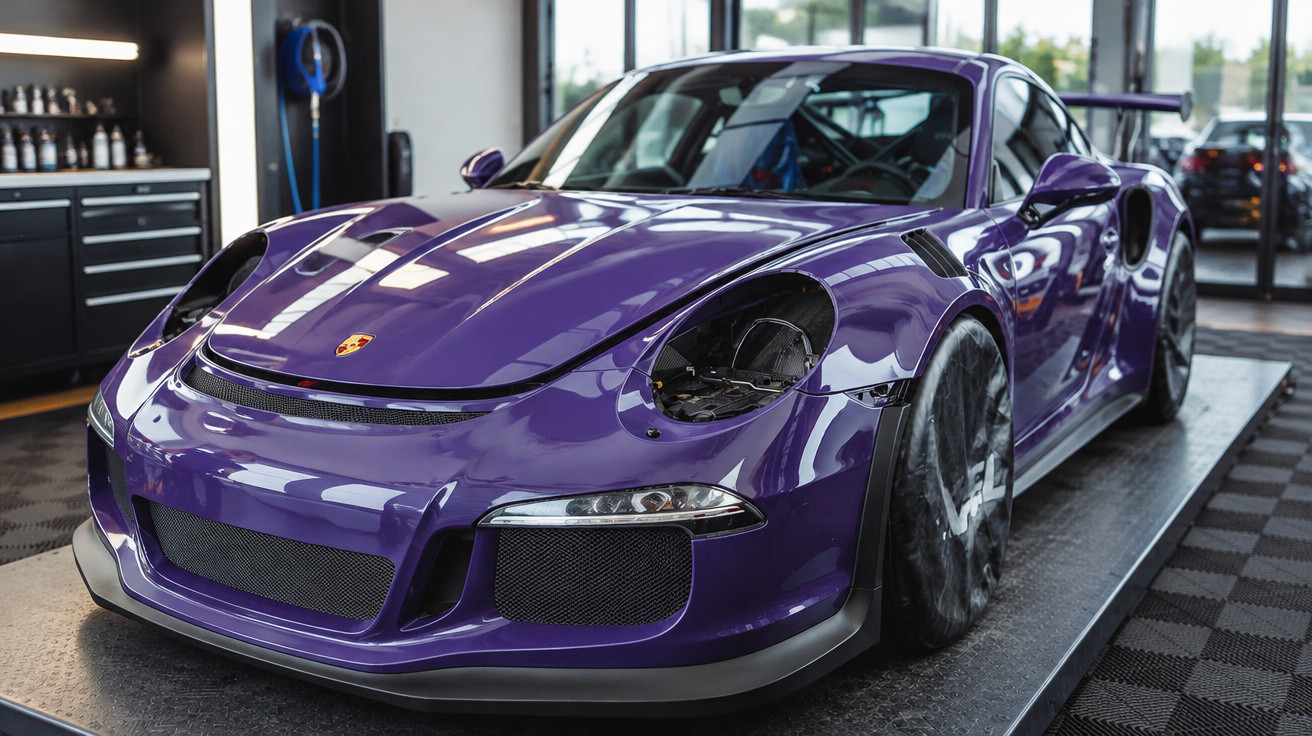
Celebrated photographer Mark has worked with TopGear for a great many years. When he is not behind the camera, he is buying unsuitable cars. Here, he reveals his obsession to the world.
Looking after the Porsche 991 GT3 RS
In an exceptionally unusual development, I have done something rather sensible this month: decided to take care of a car I already possess. A few years back, I bought a 991 GT3 RS. In just three months, I proudly doubled its mileage, using it for absolutely every trip, from the school run to taking the dog to the vet – although that does mean removing the fire extinguisher first.
On one occasion, my daughter left her coat in the footwell after we had been to the park. That was not a problem on its own, but the numerous snails she had collected and put into its pockets certainly were. I discovered this only the next day, when several trails appeared across the dashboard – a scenario Porsche’s R&D department had clearly not anticipated.
I never did locate those snails, but the episode was the wake-up call I needed to start treating the RS rather better. By then, several wheels had acquired chips, the paintwork required correction, and the interior – snail habitat aside – was becoming heavily scuffed. Before I inflicted any more harm, I investigated PPF (paint protective film) to establish whether it would justify its cost over time. I had never fitted PPF to any of my cars, and my only previous exposure to it involved truly dreadful installations that looked more like cling film than protection.
Why I chose XPEL PPF
After doing some research, I chose a company called XPEL for several important reasons. For a start, it has existed for a very long time – since 1997, in fact – and has consequently developed a strong range of products for different budgets and protection requirements. What impressed me most about XPEL, though, was its extensive archive of vehicle makes and models.
Instead of laying an enormous piece of film over a car and simply hoping it works out, XPEL holds templates in its database for specific vehicles. This enables individual panels to be cut and wrapped with very little waste. Reducing the quantity of film required saves money, while the finished result is much neater: every panel’s protective film is accurately cut to its shape, making it remarkably hard to tell that PPF has been applied at all.
XPEL Ultimate Plus protection
For my GT3, I selected XPEL’s Ultimate Plus range, which offers more than protection from paint damage. As well as shielding against UV exposure, the film protects the car from contaminants such as bird muck, which can burn into paintwork and cause lasting damage if it is not removed. Apparently, it can also ‘heal’ itself; sunlight activates this process through its heat, so each time the film warms up it actively reduces swirl marks and minor scratches.
PPF is much like buying a good set of tyres for a car. It is not necessarily the most thrilling way to spend money, and you do not notice it straight away. Yet it is also one of those purchases that should – touch wood – save more in the long run than it costs initially. I know I cannot be relied upon to look after any car I own properly, so having XPEL take care of much of that work provides some reassurance.



Comments
No comments yet. Be the first to comment!
Leave a Comment