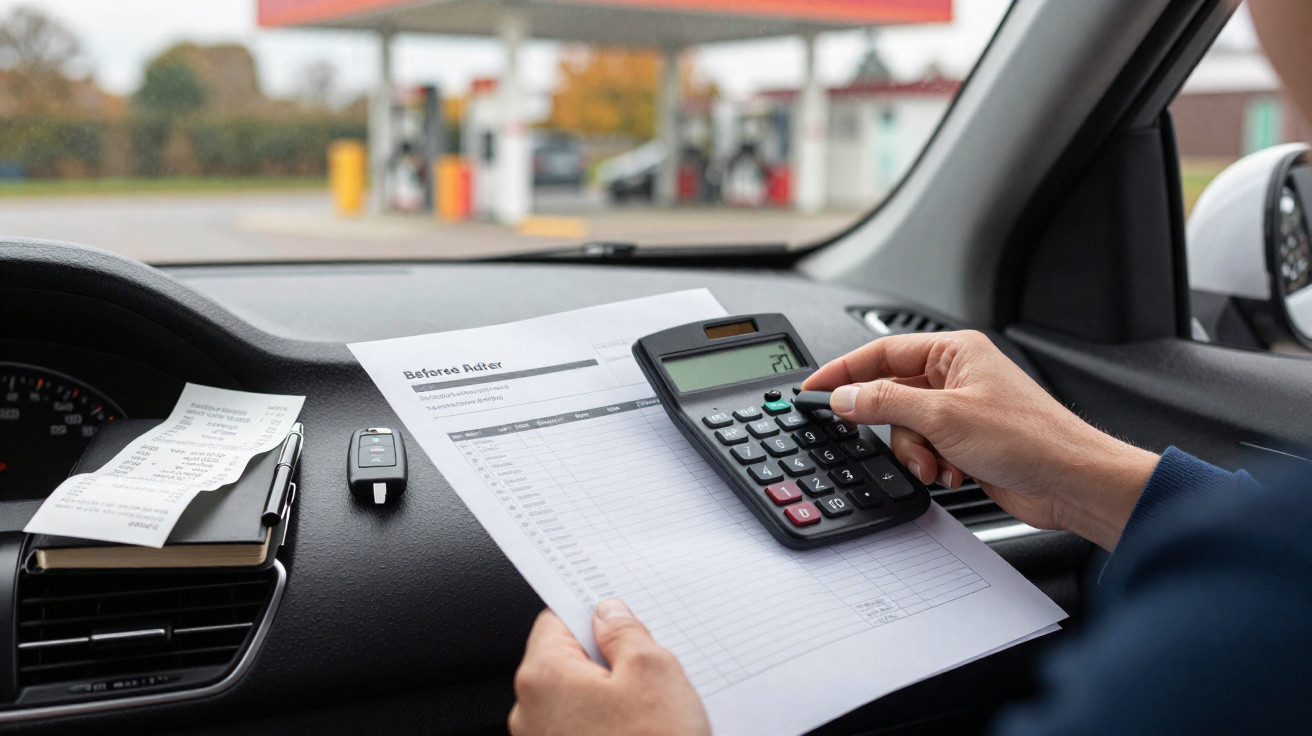
Company-car mileage claims are easy to get wrong when a rate changes or an old expenses form remains in circulation. The important point is simple: 27p per mile is not a charge for every petrol driver, nor is it a general allowance for using your own car for work.
It is a fuel-only advisory rate that has appeared in an HM Revenue & Customs (HMRC) table for particular larger-engined petrol company cars. The practical trick is to check the vehicle’s exact engine capacity, the date of the journey and the HMRC table your employer is using before you submit a claim.
What the 27p rate means
HMRC publishes advisory fuel rates for company cars. Employers can use these figures when they:
- reimburse fuel used for qualifying business journeys in a company car; or
- work out what an employee should repay for private fuel provided by the employer.
These are not all-in motoring rates. They are intended to reflect fuel costs only, not insurance, servicing, tyres, depreciation, Vehicle Excise Duty, parking or the cost of buying the car.
An advisory fuel rate is a company-car fuel figure, not a universal mileage allowance for anyone who drives to work.
That distinction matters if you use your own vehicle. Employees driving a privately owned car for business normally need to follow their employer’s mileage policy, which may use a different HMRC arrangement and different rates.
Why you must check the date
The 27p figure is not a permanent rate. HMRC reviews advisory fuel rates periodically, and the applicable figures can change as fuel and electricity costs move.
The petrol table often referred to in connection with the 27p figure grouped vehicles as follows:
| Petrol engine size | Advisory fuel rate in that table |
|---|---|
| 1,400cc or below | 14p per mile |
| 1,401cc to 2,000cc | 17p per mile |
| Over 2,000cc | 27p per mile |
That table should not be treated as a current rate card in October 2026. Before making a claim, look at the latest advisory fuel rates on GOV.UK and check your employer’s expenses guidance. A company may also specify the date from which it will use a newly published rate.
HMRC has previously allowed employers a short period to continue using previous advisory rates after new ones are published, but that does not mean a driver should choose whichever rate gives the larger claim. Follow the employer’s stated process.
Check the engine band, not the badge
The 27p band in the table above applied only to petrol cars with an engine capacity over 2,000cc. A car described in marketing as a “2.0” is not automatically in that band.
For example, an engine that is 1,998cc falls within the up-to-2,000cc band in that historic table. An engine of 2,001cc falls into the over-2,000cc band. The difference can be easy to miss when the badge and model name give only a rounded description.
You can usually find the exact cylinder capacity in:
- the V5C registration certificate;
- fleet documentation;
- the vehicle handbook or manufacturer’s technical specification; or
- your company’s vehicle portal.
Do not guess from the size of the car. A large SUV may have a smaller petrol engine, while a saloon with an older or performance-focused engine may have a capacity above 2,000cc.
How to prepare a correct claim
1. Confirm that the vehicle is a company car
Advisory fuel rates are designed for company cars. If the vehicle is privately owned, leased personally or borrowed, ask payroll or the fleet team which policy applies.
2. Use the rate for the journey date
Find the date on which the business journey happened, then check the applicable HMRC rate and your employer’s instructions for that period. Do not rely on a saved spreadsheet, a colleague’s previous claim or an old intranet page.
3. Record the business journey clearly
A useful mileage record normally includes:
- date of travel;
- start and finish points;
- business purpose;
- business miles travelled;
- vehicle registration or fleet reference; and
- rate used.
Keep the description specific enough to explain the journey. “Meeting” is less useful than “Visit to customer in Leeds” or “Travel between Bristol and Cardiff offices”.
4. Check the total before sending it
Make sure return trips are included where appropriate, but do not enter them twice. Check that private diversions have not been included as business mileage and that the mileage total is plausible for the route.
Business mileage and private fuel are not the same
The same advisory rate can be used for two different calculations. An employer may use it to reimburse fuel for qualifying business mileage, or to calculate a repayment for private fuel where the employer has paid for fuel.
Ordinary commuting between home and a permanent workplace is generally treated differently from business travel. Client visits, travel between workplaces and journeys to temporary workplaces may be treated differently again, depending on the facts.
A journey can feel work-related without being business mileage for tax purposes. When in doubt, check before claiming rather than trying to correct it later.
If private fuel is provided with a company car, the records matter particularly. The tax treatment can depend on the wider fuel arrangement and whether the employee makes the required repayment. Payroll or a fleet manager can explain the company’s process; a tax adviser can help where the circumstances are unusual.
Common mistakes to avoid
- Using 27p as a current default rate. It may relate to an older table, so always check the current HMRC publication.
- Applying the company-car rate to a personal car. A privately owned vehicle follows different rules.
- Choosing a band from the model badge. Check the precise cc figure, especially around 2,000cc.
- Using today’s rate for an older journey. The relevant rate is tied to the date of travel and employer policy.
- Claiming commuting as business mileage. Regular home-to-permanent-workplace travel is not normally handled in the same way.
- Claiming fuel receipts and mileage without checking the policy. Fuel cards, receipts and mileage claims can require separate reconciliation.
- Adding non-fuel costs to the advisory rate. Parking, tolls, hotels and rail tickets may be dealt with separately under the company expenses policy.
Keep records accurate and secure
Do not update a mileage log while driving, at traffic lights or when temporarily stopped in traffic. Add the details once you are parked safely. If the car has an automatic journey tracker, check its entries regularly: it may not know whether a journey was business or private.
Store receipts and claims securely. A photograph of a fuel-card receipt can expose card details, vehicle information or personal data, so use the approved expenses system where one is available.
If you spot an error, tell payroll or the fleet team promptly. Correcting a mistaken rate or mileage entry before payment is usually simpler than dealing with an adjustment later.
A quick check before your next journey claim
Take two minutes to confirm three things: that it is a company car, its exact engine capacity and the rate that applied on the journey date. Then compare that result with your employer’s current expenses policy.
For a petrol company car over 2,000cc, 27p per mile may be relevant only where the applicable HMRC table and your employer’s process say so. The safer rule for every driver is to use the right table, the right date and a mileage record that explains the journey clearly.













Comments
No comments yet. Be the first to comment!
Leave a Comment