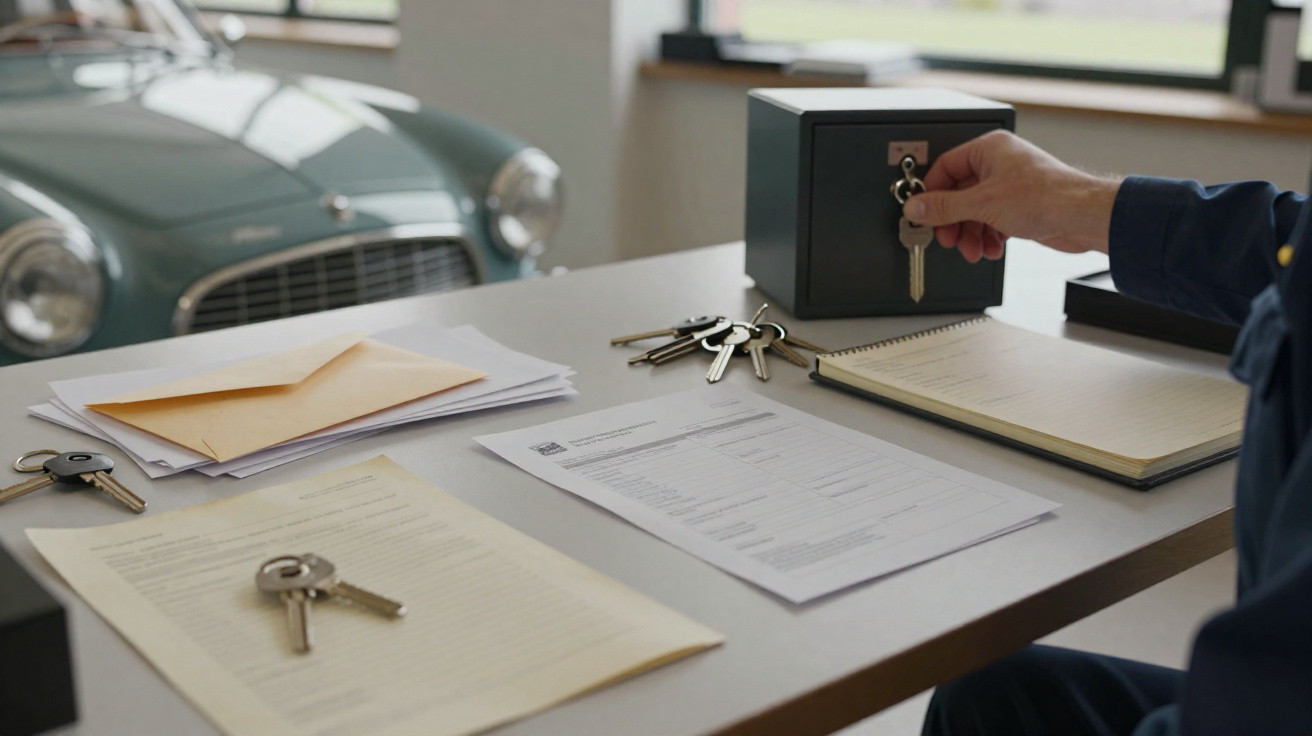
A formal request to identify a driver can be easy to mishandle when several staff members, customers and contractors have access to vehicle keys. That is the central lesson from the case involving Richard Hammond’s restoration company, The Smallest Cog Limited, which was fined after admitting it had not supplied requested driver information.
The important distinction is that the company was fined over the response to a driver-information request. The outcome does not, by itself, establish who was driving the vehicle concerned or prove the original alleged motoring offence. For garages, small fleets and businesses with company cars, that distinction is more than legal detail: it is a reason to keep reliable key and vehicle-movement records.
What The Smallest Cog admitted
The Smallest Cog Limited appeared before magistrates in Worcester in connection with a request for information intended to establish the identity of a driver of a Ford vehicle.
The company pleaded guilty to failing to provide the requested information. Magistrates imposed a fine and a victim surcharge. The available court information does not specify the amount of the fine, so it would be wrong to attach a figure to the case.
This was not a finding that Richard Hammond was driving, nor does it identify a particular employee as the driver. It was a case concerning the company’s obligation to respond to a request for information.
A business does not need a large fleet to need a clear answer to one basic question: who had the keys, and when?
What the ruling does - and does not - establish
Cases of this sort can look more dramatic than they are, particularly where a well-known name is involved. There may be two separate issues.
The first is the alleged road traffic incident involving the vehicle. The second is whether the registered keeper, or another person asked for information, responded properly to a lawful request to identify the driver.
The Smallest Cog’s guilty plea concerned the second issue. It should not be described as a conviction for the unspecified alleged offence involving the Ford.
It is also worth remembering that a limited company is legally separate from its directors. A penalty imposed on a company does not automatically mean that a director has been personally convicted, fined or given penalty points.
The case is therefore best understood as an administrative failure with potentially serious consequences, rather than a judgement on the firm’s workshop work, restoration standards or customer service.
Why businesses may be asked to identify a driver
Under section 172 of the Road Traffic Act 1988, police can require information about the identity of a driver in connection with an alleged road traffic offence. A request is commonly sent to the registered keeper of the vehicle.
Where a car or van is registered to a limited company, the company may be required to give the information it holds. The practical challenge is often not bad faith but poor records. In a busy workshop, a vehicle might be moved by several people for entirely ordinary reasons, including:
- collecting or delivering a vehicle;
- taking a car for a road test after repairs;
- attending an MOT, tyre fitting or specialist appointment;
- moving a vehicle between premises or storage;
- refuelling, valeting or photographing it;
- collecting parts or carrying out a diagnostic drive.
A restoration business may also have customer cars, trade vehicles and staff cars on site at the same time. Weeks later, memory alone is rarely a dependable way to work out who used a particular vehicle on a particular day.
A company should read any notice carefully and act promptly. The deadline and the information required will be set out in the request. If there is genuine uncertainty, it is sensible to gather records straight away and obtain appropriate legal advice rather than ignore the notice or make an unsupported guess.
A practical vehicle-record system for workshops
A small garage does not need expensive fleet-management software to make this easier. A consistent paper log, secure spreadsheet or workshop system can be enough, provided staff actually use it.
1. Record every handover
When keys change hands, note the registration, date, time, mileage and the name of the person taking responsibility for the vehicle. Record the purpose as well, such as “road test following brake repair” or “collection from paint supplier”.
For cars that do not yet have a valid registration, use the vehicle identification number or a job number alongside a clear description.
2. Link movements to job paperwork
A job card should show why a vehicle was driven and whether the owner authorised the work. If a car is taken to an MOT station, tyre centre or specialist, retain the appointment confirmation, invoice or collection note with the job file.
3. Give official post a named owner
Notices can arrive at a registered office, an accountant’s address, a director’s home address or the workshop. Nominate a person to open, scan and pass on official correspondence without delay, including correspondence received through an online account.
4. Keep records secure and proportionate
Driver logs are likely to contain personal information. Limit access to staff who need it, avoid leaving records on an open reception desk and set a sensible retention period. Businesses should also ensure their handling of personal data is consistent with their wider data-protection responsibilities.
5. Check before naming anyone
Do not name the person who usually drives a vehicle simply because they were working that day. Compare key logs, job cards, mileage, diary entries and messages before responding. Accuracy matters as much as speed.
What customers should ask before leaving a car
This case is not evidence that customers of The Smallest Cog have been treated poorly. Nevertheless, it is a useful reminder that customers should understand how their vehicles may be used while they are in a garage’s care.
Before handing over the keys, it is reasonable to ask:
- Will the vehicle need to be driven on public roads?
- Is a road test necessary, and what is it intended to check?
- Who is authorised and insured to drive it?
- Could it be taken to another site, an MOT station or a specialist?
- Is the mileage and visible condition recorded on arrival?
- How will keys be stored outside working hours?
For valuable classics, performance cars or long-term restorations, ask for these points to be written on the estimate or job card. A clear written record helps both sides if there is later confusion about mileage, damage, fuel use or an unexpected journey.
A completed job card and a controlled key system protect the customer as much as they protect the workshop.
Common mistakes with company and workshop vehicles
Assuming somebody else has dealt with the notice
A notice can be passed between a director, office manager, accountant and workshop supervisor until the deadline has gone. One person should be responsible for confirming that a response has been made.
Treating short movements as informal
Moving a car across a yard is different from taking it on the public road, but both should be traceable. A quick test drive can become difficult to explain if nobody has recorded who took the vehicle out.
Looking for evidence too late
CCTV footage may be overwritten, phone messages deleted and memories blurred. Check records as soon as a query arrives rather than relying on a rushed reconstruction close to the deadline.
Guessing the driver
An inaccurate response can create further problems. If the records do not produce a confident answer, the business should not invent one.
Mixing customer records with casual group chats
Workshop messaging groups can be useful operationally, but they are a poor substitute for a controlled record. Personal details, registration numbers and driver information should not be shared more widely than necessary.
Safety still comes before convenience
Administrative controls should sit alongside safe working practices. Only authorised, competent and properly insured staff should carry out road tests, and only when the vehicle is safe and legal to use on the road.
This is especially important with restoration projects. Vehicles with incomplete braking, steering, tyres, lights, fuel systems or seat restraints should not be driven merely for convenience. If a diagnostic road test is needed, the reason, route and driver should be recorded on the job paperwork.
Customers can help by removing valuables where possible, leaving accurate contact details and telling the garage about known faults or immobiliser procedures. Garages should secure keys and confirm any planned road use before it happens.
The practical lesson from the case
The Smallest Cog case is a reminder that official motoring correspondence deserves the same attention as an insurance renewal, supplier invoice or repair authorisation. A skilled workshop can still run into difficulty if it cannot establish who was using a vehicle when a request arrives.
For garages and small businesses, the useful response is straightforward: control the keys, log vehicle movements, monitor post and online notices, and check the evidence before replying. For customers, ask when and why your car may be driven while it is in the workshop. Those routine habits can stop a manageable information request becoming a court matter.










Comments
No comments yet. Be the first to comment!
Leave a Comment