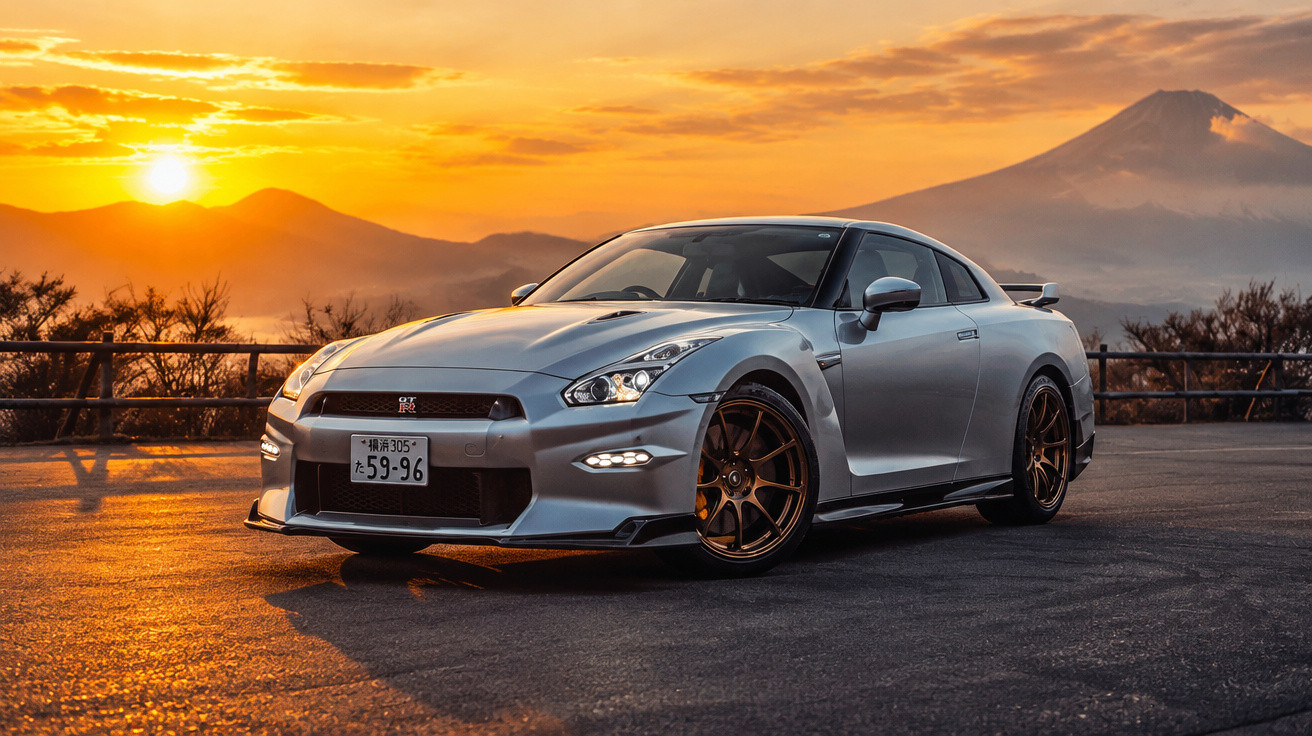
Gojira is gone. Japan’s motoring kaiju has been put to rest, sent back beneath the freezing Pacific and well clear of this increasingly noisy metaphor. Once more, the supercar establishment can breathe easily.
For almost 18 years, though, the ‘R35’ Nissan GT-R made a habit of demolishing everything in its path. In its earliest form, that included Jeremy Clarkson’s neck. “They haven’t built a new car here,” JC said, moments before Nissan’s revived Godzilla got at him. “They’ve built a new yardstick.”
We perhaps unwisely brought the R35 out of its long hibernation at Nissan’s Yokohama headquarters for one final drive. It was a farewell on home soil before a spirited run to its natural habitat, the Hakone Turnpike, accompanied throughout by two modified GT-Rs. It soon became clear that Japan is a wonderfully contradictory country: technologically advanced, yet rooted in deep history and tradition.
Photography: Toby Thyer
Nissan GT-R R35: a supercar of contradictions
Like Godzilla itself, the GT-R was an unconventional benchmark defined by contradictions. Its brick-like form concealed state-of-the-art aerodynamics. It looked like an artificial, self-driving computer on wheels, yet demanded considerable human skill to master and unlock its potential.
Most importantly, it was a four-seat Nissan costing roughly £50,000 at launch, capable of having a BMW M3 for breakfast before sizing up a Porsche 911 Turbo for lunch. Ferrari and Lamborghini were reserved for dinner. Yet Kazutoshi Mizuno, the R35’s chief engineer, never viewed matters in those terms, describing his 2007 creation as a “new kind of supercar, one with no competitors”.
Hiroshi Tamura, who planned the GT-R product during those exhilarating years, expanded on that thinking. “Some people asked me, ‘What were your competitors for the R35?’” Tamura-san told TopGear.com. “In some circumstances like a track day, it’s OK to compare to some of the other performance cars.
“But to be honest, I didn’t see any sports car as a rival, because of the ‘trend making’ standpoint of this car. We did not see any rivals because we were so focused on going our own way,” he added.
Trend making. That was the yardstick Clarkson meant. Nissan’s objective was not merely to create an unremarkable car that could out-accelerate a 911 Turbo at half the cost; it wanted to establish a 21st-century performance standard. At the time, it could scarcely have anticipated how much of that century the car would witness.
It spent that period dispatching rivals from every direction, occasionally sideways. Its first opponent happened to be the world’s fastest car: the 997 911 Turbo. “Driving these two cars back to back,” Top Gear’s Bill Thomas said in 2008, “it’s not long before you realise that the Nissan makes the Porsche seem old fashioned. The GT-R is truly extraordinary.”
“The GT-R is part car, part Terminator,” editor-at-large Jason Barlow observed when it took on the Audi R8. When Godzilla met the Evo X, TG’s Matt Master added: “To stand beside this car now is to look upon a near perfect representation of the 21st century sports car. It’s back to that schoolboy fantasy. Otherworldly, yet right here in front of me, and as spectacular and dramatic in the metal as any car I’ve ever clapped eyes on.”
Even in 2025, it remains astonishingly and unexpectedly savage-perhaps especially so in an era of effortless, unearned electric acceleration. The force released as the T-Spec’s 562bhp V6 comes alive is truly remarkable, accompanied by an exhaust note combining finely calibrated heavy industry with turbocharger hiss. Good grief, it is unnaturally fast.
Japanese pride and the GT-R legacy
Beyond its technical ability and visual appeal, the R35 carried Japan’s supercar flag. “It’s an important car because it’s the first time a Japanese car was properly tested at the Nürburgring,” Tetsuya Yamano told TopGear.com. Yamano-san won three successive Japanese Super GT300 championships between 2004 and 2006, so he understands JDM pride better than most. “It was the first time Japan really went all out to make a ‘special’ car.
“It makes Japanese people proud because we made it. Before this, we could never really battle with German and Italian supercars, but with the R35 we finally could,” he added.
The GT-R is like Gundam tech. It embodies strong power, controlled by technology. You are the commander. The car is the extension
“If I had one last lap in it? Fuji Speedway, 300kph,” he said with a smile. Yet 300kph [186mph] merely opens another part of the R35 narrative, as it continued a proud tradition established by its kaiju forebears: being modified almost beyond recognition.
“The GT-R is arguably Japan’s flagship model,” said Iain Litchfield, founder of Litchfield Motors. “More importantly, the R35 has built a community of performance enthusiasts who have bought into and built on the GT-R’s reputation.”
The GT-R has formed the core of this tuning business for over 17 years, giving Litchfield an unusually close view of its history. “The real difference the GT-Rs have had is allowing their enthusiastic owners a blank canvas to create their dream car,” he added. Such dream cars regularly produced more than a thousand horsepower without difficulty.
Over the years, Nissan itself gave the GT-R’s foundations a substantial series of revisions. As time passed, it gradually enhanced the loud, unruly heavyweight’s technology and refinement, while also evolving its performance and purpose as rivals and customer expectations changed.
When it faced the Honda NSX in 2018-a fiendishly complicated hybrid supercar that made the R35 look still more like its prehistoric cinema namesake-TG’s Tom Ford observed that “it might basically be the same car as the giant killer that arrived in 2007, but it just goes to show that the basic recipe was very, very right”.
Mizuno-san and Tamura-san devised that recipe with owners and enthusiasts central to the project. Put aside the legend, technology, warp-speed pace, competition, stiff necks and bruised supercar egos: you were the most significant element in the GT-R’s story.
“I realised the most important thing is that the car is for a customer,” Mizuno-san told TG in 2012. “The GT-R is a Japanese supercar. What is Japan? It is takumi [artisanship]. This is Japanese spirit. It is a special skill that adds something special in the customer mind and passes it on to the next generation.
“So the GT-R is takumi. I do this for the customer, not for myself or company pride,” he added. In the present day, Tamura-san expressed the same philosophy. “The question was how do we make performance car fans happy, and the answer was the R35,” he told TG. “I wanted to create happiness.
“The GT-R is like Gundam tech. It embodies strong power, controlled by technology. You are the commander. The car is the extension. Its shape is not Italian exotic. It’s not American muscle, or German tech, but it’s the spirit of our super sports car scene.
The most important thing is how the customer, how the audience feels
“It’s like the heartbeat of Japan,” he added.
What comes next for the Nissan GT-R?
Only Nissan knows what the next GT-R’s recipe might contain-assuming another one is made at all. At the time of writing, the firm is embarking on another turnaround plan, cutting jobs, closing factories and abandoning all new-car development beyond 2026.
The 2023 Hyper Force concept suggested a steroidal, 1,341bhp, all-wheel-drive electric Godzilla. However, that idea also appears to have returned to its icy slumber as Nissan fights for survival. Tamura-san believes that, if a new Godzilla does eventually emerge from the Pacific, we should focus less on what powers it and more on what it represents-just as we did with this R35.
“We need to show the next trend,” he said. “This is a very important role for the GT-R. In my opinion the most important thing is how the customer, how the audience feels.”


Comments
No comments yet. Be the first to comment!
Leave a Comment