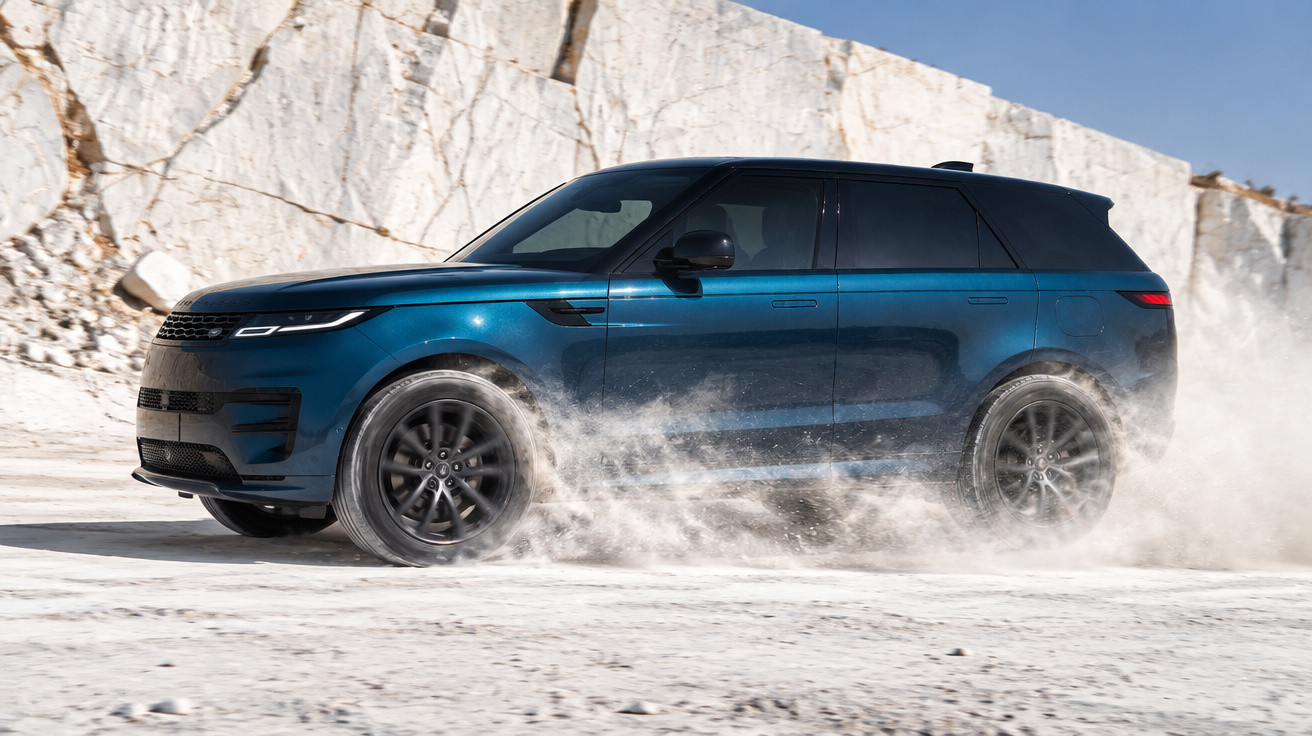
The Range Rover Sport Electric faces a more demanding brief than the Range Rover Electric. The Range Rover’s role is immediately obvious: it is tall, stately and commanding, occupying a class of its own among EVs. The less expensive Sport – £110k is less expensive, not inexpensive – must instead take on a crowded field of competitors.
Range Rover Sport Electric powertrain and range
The two battery-electric 4x4s have distinctly different driving characters, for technical reasons explained below. First, however, they use the same drivetrain: total output is 550bhp, delivered by one motor at each axle. Each has a 118.5kWh (net) battery and the same 800-volt electrical architecture, allowing that substantial battery to charge from 10-80 percent in only 22 minutes at a maximum 350kW.
With a WLTP range of 374 miles, the Sport manages two whole extra miles compared with its larger sibling.
Range Rover Sport Electric chassis technology
The distinctions between them are what create their contrasting on-road personalities, and what equip the Range Rover Sport to compete directly with the Porsche Cayenne Electric, the BMW iX5 arriving in spring 2027, the Mercedes-AMG EQE 53 SUV and – in markets where it is available – the Cadillac Lyriq V.
During the move from combustion power to electric propulsion, the taller Range Rover has dispensed with its active anti-roll system. The reasoning is straightforward: the battery pack’s mass lowers the centre of gravity, making the vehicle less prone to leaning in the first place. Removing the system cuts cost, mass and energy use. The RRS, though, keeps active anti-roll control.
As with the RR Electric, the RRS Electric uses twin-chamber air springs, enabling its electronics to vary the spring rate itself as well as the ride height. It also features adaptive dampers, rapid front-to-rear active torque distribution, four-wheel steering and brake-based lateral torque vectoring. Active anti-roll is included too.
That gives the car’s electronic systems considerable freedom to alter its driving manner according to both the conditions and the selected drive mode.
On the road – or, more accurately, on JLR’s Gaydon test track, as this remains a prototype – the RRS Electric consistently feels lower and more securely tied down than the larger Range Rover Electric. It also leans less, including in the standard drive mode.
Select dynamic mode and the change is not exaggerated or cartoonish, but it is both worthwhile and clear. It seems a mode you would want to use on an enjoyable road. Ride comfort remains entirely acceptable, while the steering gains weight and the firmer air-spring and damper settings give the car a convincing sense of alertness. Accelerating hard out of a corner, the rear tyres can be felt settling into their work and carrying the load.
Driving modes and regenerative braking
The RRS Electric’s powertrain settings and responses closely resemble those of the RR Electric, although its cooling has been revised to ensure it can cope with more prolonged brisk driving. Regeneration strength is selected on the screen rather than through paddles (boo), but the drive-selector lever does have an S setting. This stands for 'single pedal', not 'sport', yet it introduces some regeneration and uses the disc brakes to bring the car smoothly and gently to rest.
There is no need to revisit the battery, motor or high-voltage-system details here, since they are shared with the Range Rover Electric – a car covered previously.
Rivals have been mentioned, so a few comparisons are useful. These figures are probably not committed to memory.
| Model | Power | Range | Battery |
|---|---|---|---|
| Range Rover Sport Electric | 550bhp | 374 miles | 118.5kWh |
| BMW iX5 60 xDrive | 578bhp | 525 miles | 141kWh |
| Porsche Cayenne S Electric | 666bhp | 405 miles | 108kWh |
| Cadillac Lyriq-V | 646bhp | 294 miles | 102kWh |
| Mercedes-AMG EQE SUV 53 4Matic+ | 625bhp | 279 miles | 90kWh |

Comments
No comments yet. Be the first to comment!
Leave a Comment