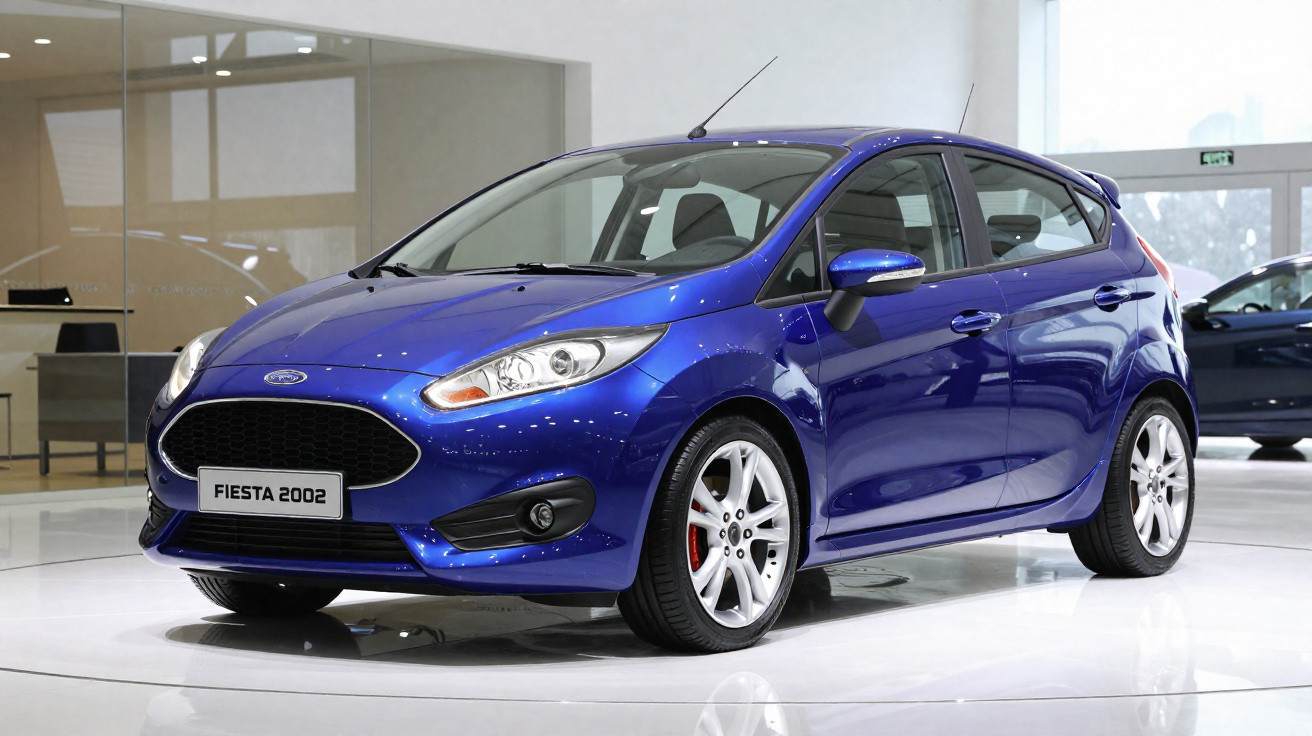
Ford Fiesta range and interior
Ford’s new Fiesta will arrive in April 2002 exclusively as a five-door, at least initially. Considerably longer, wider and taller than the model it replaces, the new car makes the most of its cabin room, one of its principal selling attractions. LX, Zetec and Ghia will remain the familiar trim choices, while pricing is expected to stay broadly in line with the outgoing range.
The engine line-up opens with a 1.3-litre, eight-valve 67bhp petrol unit, followed by the 1.4-litre, 16-valve 79bhp petrol engine, which is likely to be the volume seller, and finishes with the 1.6-litre, 16-valve 99bhp petrol version. No European range is truly complete without a diesel, however, so this new-generation Fiesta receives a new-generation TDCi derv-drinker. Its 1.4-litre capacity, eight valves and 67bhp output are modest, but the common-rail turbocharged engine produces a creditable 118lb ft of torque.
Inside, the Fiesta has a faint Mondeo-like feel, particularly in its door-handle design and plastic finishes. Its instrument binnacle is entirely new, though, and impressively uncluttered. There are only two main dials, covering road and engine speed; a square liquid-crystal display for the fuel and temperature read-outs; and a rectangular LCD showing the digital clock, trip and odometer, with warning lamps and indicator flashers filling the dark areas between them.
The seats offer decent comfort, and finding a suitable driving position is both simple and fast. A height-adjustable driver’s seat, the steering column’s up-and-down adjustment and a carefully located gear lever, mounted higher than in the previous Fiesta, all help.
Ford’s new baby has taken a long time to arrive. As with many overdue babies, it has put on some weight: the 1.6 Ghia five-door is roughly 50 kilos heavier, and every version is 87mm longer, 50mm wider and about 100mm taller.
Ford Fiesta chassis, engines and brakes
It is remarkable that such a small car, with a comparatively short wheelbase, can deliver such a comfortable ride. The Fiesta chassis is exceptionally well damped, composed and thoroughly resolved, setting a standard that rivals should find difficult to match. In fact, that is about the only difficult thing concerning it.
Reaching this standard cannot have been straightforward. The result is a chassis that will rescue you after an error, such as misjudging an unfamiliar corner and needing to brake halfway through it, yet still lets you alter your cornering line with the throttle. Any rear-end movement is mild and progressive, as is the return to balance. This chassis has no understanding of the word ‘snap’.
Unfortunately, the 1.4-litre petrol Fiesta I drove seemed similarly unfamiliar with the word ‘power’. Anyone hoping to exploit the chassis properly would be better served by an engine with more muscle. It must be driven hard to make respectable progress, and that feels like unnecessarily hard work. Keeping pace with motorway traffic also brings a persistent drone.
The TDCi is a far better proposition. While it lacks both the mid-range shove suggested by 118lb ft and any meaningful top-end urge, this diesel is more adaptable and needs fewer gearchanges than the petrol alternative. It was developed jointly with French firm PSA, maker of Citroëns and Peugeots and therefore recognised as an expert in the dark art of diesel engines. Built largely from aluminium, it is light for a diesel, so the Fiesta does not feel nose-heavy. It is also quiet in everyday use.
The brakes are worthy of praise as well. With discs at the front, drums at the rear and ABS with EBD electronic brake distribution fitted as standard, they have a reassuring feel and perform equally well.
Safety and driving compromises
One further strength of the new Fiesta is equipment that everyone hopes never to require: intelligent dual-stage airbags, with two at the front and one on each side, an optional inflatable side curtain, plus computer-aided-designed crumple zones and crash protection. Still, it is reassuring that they are present.
Its steering, however, offered little feedback. The 1.4-litre engine, despite apparently having induction tuned to give it a rorty note, made very little sound of consequence, and in the left-hand-drive car through left-hand bends I was shifting from side to side because the left A-pillar obstructed my view.
The extra mass and taller centre of gravity, entirely understandable and inevitable in view of modern safety and accommodation requirements, mean that it no longer feels remotely like the previous Fiesta, which I considered genuinely magical to drive. I now miss that rawness. Such is progress.
Colin Ryan



Comments
No comments yet. Be the first to comment!
Leave a Comment