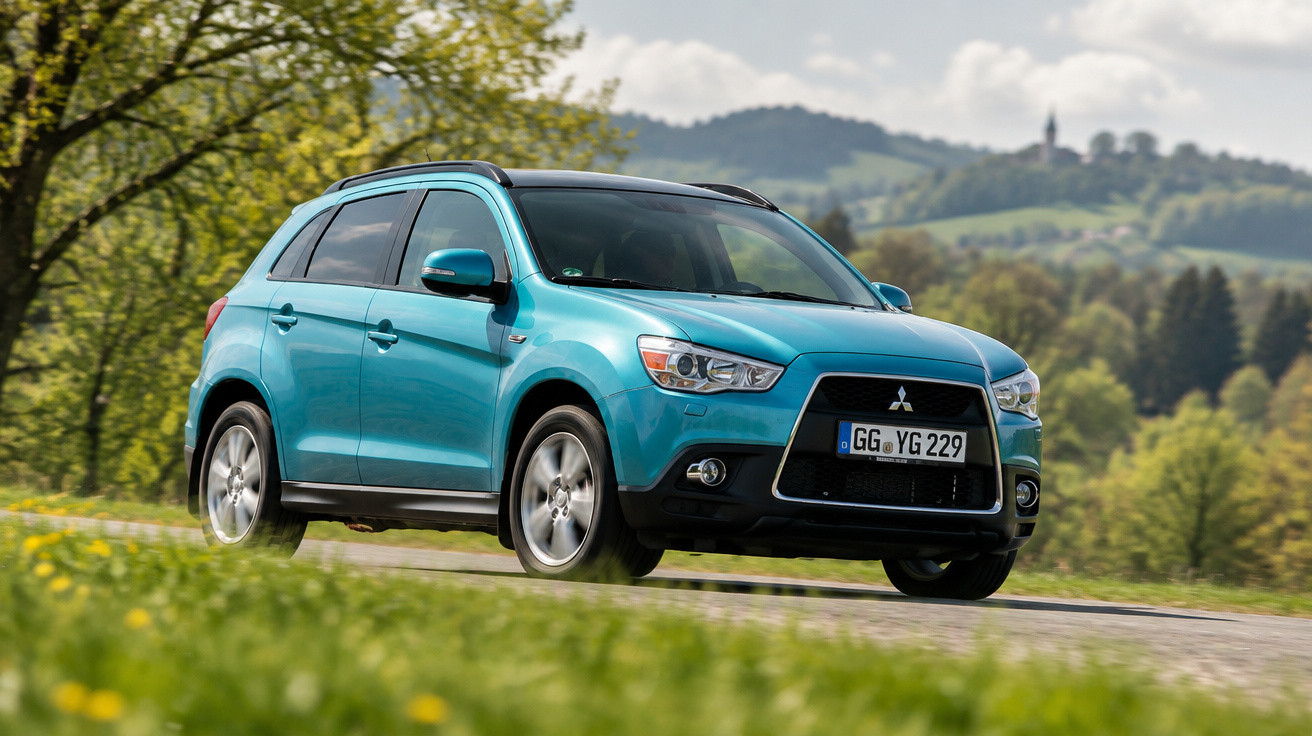
Mitsubishi ASX: a Qashqai rival
The Mitsubishi ASX is not simply a car; in the firm’s marketing language, it is an ‘Active Sports X-over’. Created to challenge the Qashqai in the rapidly expanding crossover sector, it is broadly comparable in size and is set to cost fractionally less than the Nissan. As with the Qashqai, four-wheel drive is available, although – again like the Qashqai – around 80 per cent of customers are expected to choose the front-wheel-drive version instead.
While their exterior dimensions appear closely matched, the ASX has the advantage over the Nissan for interior space. Mitsubishi has used precisely the same wheelbase as the bigger Outlander, before trimming length from the front and rear. The result is a roomy passenger compartment and 32 litres more boot space than the Qashqai. Although it is narrower and only slightly lighter than its Nissan rival, the ASX also feels less top-heavy and ungainly. That difference is particularly apparent over speed bumps, where it feels low-slung and car-like rather than tall and SUV-like.
These are encouraging early signs, particularly given Mitsubishi’s reputation for producing large, tough vehicles. The L200 pick-up accounts for one-third of its sales, while Shoguns and Outlanders make up a sizeable proportion of the remainder. Yet, alongside the all-electric iMiev and the playful little Colt, Mitsubishi’s future models appear to be moving towards urban chic rather than mud’n’peat.
Mitsubishi ASX engines and emissions
Returning to the ASX, there will be two engine choices: a 1.6-litre petrol producing 115bhp, plus the 1.8-litre DiD tested here, which develops 147bhp. This diesel is the first to feature variable valve timing. As a result, it uses a lower compression ratio, placing less strain on the engine and allowing it to idle at only 600rpm.
That arrangement delivers a useful compromise between output and economy. The diesel produces 145g/km CO2, placing it around the middle of the class emissions table. The comparable Qashqai improves on that figure with 129g/km, but the ASX offers a third more power, which feels like a fair trade-off for its higher emissions. Its performance is brisk, further enhancing what is generally an enjoyable drive.
Styling and cabin practicality
Opinions on the appearance will naturally differ, but its ‘jet-fighter’ front end, borrowed from the Evo, together with its crisp, assertive lines, makes it an attractive design. It looks considerably sharper than the rather shapeless Qashqai. Nissan has recently neatened its crossover with a facelift, yet the ASX still has the more stylish edge in our view.
It may follow the Qashqai formula, but it is a strong interpretation of it. The ASX does nothing especially revolutionary, although it handles most tasks well. We would prefer a more inviting interior: Mitsubishi says the plastics are soft-touch, but they felt about as yielding as Formica to us. Still, the effective use of space and distinctive design are impressive, and provide sufficient reason to select it over a Qashqai. Has Mitsubishi achieved its aim? We reckon so.


Comments
No comments yet. Be the first to comment!
Leave a Comment