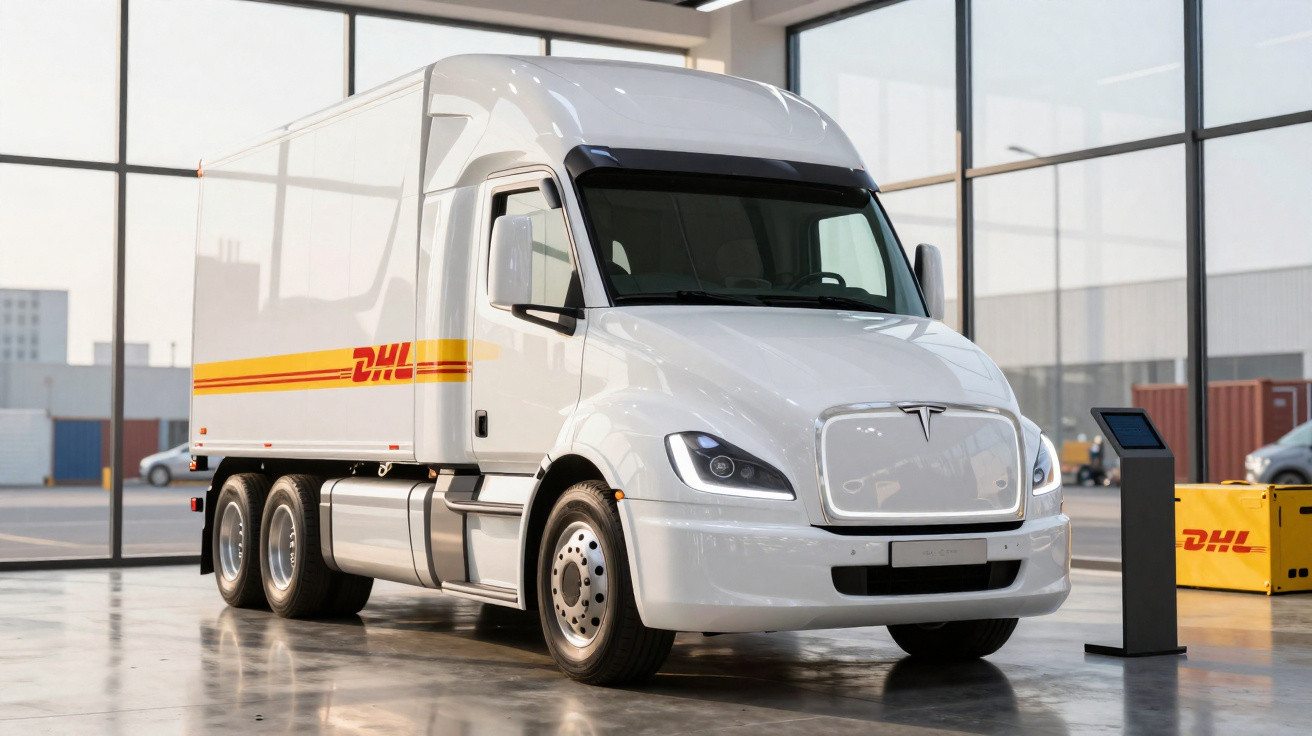
Diesel is no longer beyond challenge, and the German multinational is fully convinced of it. Tesla’s all-electric truck has just confirmed that it has more than enough to establish itself within its logistics fleets.
Just over a year ago, the Tesla Semi was already being tested by DHL, while Elon Musk confidently announced that it would become available the following year, following an exceptionally sluggish production ramp-up. Now it is 2025 and, on the rare occasion that a promise from Tesla’s CEO broadly holds true, credit where credit is due: the Semi is about to hit the road.
Admittedly, the Tesla Semi has not yet been embraced by hundreds of businesses, but DHL has now officially added its first Semi to its US logistics network. That is a very respectable start for a vehicle dismissed by many observers as operationally useless. DHL is, after all, one of the world’s leading transport and logistics companies: there are far worse places to begin a career.
Tesla Semi: a powerful yet efficient road giant
DHL did not make the move on a whim. It only signed with Tesla after completing an extensive pilot programme in Livermore, California. By its conclusion, the Semi’s efficiency had been demonstrated beyond doubt: over a journey of roughly 628 km, during which the lorry’s gross combination weight reached 34 tonnes, including both vehicle and cargo, its average energy use was just 1.07 kWh/km, or 107 kWh/100 km.
For a vehicle in this class, that figure is simply outstanding, particularly as Tesla committed in 2017 to keeping its Semi “below 2 kWh per mile” - around 1.24 kWh/km. Many experts doubted those figures, yet DHL has shown not only that they are achievable, but that the target can be beaten by a considerable margin, even with a trailer loaded to the roof.
Jim Monkmeyer, president of DHL Supply Chain North America, enthusiastically stated: “Our trial phase exceeded our expectations. The Tesla Semi proved its ability to carry our goods over long distances on a single charge. This is a vital step towards our decarbonisation targets.” In his view, its claimed range of up to 800 kilometres “creates opportunities that had until now been beyond reach for electric heavy goods vehicles”.
Lower energy and maintenance costs for DHL
The single truck now operating in DHL’s fleet covers an average of 160 km each day and only needs to visit a charging point once a week. This offers a highly effective way to cut running costs: with consumption this low, average energy costs fall to between 12 and 15 euro cents per kilometre.
Against an equivalent diesel model, which costs between 34 and 47 cents, the gap is vast. The Semi can therefore cut energy bills by as much as 75%. That calculation does not even include maintenance savings, a major expense for diesel fleets, as an electric motor requires far fewer trips to the workshop.
Although it costs more to buy - the Semi is priced at more than $200,000 in the US, compared with an average of $120,000 for a basic diesel lorry - the price difference is erased after a few years for a truck used every day.
A major endorsement for Tesla
For Tesla, this latest partnership is naturally hugely valuable. DHL is among the sector’s largest prospective customers and could encourage other international hauliers to follow suit. Walmart, Costco and Sysco are also among the major customers that have already ordered the truck. Programme director Dan Priestley says the company has “logistics expertise [that] will help improve the Semi for its future markets”.
DHL plans to add further Tesla Semi trucks
DHL began gradually moving away from diesel several years ago and already runs more than 150 electric heavy goods vehicles in North America. It intends to expand that fleet by adding further Tesla Semi trucks from next year, once the manufacturer finally begins mass production.
This is excellent news for the American manufacturer, following the many setbacks this year that have badly damaged its reputation - arguably with good reason, although that is not the point here. Nearly eight years after it was announced, the Semi will finally travel America’s wide roads, while major businesses look on enviously. Much like the misunderstood child everyone mocked in the playground, only to return years later to claim a well-deserved revenge.















Comments
No comments yet. Be the first to comment!
Leave a Comment