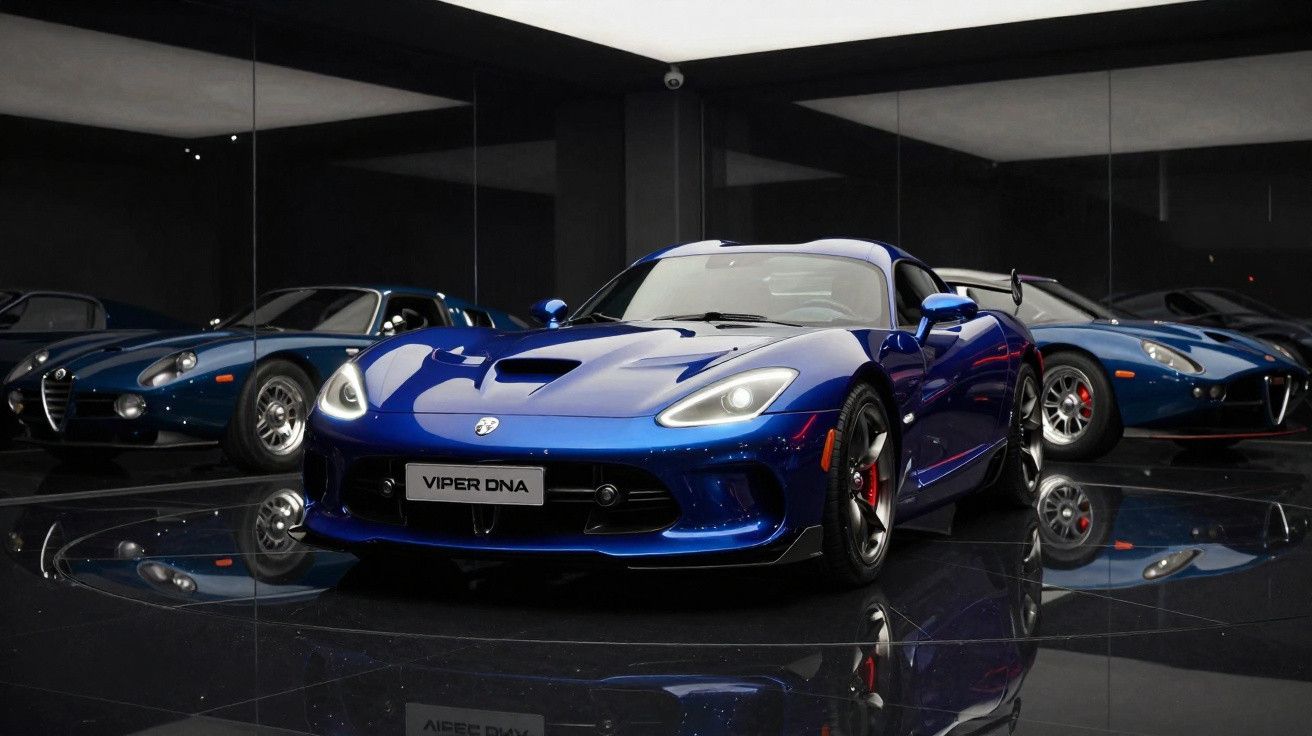
The Dodge Viper, the spiritual successor to the Shelby Cobra, remains every bit as captivating and intimidating as it was when it was unveiled to the world in 1989 as a concept. It was not long before it entered production in 1991, arriving as a ‘brutalist’, minimalist roadster - it did not even have exterior door handles.
Its curvaceous, muscular styling was striking enough, but its engine was even more remarkable: a huge naturally aspirated 8,000 cm³ V10. Derived from a V8 unit and developed with Lamborghini’s assistance, it initially produced 400 hp (406 PS), making this American car the most powerful on the market at the time.
Raw, rugged, thrilling and intimidating are words that followed the Dodge Viper throughout its five generations. Its career ended in 2017, by which point the V10 had grown to 8.4 litres and output stood at 645 hp (654 PS). It had become more refined and ‘well mannered’ - but not by much…
It was never the most sophisticated sports car, yet the Dodge Viper’s platform and engine were still regarded as ideal starting points for other machines wearing different badges. That is precisely the case with these four sports cars. Do not be fooled: even beneath their disguises, their origins remain clear.
Bristol Fighter
The historic and eccentric British marque unveiled the Fighter in 2003, with production beginning in 2004 and continuing until 2011. It was a high-performance two-seat coupé shaped by meticulous aerodynamic work, achieving a drag coefficient of just 0.28.
Of every model on this list, it is the least recognisably Viper-like, despite borrowing many of its components from the American sports car. Bristol designed the chassis itself, which accounts for a width 115 mm narrower than that of the Viper. Its gullwing doors were another notable feature.
The Dodge Viper’s 8.0-litre V10 was not left untouched either, as Bristol extracted 532 hp from the big American unit. With the introduction of the Fighter S, that figure rose to 637 hp - climbing to 670 hp at very high speeds through the ‘ram-air’ effect. Paired with a six-speed manual gearbox, first gear alone was enough to send the 1,600 kg Fighter to 60 mph (96 km/h) in 4.0 seconds. Its claimed top speed was 340 km/h.
In 2006, Bristol announced the ultimate Fighter T, featuring a turbocharged V10 with more than 1,000 hp and the ability to reach 362 km/h, electronically limited. There is no record of any Fighter T examples actually being built.
As with other Bristols, the exact production total is unknown, although no more than 13 Fighters are thought to have been made.
Devon GTX
The Devon GTX was unveiled at the 2009 Pebble Beach Concours d’Elegance as a prototype previewing a new American sports car. Beneath its carefully crafted and widely praised styling sat a second-generation Dodge Viper.
Several circumstances ensured that it never reached production. These included the international financial crisis that had struck the previous year, as well as Chrysler - Dodge’s owner - declining to supply chassis for Devon GTX production.
Before Devon closed its doors, two examples of this carbon-fibre-bodied sports car were completed, one of which was auctioned in 2012.
Alfa Romeo Zagato TZ3 Stradale
Perhaps the most unusual ‘creation’ in this group, the TZ3 Stradale was an Alfa Romeo with the voice of a muscle car. It was not an official Alfa Romeo product, but a Zagato creation. Although the celebrated Italian design house has recently been associated more readily with Aston Martin than Alfa Romeo, its connection with Arese is deep and historic.
The TZ3 Stradale appeared in 2011, one year after the TZ3 Corsa, a one-off racing model derived from the 8C. It not only paid tribute to the Alfa Romeo TZ (Tubolare Zagato) cars of the 1960s, but also marked the Italian marque’s 100th anniversary, spanning 1910–2010.
Interest was considerable, prompting Zagato to revisit the theme with the TZ3 Stradale. Under its evocative yet divisive bodywork was not an 8C, but a far more unexpected foundation: the Dodge Viper - specifically, the track-focused Viper ACR-X, modified for road use. In the TZ3 Stradale, the 8.4-litre V10 delivered 600 hp to the rear wheels through a Tremec six-speed manual gearbox.
The cabin was identical to that of the Viper in every respect apart from its trim materials and the marque’s badges. Zagato built only nine examples of this intriguing machine.
VLF Force 1
The newest and final sports car created from the Dodge Viper was the VLF Force 1, unveiled in 2016.
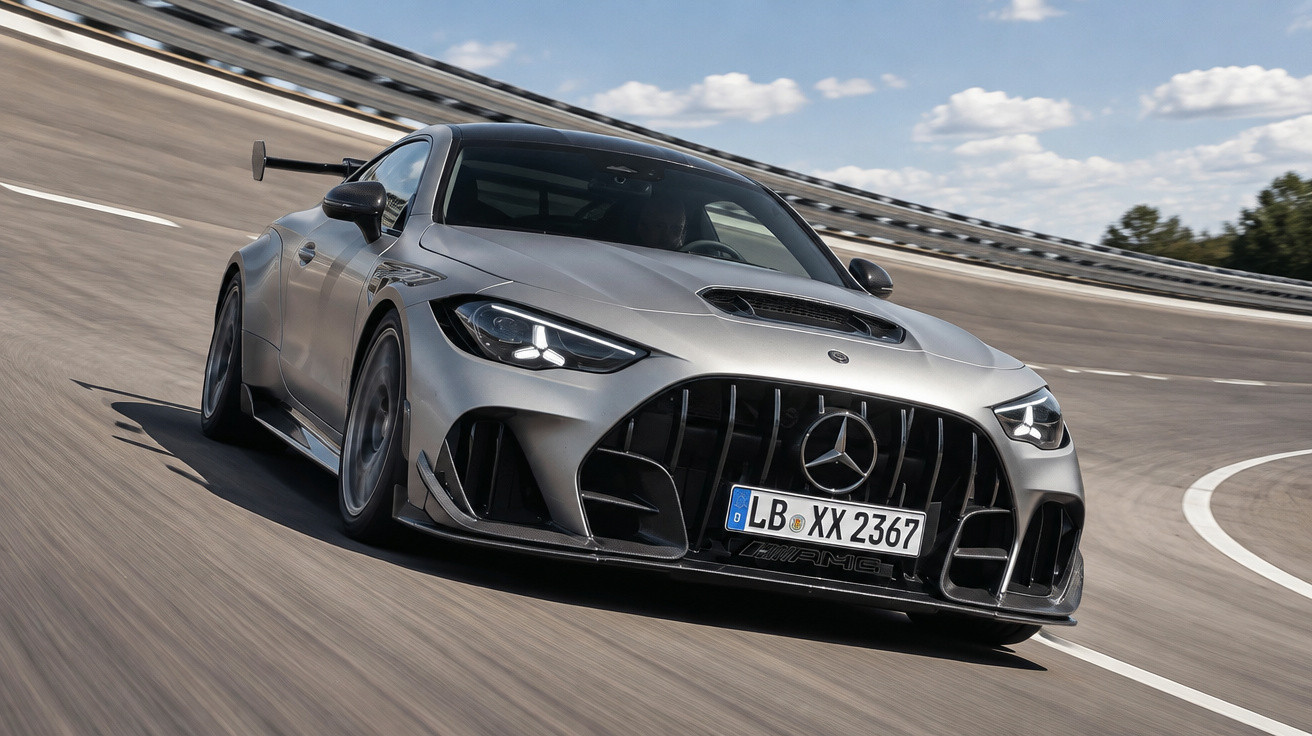
It was designed by Henry Fisker - responsible for cars such as the BMW Z8, Aston Martin DB9, Fisker Karma and this intriguing Mercedes - and the ‘F’ in VLF represents his surname. The remaining letters are the initials of the company’s co-founders: ‘V’ for manufacturer Gilbert Villarreal and ‘L’ for Bob Lutz, an automotive industry executive of near-legendary status who was never one to mince his words.
Based on the final Dodge Viper, the VLF Force 1 lifted the Viper V10’s almost 650 hp to a more impressive 755 hp, without forced induction. The extra power enabled it to reach 100 km/h in just 3.0 seconds and raised its top speed to 351 km/h.
Alongside its dramatically different, aggressive carbon-fibre bodywork, the interior was trimmed in leather, Alcantara and suede. It also gained additional technology, including navigation, connectivity and a Wi-Fi hotspot, plus distinctive details such as a gear lever ‘sculpted’ from a solid block of aluminium. It could even be specified with a compartment for a bottle of champagne and two glasses.
Originally intended to be built in a run of 50 units, only five appear to have been produced.

Comments
No comments yet. Be the first to comment!
Leave a Comment