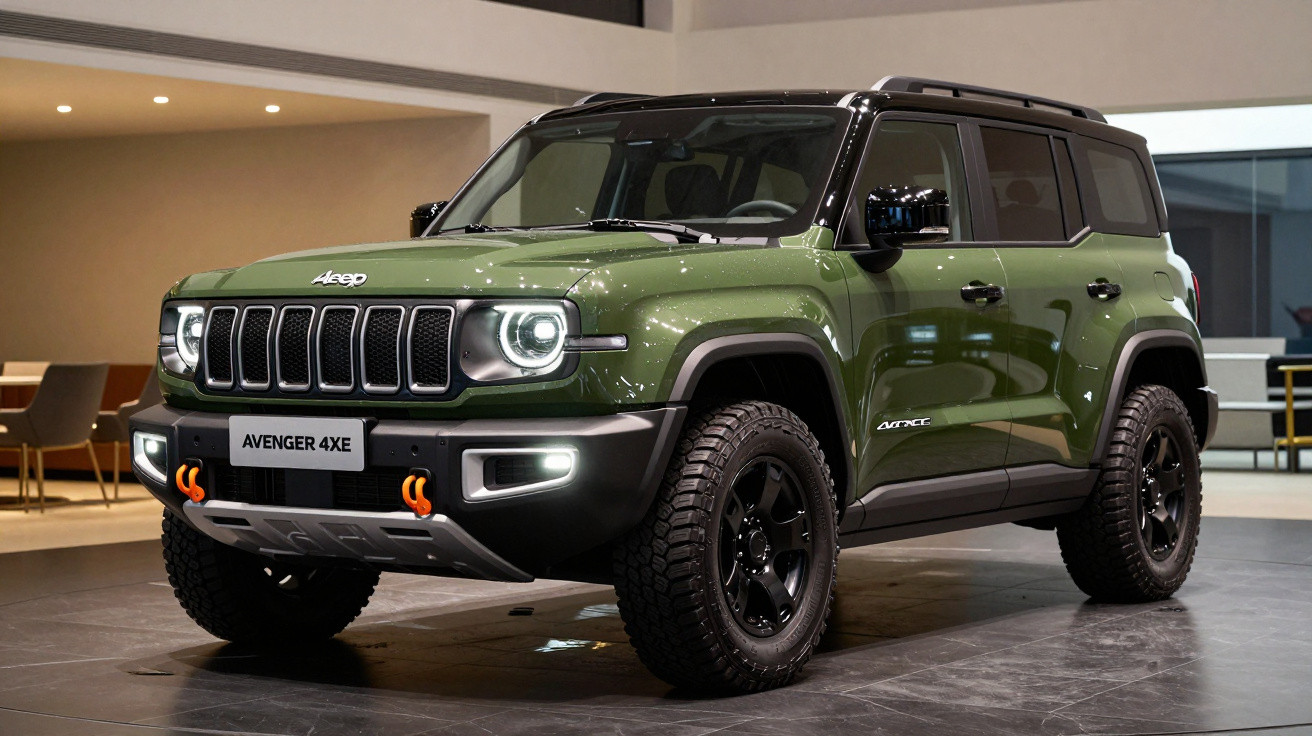
With electric rear-wheel propulsion, the Jeep Avenger 4xe impressed both away from the tarmac and… on it, although four-wheel drive is not always available.
At a time when the watchword is “hybridisation”, the Jeep Avenger 4xe brings a four-wheel-drive version to the range. Until now, the line-up consisted only of petrol engines, a mild hybrid and a fully electric model.
For this new 4xe, the chosen solution was to add an electric motor to the 48 V mild-hybrid system, resulting in two electric motors alongside an internal-combustion engine. The first is incorporated into the six-speed dual-clutch automatic gearbox, while the second is built into the rear axle. Both assist the three-cylinder petrol engine, helping it to deliver more performance while using less fuel.
It also lends support whenever extra traction is required over rough surfaces and moderate gradients with little, or very little, grip - mud, gravel, ice and so on.
Put simply, the Avenger has become more of a Jeep, despite there being no propshaft linking its two axles.
Depending on the version of this 48 V hybrid 4xe - Upland, Overland or Northface Edition - it gains several differences over the more urban-focused variants. Externally, these include redesigned bumpers with scratch-resistant finishes, steel protection underneath the front and rear sections, reinforced roof bars, a tow hook and green bodywork inserts.
Inside, there is a black headlining, along with stain- and mud-resistant seat upholstery, among other details.
Freedom beyond the tarmac
The Avenger 4xe sits 10 mm higher off the ground, with total ground clearance of 210 mm, giving it greater freedom over moderately challenging terrain. That figure makes this Jeep considerably more capable in such conditions than rivals including the Toyota Yaris Cross Hybrid (170 mm) and Suzuki Vitara Hybrid (175 mm).
Its enhanced off-road ability is also helped by the independent rear suspension, which uses a multi-link layout. Compared with the torsion-beam axle fitted to other Avenger versions, it allows greater axle articulation while also creating the space needed for the rear electric motor.
The turbocharged 1.2-litre three-cylinder petrol engine produces a maximum 136 hp. It is supported by the two previously mentioned electric motors, both rated at 21 kW or 29 hp, although they deliver different torque outputs: 55 Nm at the front and 88 Nm at the rear, with one motor on each axle.
The combined maximum output of the three motors is 145 hp - exactly the same as the Junior Ibrida Q4 - and is delivered through the aforementioned automatic gearbox, which can also be operated using paddles positioned behind the compact steering wheel.
Strong performance
Engine response is pleasingly eager from low revs, thanks to the instantly available electric propulsion. Its claimed top speed of 194 km/h and 0–100 km/h time of 9.5 seconds confirm that the Avenger 4xe is brisk enough, outperforming both of the aforementioned Asian rivals in either test.
Choosing to use the steering-wheel paddles can lead the driver to hold the engine at unnecessarily high revs. This makes the three-cylinder engine sound less refined and also sends fuel consumption upwards.
Jeep quotes 5.4 l/100 km, but during this 64 km test we recorded a figure well above that average. This was chiefly because the route involved climbing a mountain to reach the off-road course.
Four-wheel drive only up to 90 km/h
The driver can choose between four driving modes - Auto, Sport, Mud/Sand and Snow - using the control located on the centre console between the front seats.
The system has some particular characteristics, including the fact that, regardless of the selected mode, above 90 km/h the car has front-wheel drive only.
In the driving modes intended more specifically for off-road routes - Mud/Sand and Snow - the Avenger 4xe has permanent four-wheel drive up to 30 km/h. Between 30 km/h and 90 km/h, the 4×4 system is activated only when required - when it detects a loss of traction at the front wheels - exactly as it does in Auto mode.
In Sport, all three motors give their maximum to sharpen acceleration up to 40 km/h; beyond that speed, the Avenger 4xe also reverts to front-wheel drive only.
The modes tailored to off-tarmac driving also bring different traction- and stability-control settings, intended to prevent the slightest wheelspin from being immediately corrected by electronic intervention.
Dedicated Jeep Avenger 4xe driving modes
One of the most positive aspects of this part-time four-wheel-drive system is its ability to get the car out of highly demanding terrain, even if the front wheels have no grip at all and the small battery is depleted.
This is possible because the rear electric motor can always receive energy, as the front motor can also operate as a generator.
Jeep engineers say the car can tackle gradients of up to 40% on difficult surfaces and retain up to 20% traction when the front axle has little or no grip.
Although we did not verify those exact percentages, the off-road route demonstrated that the Avenger 4xe can overcome any moderately sized obstacle placed in its path.
The system’s least positive point is that the Jeep Avenger 4xe never has four-wheel drive above 90 km/h. This means it does not provide added security, for example, when the road surface is wet on faster roads.
On tarmac, there is also a noticeable difference between Auto and Sport in accelerator-pedal response and steering weight - sharper and heavier respectively in Sport. However, after pressing the relevant button, this change takes around two seconds to activate or disengage, a sluggishness shared by all Stellantis models.
The balance between stability and comfort deserves praise - the car driven was fitted with 215/60 R17 tyres and wheels - while the adoption of the new rear suspension mentioned above improves its ability to absorb surface imperfections, especially for rear-seat passengers. The brake pedal felt slightly spongy at the start of its travel.
Little changes inside
The Avenger 4xe dashboard retains the minimalist design familiar from the other models. Buttons marked Parking, Rear, Neutral and Drive replace any conventional transmission lever and, thankfully, given the functional approach expected from the brand, conventional buttons are used for the climate-control functions.
All trim surfaces are hard to the touch, but this does not clash with the vehicle’s philosophy. There are then inserts - coloured ones or 4xe logos - whose number and colour vary according to trim level.
Other details reveal that costs have been kept tightly under control, such as the lighting area beside the interior rear-view mirror, where the finish is not especially convincing, exposed screw heads, and the absence of any lining in the door pockets or glovebox.
Both the instrument display and central screen measure 10.25 inches diagonally. The infotainment system’s graphics and software require little time to become familiar with, offering intuitive logic and crisp visuals.
Even so, the “average consumption” readout in the instrument cluster makes little sense when the same menu also shows the proportion of time, expressed as a percentage, that the car has travelled in fully electric mode. Wireless Apple CarPlay and Android Auto connectivity is also standard.
Enough room
Available space is not one of the Jeep Avenger’s strongest selling points, yet four adults standing 1.80 m tall can still travel with sufficient room.
A third occupant in the middle rear seat - which is firmer and narrower - will be noticeably more restricted, as is normal in this segment. At least the transmission-tunnel intrusion is relatively low and narrow, while the rear seats sit higher than those at the front, creating an amphitheatre effect.
The boot is not large, at 325 litres - 55 litres less than in other Avenger versions - because of the electric motor mounted above the rear axle. However, it remains marginally larger than the luggage compartments of the Toyota Yaris Cross Hybrid (320 l) and Suzuki Vitara Hybrid (289 l).
Price and rivals
The entry-level Jeep Avenger 4xe Upland has a starting price of €34,237, around €3,000 more than the Suzuki Vitara 4WD Mild-hybrid but almost €5,000 less than its Italian cousin, the Junior Ibrida Q4.
Above the Upland sits the better-equipped Overland, starting from €36,237. At the top of the range is the limited edition developed in partnership with The North Face, with only 4,806 examples available, a reference to the altitude of Mont Blanc, Europe’s highest mountain. In this case, prices start at €40,237.

Comments
No comments yet. Be the first to comment!
Leave a Comment