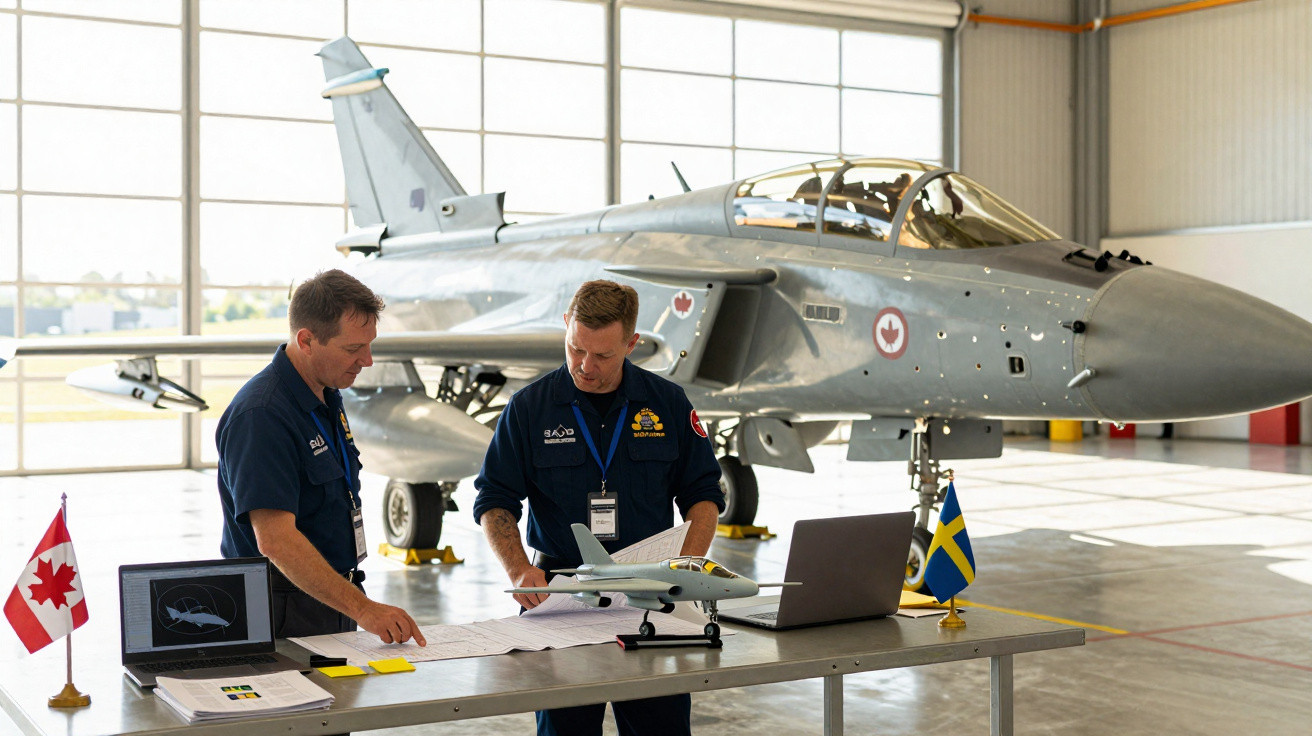
Swedish aerospace group Saab sees an unusual opportunity in North American defence policy. It is promoting a plan under which Canada would fly Gripen E/F fighters alongside US-made F-35s, while bringing a substantial part of Gripen manufacturing to Canada.
Saab sees an opportunity as US–Canada tensions rise
The Swedish company is advocating a “dual fleet” model. Under this approach, Canada would continue with its F-35 acquisition while adding Gripens, reducing its dependence on US equipment and political support.
During an investor call, Saab chief executive Micael Johansson said Canadian officials are considering how not “to be too dependent on the US” for combat airpower. In response, Saab has supplied detailed technical and industrial material to support its proposal.
Saab is feeding Ottawa detailed information on the Gripen’s technology transfer, production timelines and long-term export potential, betting that strategic autonomy now matters as much as raw performance.
The proposal comes at a politically delicate time. Washington and Ottawa have faced strained relations following public threats by former US President Donald Trump and a direct warning from US Ambassador to Canada Pete Hoekstra concerning Canada’s long-standing F-35 purchase.
What Saab is offering Canada
Saab has structured its proposal to attract both Canadian defence planners and the country’s aerospace sector. Its offer concerns more than aircraft: it also addresses their manufacturing location and method.
Local production and technology transfer
Johansson told investors that Saab has given Canada details on the speed at which it could establish a domestic Gripen production line, as well as the level of technology transfer it would be willing to provide.
- Creation of a Canadian final-assembly and production site
- Transfer of important manufacturing and maintenance expertise
- Use of the Canadian line to manufacture Gripens for other export customers
Saab is also setting out how Canada could benefit from future worldwide sales if Ottawa selects the aircraft.
Saab is framing the Gripen offer not just as a purchase, but as an entry ticket into the global fighter export business.
The company currently operates two Gripen production lines: one in Sweden and another in Brazil. A facility in Canada would become the third, and Saab says it could act as a centre for selected international orders.
A growing export portfolio
Saab hopes the expanding Gripen E/F customer base will assure Canadian decision-makers that Canada would not be operating the type in isolation.
| Country | Gripen deal | Approximate value |
|---|---|---|
| Brazil | Ongoing production and deliveries of Gripen E/F | Multi-billion dollar programme |
| Colombia | 17 aircraft ordered (2025 agreement) | €3.1 billion (around $3.7 billion) |
| Thailand | Four additional aircraft | 5.3 billion Swedish kronor |
| Ukraine | Letter of intent for 100–150 aircraft | Potentially one of Saab’s largest deals |
Saab is increasing its manufacturing capacity as well. A company executive recently stated that the goal is to produce 36 Gripens annually, a target that could be easier to achieve with an additional North American production line.
Canada reviews its F-35-only plan
Canada is already committed to the US-led F-35 programme and presently intends to buy 88 aircraft as replacements for its ageing CF-18 fleet. The budget announced in 2023 is 27.7 billion Canadian dollars (around $20.3 billion), although that amount is being reviewed.
Despite the political debate, Ottawa is still expected to purchase an initial 16 F-35s. Eight are scheduled for delivery to Luke Air Force Base in Arizona between 2026 and 2027 for pilot training.
However, the government is reassessing privately how much of its future combat air capability should depend on one aircraft type supplied by a single ally. An Auditor General report said the F-35 plan was being reviewed “to ensure” that the aircraft remains the “best choice” for Canada’s requirements.
This changed language has evidently boosted Saab’s prospects. A senior Canadian official previously called the Swedish offer “very interesting”, indicating that a mixed-fleet model is now being considered in a way that it was not several years ago.
US pressure and industrial leverage
Analysts argue that Washington retains considerable leverage should Canada cut its F-35 purchase. Bryon Callan of Capital Alpha Partners told investors that any decision to “truncate” the plan for 88 jets could have consequences for Canadian companies.
More than 30 Canadian aerospace companies are tied into F-35 production work, a powerful economic lever for the US if Ottawa shifts away from the programme.
Most of these businesses supply parts and services throughout the F-35 supply chain, providing them with valuable, long-term contracts. A reduced Canadian order could weaken the justification for their continued participation.
Callan also highlighted a further weakness in Saab’s proposal: the Gripen E uses the GE Aerospace F414G engine, which is manufactured in the United States. In a worst-case situation, US export restrictions on the engine could become a source of pressure even if Canada brought Gripens into service.
Nevertheless, Callan described Ottawa’s aim of diversifying its defence suppliers as “prudent”, given Trump’s public threats that questioned Canada’s defence commitments and decisions on sovereignty.
High-stakes timing and political calculations
Johansson would not predict when Canada might decide on Gripen, emphasising that “high-level political decisions” will ultimately determine the result. He said Saab is holding “intensive discussions” with Canada but does not have a fixed timetable.
Any move towards a dual fleet would have to reconcile several factors:
- Canada’s commitments to NATO and NORAD
- Current contractual and industrial connections to the F-35 programme
- Domestic industrial gains from a potential Gripen line
- Relations with Washington and wider US defence policy
For Ottawa, this is not solely a technical decision. The F-35 provides stealth capabilities and close integration with US forces, whereas a second fighter fleet could give Canada greater control over upgrades, maintenance and export controls affecting its aircraft.
GlobalEye, NATO and Saab’s wider Canadian ambitions
Saab’s Canadian discussions extend beyond fighter aircraft. Johansson said he is closely monitoring Ottawa’s development of a new surveillance-aircraft requirement, which is widely expected to include an offer for Saab’s GlobalEye airborne early warning and control platform.
GlobalEye combines a Bombardier Global business-jet airframe with advanced radar and sensors, many of which can be adapted to national requirements. Canada is regarded as a natural candidate because of its extensive maritime and Arctic surveillance needs.
Meanwhile, Saab is awaiting a NATO decision on a possible GlobalEye contract as the alliance looks for a replacement for its ageing E-3 Sentry fleet. NATO had previously considered Boeing’s E-7A Wedgetail, but set that option aside, giving GlobalEye another opportunity.
What a dual fleet would mean in practice
Operating both F-35s and Gripens would make the Royal Canadian Air Force more complex, but also more flexible. Two fighter types would require separate training routes, logistics systems and simulators. They would also provide more choices during a crisis.
Operationally, Canada could use F-35s for tasks requiring stealth and deep penetration of defended airspace, including the opening stages of a NATO air campaign. Gripens could conduct quick reaction alert duties at home, Arctic patrols and many coalition operations where stealth is less essential.
A dual fleet could additionally protect Canada from the risk of an entire force being grounded. Should a technical problem halt one fleet’s operations, the other could remain airborne. That redundancy has genuine operational value for a country tasked with defending vast northern airspace.
Key terms and risks worth understanding
Two ideas are central to the discussion: technology transfer and industrial participation. Technology transfer describes the degree of design and manufacturing expertise a supplier will share, enabling domestic companies to build, repair and upgrade systems themselves. Industrial participation refers to the wider package of employment, facilities and export work linked to a contract.
Saab has traditionally presented itself as generous in both areas, whereas the US is generally more restrictive, particularly regarding sensitive stealth technology. This distinction forms part of the Gripen proposal’s appeal to Canadian industry, but it brings risks too. Heavy reliance on foreign technology, even where transfer arrangements exist, may still be vulnerable to political changes, export controls or sanctions in supplier nations.
For Canada, the decision is not simply about choosing a “winner”, but about balancing sovereignty, alliance politics and value for money over decades. The Gripen proposal introduces a new factor into that calculation, increasing Ottawa’s bargaining power while also raising the stakes with its closest ally.











Comments
No comments yet. Be the first to comment!
Leave a Comment