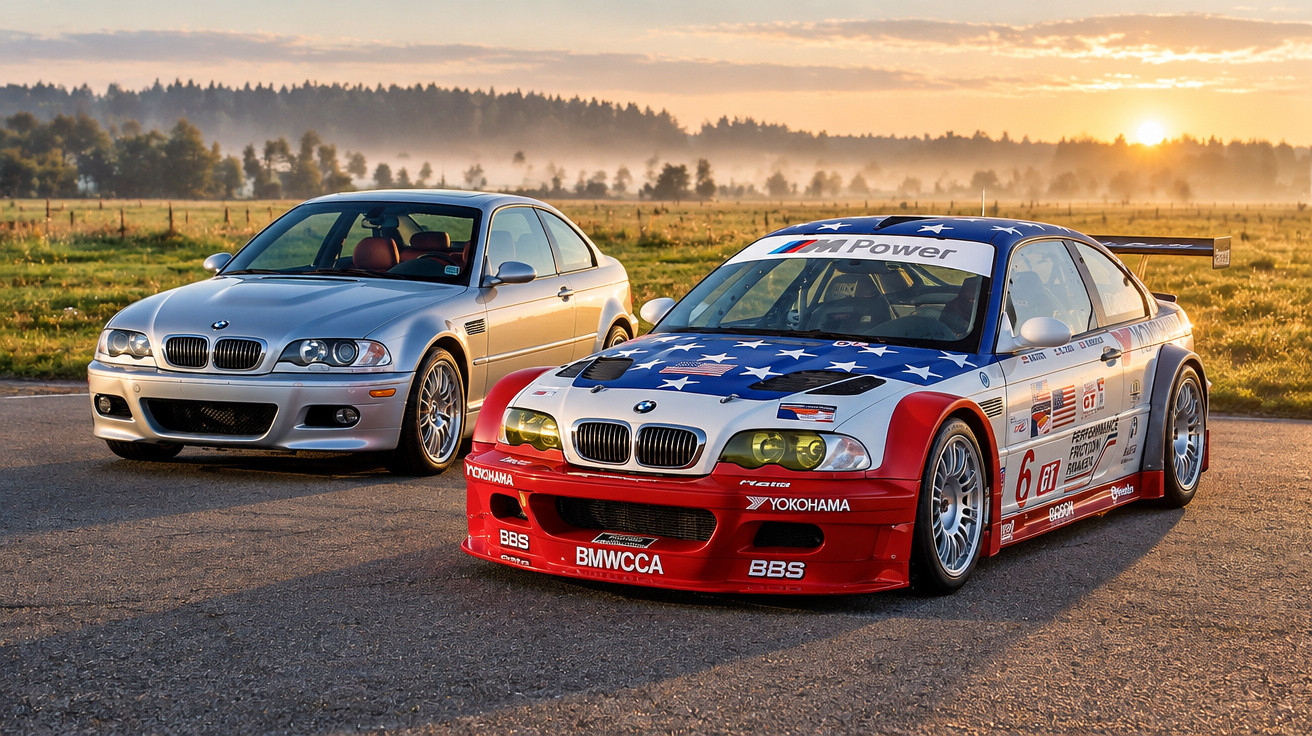
BMW North America’s former product planning and strategy chief, Rich Brekus, recalled: “Paul Rosche thought we had a hick NASCAR team running our M3 programme.”
That assessment came from within BMW rather than from a detached observer. As part of the 3 Series’ 50th-anniversary celebrations, BMW USA has shared Brekus’s remarkable account of a motorsport campaign from more than 25 years ago.
It centres on the creation, racing career and brief triumph of the formidable V8-engined E46 BMW M3 GTR. It also involves Prototype Technology Group (PTG), which operated BMW North America’s (NA) M3 GT cars, alongside Porsche and Schnitzer.
PTG’s BMW M3 racing record
Before the E46 era, PTG had already made a success of BMW’s straight-six contender during the latter part of the Nineties. Running BMW NA’s E36 M3s, the squad secured three GT class championships from 1996-1998. Those E36 racers also won half of every race they contested.
Even so, Brekus believed BMW’s Munich headquarters had little enthusiasm for PTG. “It was a constant refrain that BMW Motorsport [in Munich] should run it,” he added. Backed by some people within HQ, Brekus continued to support PTG as it campaigned BMW NA’s M3s.
Porsche changed the picture in 1999 with the arrival of the 996-generation 911 and its water-cooled GT3R counterpart. The ageing E36s claimed two early-season victories, but the 996 then dominated and Porsche took the championship.
A more competitive racing car was therefore required. Brekus knew that the newly introduced E46 M3 retained the E36’s shortcomings: a bluff nose and a 3.2-litre straight-six engine. Porsche’s six-cylinder unit displaced 3.6 litres. “Restrictor racing is a displacement game,” Brekus said, “because the higher the displacement, the earlier you develop torque, and the faster you can come off a corner.”
When IMSA became ALMS in 2000, Porsche comprehensively outclassed the E46 M3 GT. At the same time in Munich, BMW Motorsport was winding down its V12 LMR prototype project after Audi’s R8 had overwhelmed it. Brekus and PTG again encountered internal resistance to their M3 racing operation.
The V8-powered E46 BMW M3 GTR arrives
Mario Theissen, pictured above, was co-director of BMW Motorsport alongside Gerhard Berger at the time. “Thiessen was very much of the opinion that sales subsidiaries like BMW NA should only market motorsport, not run it,” Brekus said. “I basically said we’re not going to do it that way. We have a great race team, and I don’t like the way you guys run racing.
“You basically freeze everybody out, and you’re not very good with fans,” he added. Remaining support within HQ enabled Brekus to retain PTG’s M3 programme, although the car needed considerably more punch.
That came courtesy of Reinhard Könneker, a former Porsche engineer who had worked at Weissach on the dominant 917 and further projects under the late Hans Mezger. Having later worked on BMW’s Formula 1 engine, he designed the ‘P60’ V8 destined for the front of the E46 M3 GTR.
The engine was created to deliver greater torque, while its more compact dimensions compared with the outgoing S54 3.2 also improved cooling. In this specification, it produced 493bhp at 8,000rpm and 354lb ft at 6,500rpm. The contest was on.
Porsche, Schnitzer and the 2001 season
The challenge did not come solely from Porsche and its 996 GT3R. BMW Motorsport’s own Team Schnitzer was also running M3 GTRs. “Thiessen had agreed to do the V8 M3,” Brekus said, “but he didn’t think PTG was capable of developing the car and that Schnitzer need to run it.” Brekus subsequently asked BMW HQ to provide PTG with precisely the same V8 M3s used by Schnitzer.
“They agreed, and so did Albert Biermann, who was responsible for all non-F1 racing,” Brekus said.
Alex Job Racing’s 996 GT3Rs won the opening three rounds of the 2001 campaign as the V8 M3s were brought up to speed. Schnitzer then won the following two races with its newly engined cars. PTG won at Portland, before Schnitzer collected victories in the next three rounds.
Did Brekus suspect Schnitzer of interfering with the ECUs on its V8 M3s? “I don’t think so,” he said. “A lot of the difference in performance between the two cars was the tyres. Yokohama was a fantastic supporter of ours, but for sure the Michelins were better.”
The season finale at Road Atlanta almost did not take place after the September 11 terrorist attacks. It ultimately went ahead, with every entrant carrying an American flag decal in solidarity with the USA. As the American team in the field, PTG transformed its entire car into a 493bhp moving US flag.
PTG ultimately won the race, although Schnitzer secured that year’s championship. Despite their rivalry during the season, the two BMW teams congratulated each other.
That race marked the M3 GTR’s final outing. The ACO ruled that the P60 V8 would be illegal unless BMW built 1,000 road-going versions. BMW announced a €250,000 M3 V8 road car during the season and constructed ten prototypes ahead of a proposed limited-production run, but producing all 1,000 required cars was not feasible.
Nevertheless, PTG driver Bill Auberlen considered the machine exceptional. “The M3 GTR was the best-handling GT car ever,” he said. “The engine was so light, and so small, and the way it put power down was exactly matched to the tyre.
“You were right on the edge of adhesion all the way up the powerband, and it drove away like a rocket.”

Comments
No comments yet. Be the first to comment!
Leave a Comment