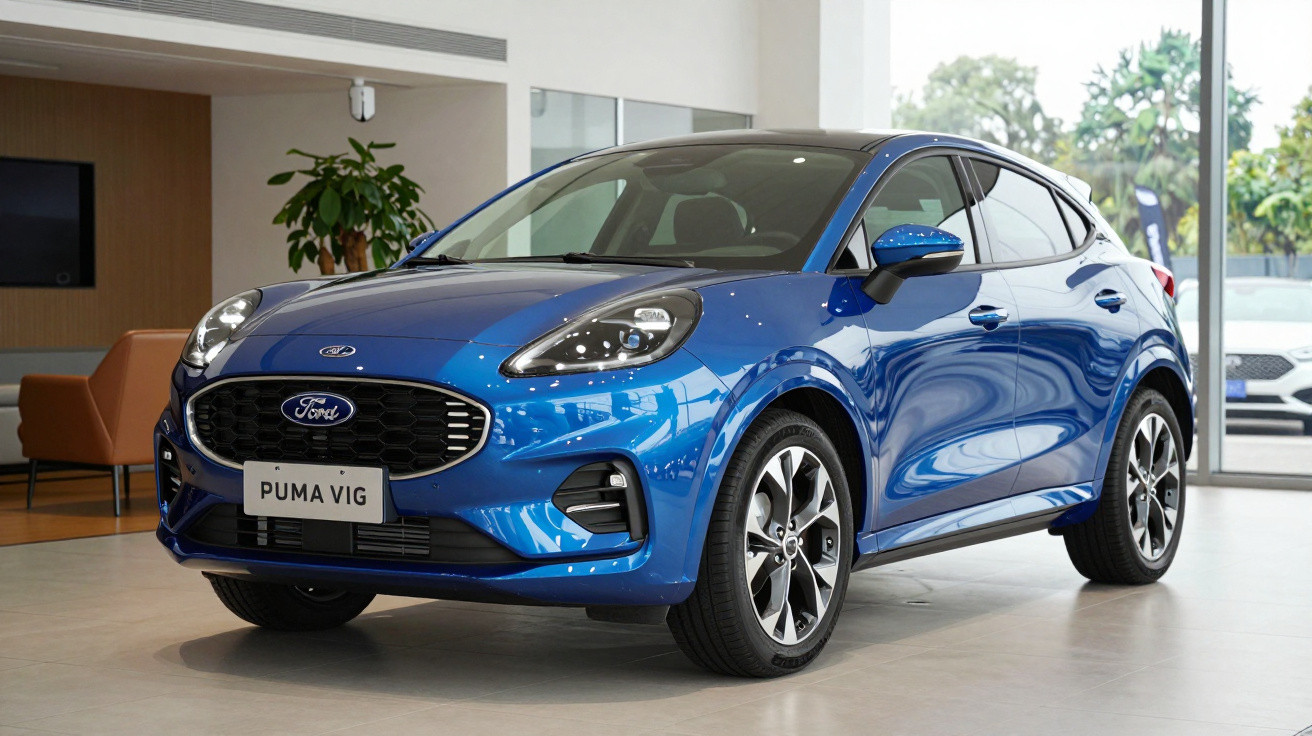
The Ford Puma quickly won us over with its dynamic abilities and its small yet highly energetic 1.0-litre three-cylinder engine. Now, in Puma Vignale form - the range’s most “luxurious” trim level - it appears to be trying to temper that character, bringing an extra measure of elegance and refinement inside and out.
To achieve this, the Puma Vignale receives a distinctively treated front grille, “sprinkled” with numerous chrome details. Chrome trim is not limited to the grille, either: it also appears along the lower edge of the windows and at the bottom of the bodywork. The lower sections of both bumpers are also finished differently.
Whether these chrome additions suit it better than the more familiar ST-Line models is a matter of personal taste. However, when paired with the standard Full LED headlamps, the optional 19-inch alloy wheels - 18-inch wheels are standard - and our test car’s equally optional, striking red paintwork, it certainly attracted attention.
Ford Puma Vignale interior and exterior refinement
Inside, the main highlight is the fully leather-trimmed seats; those in the ST-Line are only partially leather-trimmed. In the Vignale, the front seats are heated as well. The dashboard also receives a dedicated Sensico covering and Metal Grey stitching. These details raise the perceived sense of sophistication in the Puma compared with the sportier ST-Line, although they do not transform it completely.
Refined in appearance, but on the road too?
At first glance, the Puma Vignale almost succeeds in presenting itself as a more polished and refined interpretation of Ford’s feisty compact SUV. The issue - if it can really be called an issue - emerges once you set off: it takes very little time for that impression to fade and for the Puma’s true personality to reappear.
After all, beneath the bonnet remains the eager 125 PS 1.0 EcoBoost. Do not misunderstand me: although it is not the most refined engine of its type, the 1.0 EcoBoost remains one of the Puma’s strongest selling points and a major part of its appeal.
What is new here is its pairing with the seven-speed automatic dual-clutch gearbox. Yet this does little, if anything, to soften its lively temperament - and thankfully so… - even though it tends to shift up sooner rather than later. As a result, it does not often allow the engine to reach the higher rev range, where this three-cylinder feels surprisingly at ease compared with similar engines.
To make the most of the engine’s “effervescent” nature, Sport driving mode needs to be selected. In this setting, the dual-clutch gearbox lets the engine rev higher before changing gear, and its operation is more convincing than that of comparable dual-clutch systems in similar modes in other models. Alternatively, gears can be selected manually using the small paddles behind the steering wheel - although they could be larger and should not rotate with the wheel.
Ride comfort and refinement in the Ford Puma Vignale
Another aspect that works against this more “posh” take on the Puma is its sound insulation. We have mentioned it before, but it seems more apparent here, presumably because of the optional 19-inch wheels and lower-profile tyres fitted to this example. Road noise becomes more noticeable than in the 18-inch-wheeled ST-Line - which was not particularly strong in this respect either - even at more moderate speeds of 90–100 km/h.
Larger wheels and less tyre sidewall do not help the ride quality either. The Ford Puma is naturally somewhat firm and abrupt over bumps, and these wheels amplify that trait.
On the other hand, dynamically, the Puma remains true to itself, even in Vignale trim. What it gives up in comfort, it gains in body control, chassis precision and responsiveness. Its rear axle is also cooperative enough to introduce a welcome dose of enjoyment when the pace increases.
Is the ~~car~~ Ford Puma right for me?
Even dressed in this more sophisticated Vignale guise, the Ford Puma remains unmistakably itself. It is still one of the segment’s benchmarks for combining the practical advantages of this type of vehicle with a genuinely engaging driving experience.
However, it is difficult to recommend the Puma Vignale over the ST-Line/ST-Line X. Most of the equipment fitted to the Vignale is also available on the ST-Line versions, although selecting one or two items may add to the options list. There is also no difference in the dynamic set-up: for example, it is not more comfortable, despite what its more refined positioning might suggest.
The decision over the dual-clutch gearbox is a little less clear-cut. First of all, this option is not exclusive to the Vignale, as it is also available on other trim levels. It is not difficult to justify, either: it undeniably makes everyday use more comfortable, particularly in town, and works well with the 1.0 EcoBoost.
On the other hand, it makes the Puma slower and thirstier than the manual ST-Line X I tested on the same routes last year. I recorded fuel consumption of between 5.3 l/100 km at steady moderate speeds (4.8–4.9 with the manual gearbox), rising to 7.6–7.7 l/100 km on the motorway (6.8–6.9 with the manual gearbox). On shorter urban journeys, it remained a few tenths above eight litres. The wider tyres, a consequence of the optional wheels, do not help in this particular area either.
The Ford Puma ST-Line with this 125 PS engine, but fitted with the manual gearbox, remains the most balanced choice in the range.

Comments
No comments yet. Be the first to comment!
Leave a Comment