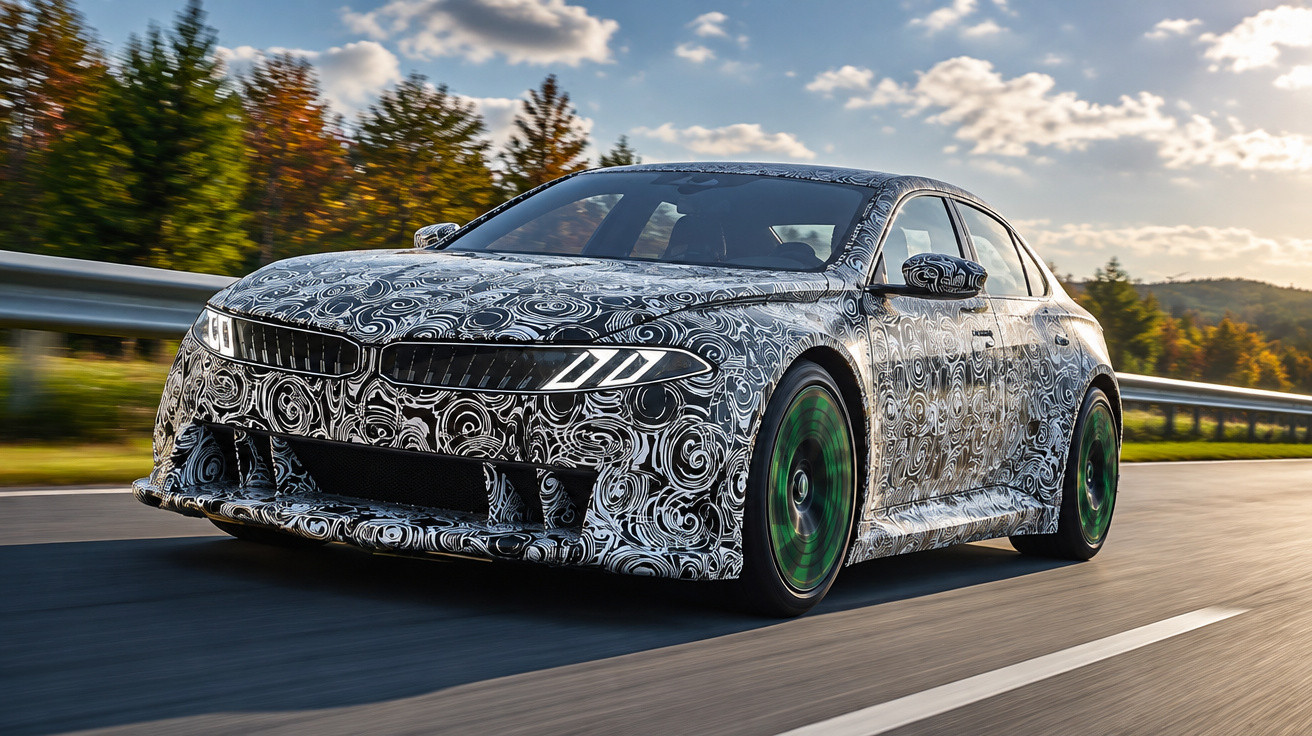
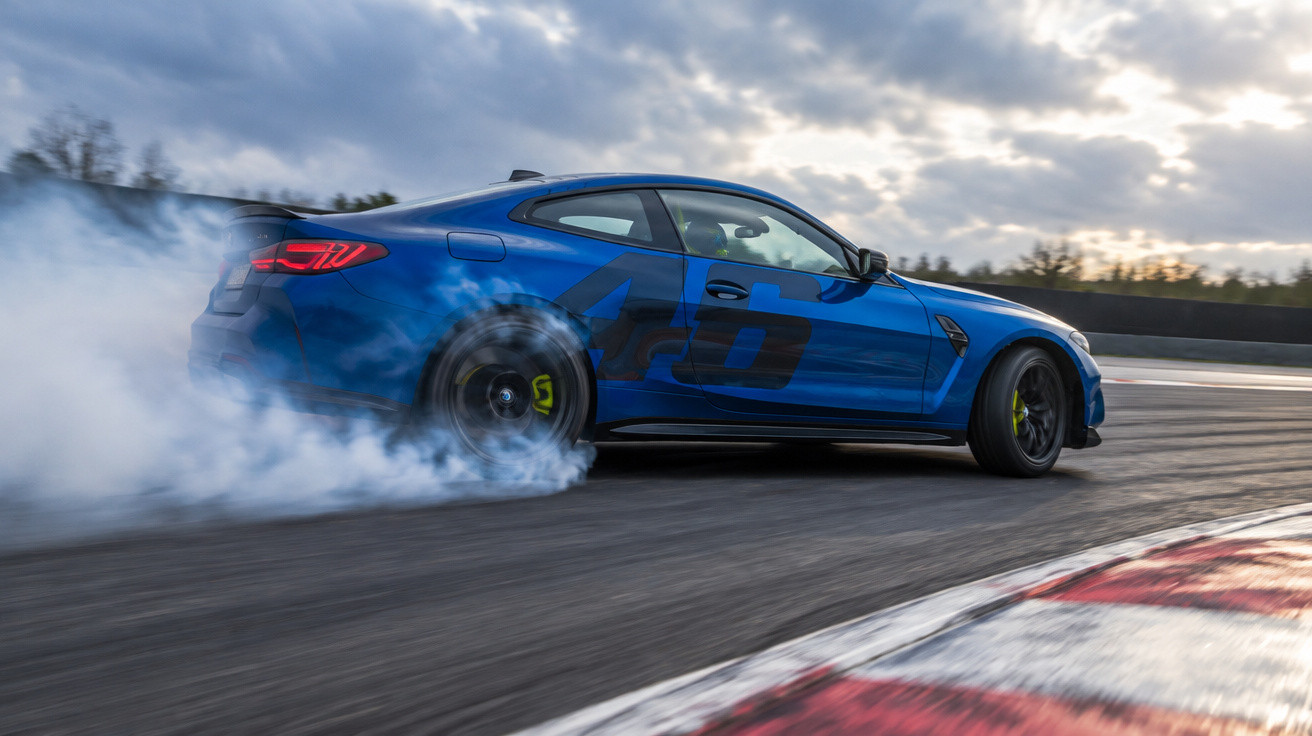
Meet the Vision Driving Experience: BMW’s frankly bonkers electric test platform, created to take EV handling far beyond sensible boundaries and into entirely new territory.
“Hang on!” we hear you cry. “This looks like a development mule destined for the crusher, what am I missing?” What you are missing is 13,269lb ft (17,991 Nm) of torque. That is more than five times the output of a Koenigsegg Gemera, which, as far as we know, remains the production-car record holder for sheer mechanical muscle. Blimey.
BMW Vision Driving Experience and Neue Klasse
The VDX will not be built for customers. Not ever. Its influence will, however, reach BMW production models: most notably the forthcoming Neue Klasse range, whose first member arrives later this year. Further down the line, it will also inform four-motor M cars.
BMW’s logic is that, if its system can manage a colossal burst of power on this scale, ordinary day-to-day driving loads should be effortless. It is the automotive equivalent of preparing for an Ironman simply to make walking upstairs easier.
The Vision Driving Experience is so firmly rooted in the experimental world that BMW is keeping most of its specifications under wraps. Battery chemistry, power output and performance figures are all, apparently, none of our beeswax.
We do know that it uses a carbon chassis. It also has driving modes, among them Drift, which is entirely credible, and Comfort, which rather less so. In Track mode, five impellers - effectively fans - pull the car towards the road surface to mimic enormous downforce. Do not expect BMW to take the Gordon Murray T.50 route and fit this technology to a production car, though.
“The fastest test rig in the world,” says Christian Thalmeier, BMW’s Heart of Joy expert - a job description we will return to shortly. “It’s a beast.”
LEDs mounted in the wheel hubs show the engineers - presumably observing safely from a heavily reinforced concrete bunker - what the car is doing. Green indicates acceleration, blue denotes energy recuperation, and orange signals that the friction brakes are in use. At one point, brake temperatures were reportedly so extreme that they destroyed the batteries.
Regenerative braking in BMW Neue Klasse cars
That leads to an important point: BMW intends for Neue Klasse models to do almost all of their stopping through recuperation, using regenerative braking right up to the point at which ABS intervenes. Crikey. The company says its rear-wheel-drive models will recover 60 per cent more regenerative force than its, er, 2021 Klasse of EVs, while all-wheel-drive versions will gain 40 per cent.
Discs and pads cannot disappear completely, of course. Picture beginning a trip high up with the battery fully charged: on the descent, energy recovered while charging downhill would have nowhere to go. Even so, the pads will be commanded to operate from time to time - it is brake-by-wire, after all - to stop them corroding. BMW has identified problems among owners who travel slowly everywhere in B mode…
The outcome is a small efficiency improvement worth roughly nine miles (14 km) of additional range, but it may enable BMW to all but remove brake noise. Thalmeier calls it the “smoothest stopping since the invention of the wheel”.
Heart of Joy driving dynamics control
Now, then: Heart of Joy. What is it? Another system proven in the VDX brings the drivetrain and vehicle dynamics under a single controller, an achievement BMW says makes it the first manufacturer in the world to do so. A number of patents are still pending. Roughly the size of a DVD player - remember those? - it can control as many as four electric motors and will feature in every Neue Klasse model. Thalmeier says: “We treat it like a heart because it makes the car alive.” His short-form patter is rather good, is it not?
Created entirely in-house over three years, Heart of Joy governs acceleration, braking, stability, dynamic steering and charging management. It runs at 1 kHz, which is 10 times faster than older BMW systems, with response times said to be ‘in the millisecond range’. A rearward bias will be a recurring principle, with braking apportioned between axles - or even individual wheels - to improve cornering. The aim is both high stability and high agility. You hardly need us to spell out what that might do to the pulse of the soft organ behind the steering wheel.
Thalmeier freely concedes that the mass of electric cars is “not good”, but insists BMW can make its EVs feel “more light-footed” while insulating occupants from physics’ less enjoyable consequences. “The weight is lower. The centre of gravity is lower. And because of this big battery pack, it's a very centred mass. So from the point of agility, this is really good.
“It is responsiveness, how the car reacts. For me personally, it is still the feeling. The car moves, the car is precise, I feel the forces to my body, yeah? This is what driving pleasure is. Everything works together... I’m getting into a flow, and the car supports me.
“People who say ‘Well, I don't like it at all, because I don't hear anything’ – you can get used to [it]. To drive an eight-cylinder for example, it's really nice. But to drive other [electric] cars… it's the same joy for me.”
Hand us 13,269lb ft (17,991 Nm) to experiment with and we would be inclined to concur. Immediately.






Comments
No comments yet. Be the first to comment!
Leave a Comment