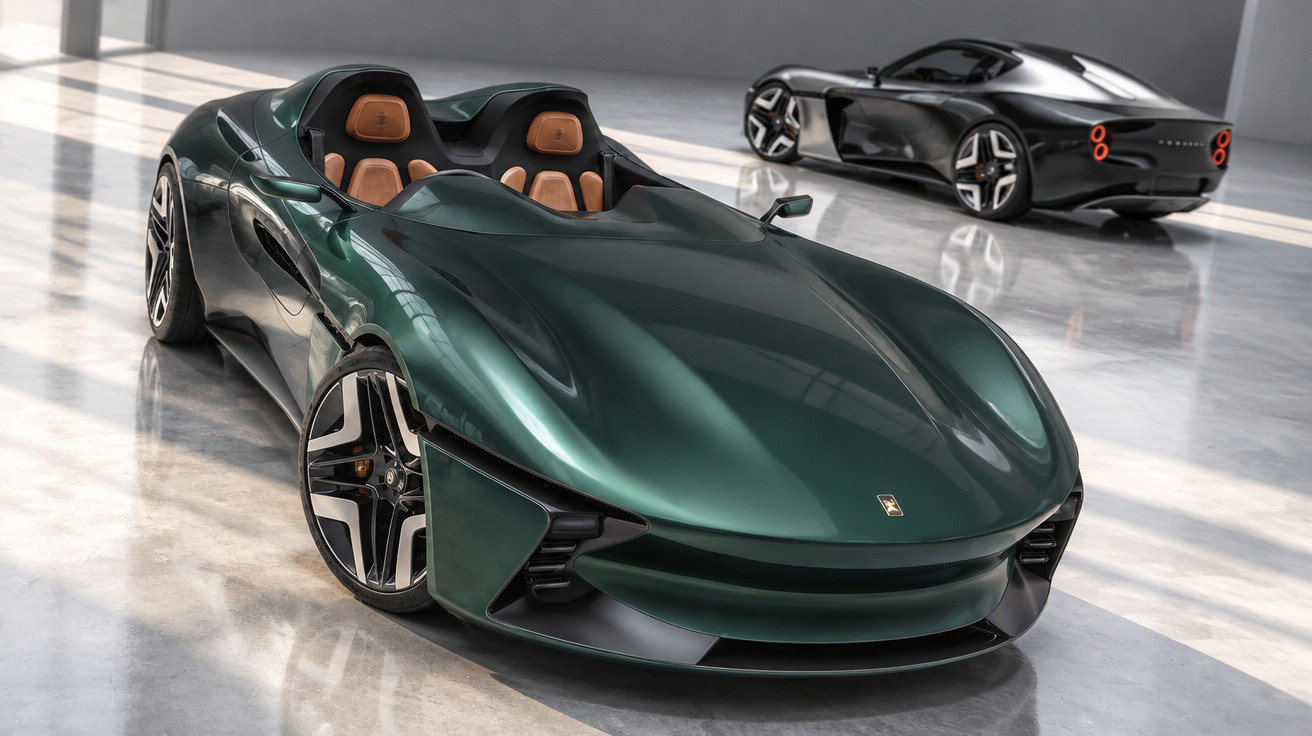
Meet the Longbows: two all-electric British sports cars created by people whose combined CVs include launches at Tesla, Polestar, Lucid, Uber and BYD. What this dream EV start-up team wanted, however, was a genuine sports car.
Longbow Speedster and Roadster specifications
The Speedster - the version with neither roof nor windscreen - will arrive first. Limited to 150 units, it weighs only 895kg, promises 275 miles of range and costs £84,995. It sends power to the rear wheels and is claimed to reach 62mph from rest in 3.5 seconds.
For those unwilling to eat bumblebees for breakfast, a Roadster will follow shortly afterwards. Despite its name, it is not a roadster at all: it is a fixed-roof, two-door, two-seat coupé. Although it is 100kg heavier, it still manages 0-62mph in 3.6 seconds, offers 280 miles of range and is priced at £64,995.
That peculiar name is a dig at Elon Musk’s notoriously poor sense of timing, but more on that shortly.
Longbow Motors was founded by British engineers Daniel Davy and Mark Tapscott. Having enjoyed successful careers across the EV and technology sectors, they have put their resources into an electric sports car company because they were frustrated that nobody else was doing it.
“I used to design and build Lotuses, but realised electrification was the future,” explained Mark, “and the other day I spoke to ex-Lotus CEO Phil Popham, and laid it on a bit thick that this is the car the Chinese won’t let Lotus build.”
Daniel put it more plainly: “If you want to sell cars, make it cheap. Whatever anyone tells you, if you're not Ferrari or Bugatti or a known brand, if you want to sell cars, make it as affordable as possible. That's how you move volume. That's a lesson from both Tesla and Lucid.”
A British sports car approach to EV engineering
One conclusion the pair have drawn from earlier EV ventures is that Longbow should not attempt to make everything itself. Complex components, including the batteries, motors and brakes - all connected through bespoke software - can instead come from external suppliers.
Longbow’s strategy borrows from the proven British sports car formula: let somebody else handle those parts. Caterham and Ariel have made it work, and the Elise did the same for almost three decades.
Daniel said: “If you start with a software-defined vehicle, then effectively motors, batteries, inverters are plug-and-play. If you're not looking to get from 0-60 in 1.9 seconds, you're not having to squeeze every last volt out of specialist chemistry. We have a 240-kilowatt motor: there are 12-15 we can buy off the shelf. We personally have good relationships with all the major Chinese semi-state owned businesses and suppliers.”
At present, the proposal is to use 2170 nickel-cadium cells to supply a 240kW (322bhp) motor, while retaining the option of a dual-motor model later. Its architecture will be modular and interchangeable, so switching motors, battery chemistry or power output will not call for a complete redesign. It is comparable to Caterham’s move from Rover K-Series to Ford Duratec engines in the Seven, or Ariel’s transition from naturally aspirated VTEC to turbocharged Honda power.
There is no expensive McLaren-style carbon tub or bodywork in the name of cost control. Instead, the structure is aluminium and the panels are made from sustainably produced lightweight composites. The company is content to say that items such as lamps and mirrors will be sourced from existing parts bins: spending a couple of million quid on a light cluster is alarmingly easy, while buyers will not care and it will not improve how the car drives.
The driving experience itself is intended to remain purposeful and uncomplicated. Electronic power steering and anti-lock brakes are included, but Longbow is not planning artificial Hyundai Ioniq 5 N-style gearchanges or Star Trek soundtracks. Daniel notes that Christopher Nolan used a Tesla Roadster’s whine as the soundtrack for the Batpod in The Dark Knight, suggesting that EVs need not broadcast fake exhaust sounds to seem threatening.
Longbow’s race to market
Naturally, the task is to establish an entirely new sports car manufacturer before Alpine and Lotus turn their attention to electric replacements for the A110 and Emira, while Porsche releases 2025’s most divisive car, the electric 718 Boxster and Cayman. Longbow says a working prototype will be ready by summer, with early customers who sign up potentially receiving cars as soon as next year.
And the name? Longbow itself is straightforward: it refers to the relationship between an archer and their weapon, as neither is lethal without the other. The company says that precision and connection - the harmony of person and machine - informed its philosophy. It should also irritate the French, which is never a bad thing. Perhaps an Agincourt Edition will follow.
The ‘Roadster’ sports car name has a more contemporary origin. It is a thinly disguised jab at the repeatedly delayed, gimmick-laden Tesla Roadster MkII. “A lot of customers have put deposits down for a Roadster that they can't get," said Daniel. "So we thought we'd be the first electric Roadster to follow the Tesla Roadster.
"If people want to get back their $250,000 deposit for a 2020 car and put it into a better car, they're going to get one sooner. They're welcome to do it. Our Roadster's going to be on the ground first.”
Can Longbow succeed where so many EV start-ups and British sports car manufacturers have stumbled? Click here to read our conversation with the founders and discover why they believe they have found a winning formula…
Comments
No comments yet. Be the first to comment!
Leave a Comment