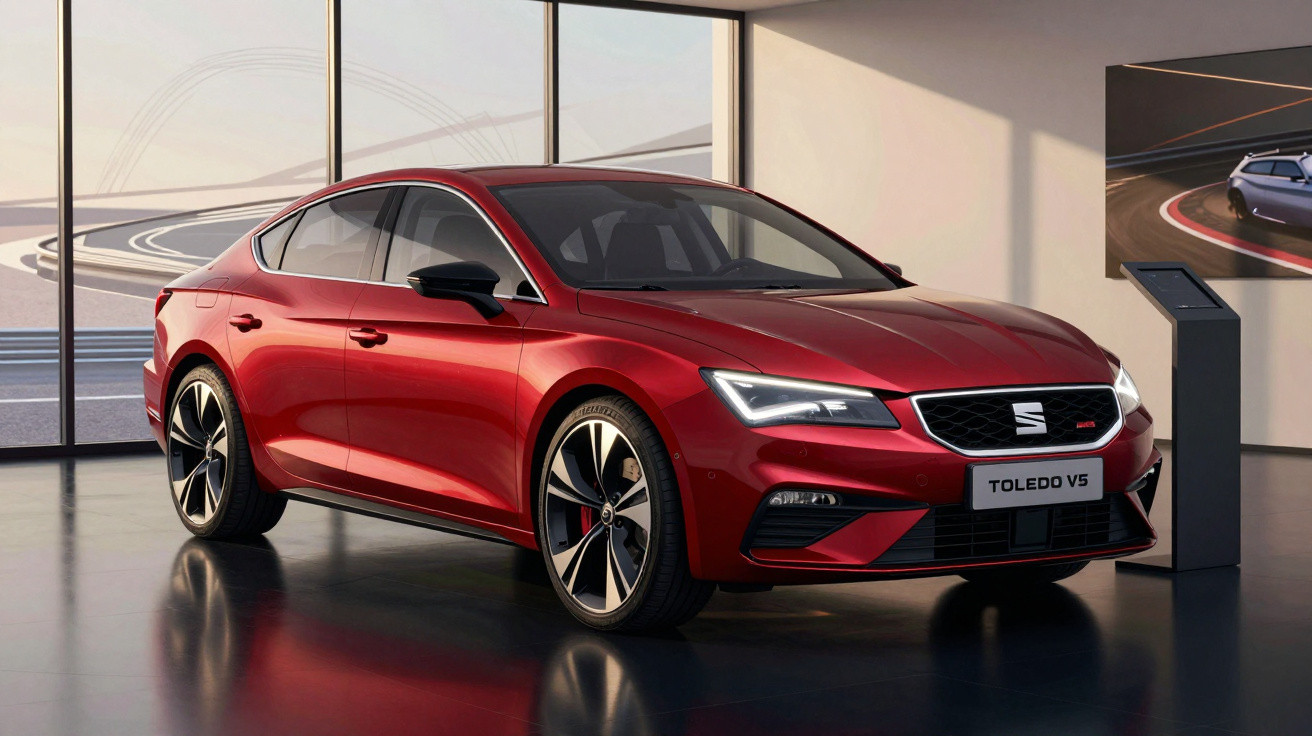
The SEAT Toledo was named Car of the Year in Portugal once again in 2000. This was the second-generation 1M model, introduced in 1998, following the award won by the first-generation 1L in 1992.
The Spanish family car, first unveiled at the 1991 Barcelona Motor Show, became only the second model to claim the award twice, after the Volkswagen Passat.
Like its predecessor, the second-generation Toledo was styled by Giorgetto Giugiaro. It made its public debut at the 1998 Paris Motor Show and used the Volkswagen Group's PQ34 platform, first introduced beneath the Audi A3 in 1996. At the time, this architecture also underpinned several other group models: the Audi TT, SEAT Leon, Skoda Octavia, Volkswagen Beetle, Volkswagen Bora and Volkswagen Golf.
A family car with sporting character
Although it shared numerous components with the Octavia and Bora, the four-door Toledo positioned itself as the sportiest option of the three. There was much speculation at the time about potential Toledo derivatives, particularly a coupé version. The model that arrived soon afterwards, however, was a five-door hatchback: the first Leon.
Inside, the dashboard was derived from that of the first-generation A3, while the boot offered 500 litres of luggage capacity, expanding to 830 litres with the rear seats folded. This figure suited the Toledo's family-car role, yet the Spanish brand's new positioning meant that the cabin's materials and finish quality were also well regarded.
The engine line-up was led by the 1.9 TDI unit, offered with 90 and 110 hp, alongside three petrol engines: a 100 hp 1.6 cross-flow, a 125 hp 1.8 20v of Audi origin, and a 150 hp 2.3. The latter was the first five-cylinder engine fitted to a SEAT and, more unusually still, featured a V-format five-cylinder layout derived directly from the VR6.
While it never received a facelift, the second-generation Toledo gradually gained new engines to meet increasingly restrictive European emissions regulations. In 2000, the entry-level unit was replaced by a 105 hp 1.6 16v, promising improved performance and lower fuel consumption. A year later, in 2001, an even more powerful 150 hp 1.9 TDI version arrived - with the legendary three TDI letters in red.
180 hp for the most powerful Toledo
The 2.3 V5 saw output rise to 170 hp in its multi-valve version, with 20 valves in total. Nevertheless, the most powerful SEAT Toledo would be the Audi-derived 1.8-litre turbocharged four-cylinder producing 180 hp. Coincidentally, it also had 20 valves, although in this case it used five valves per cylinder.
The 1.9 TDI also gained a new 130 hp variant in 2003. SEAT used the opportunity to fit the Toledo with new heated, electrically adjustable door mirrors inherited from the new third-generation Ibiza.
As the European market increasingly turned its attention towards larger saloons and… MPVs, at the expense of medium-sized saloons, the Toledo became a casualty of this changing landscape. It did not achieve the sales figures the Spanish manufacturer had hoped for, falling short of its first-generation predecessor.
It spawned one of the most special Leons ever
Perhaps for that reason, one of the versions that could have added more “spice” to the Toledo was never built. This was, inevitably, the SEAT Toledo Cupra shown at the 1999 Geneva Motor Show. It featured 18-inch wheels, lowered suspension, an upgraded interior and, most importantly, a 2.8-litre V6 engine - the Volkswagen Group's VR6 - producing 204 hp and sending its power to all four wheels.
It was never sold, but this was ultimately the engine selected to “animate” the equally rare Leon Cupra 4. It remains the only Leon in history to have more than four cylinders.
It made its mark in touring car championships
The second-generation Toledo also enjoyed a spell in motorsport through the Toledo Cupra Mk2, introduced in 2003 for the European Touring Car Championship (ETCC). When the ETCC became the World Touring Car Championship (WTCC) in 2005, the Toledo Cupra Mk2 remained in competition.
In 2004 and 2005, SEAT Sport also entered two Toledo Cupra Mk2 cars in the British Touring Car Championship (BTCC), similar to those raced in the ETCC. The model went on to enjoy a long competition career, with private teams still using it in this British touring car series in 2009.
The SEAT Toledo was replaced in 2004, when the model's third generation arrived with a… different body style. No longer a four-door saloon, it became an unusual, tall five-door hatchback with MPV-like ‘looks’. Derived from the Altea, it was designed by Italian Walter de Silva, the “father” of cars such as the Alfa Romeo 156 and Audi R8, who led Volkswagen Group design for several years.
Would you like to discover the remaining Car of the Year winners in Portugal? Follow the link below:


Comments
No comments yet. Be the first to comment!
Leave a Comment