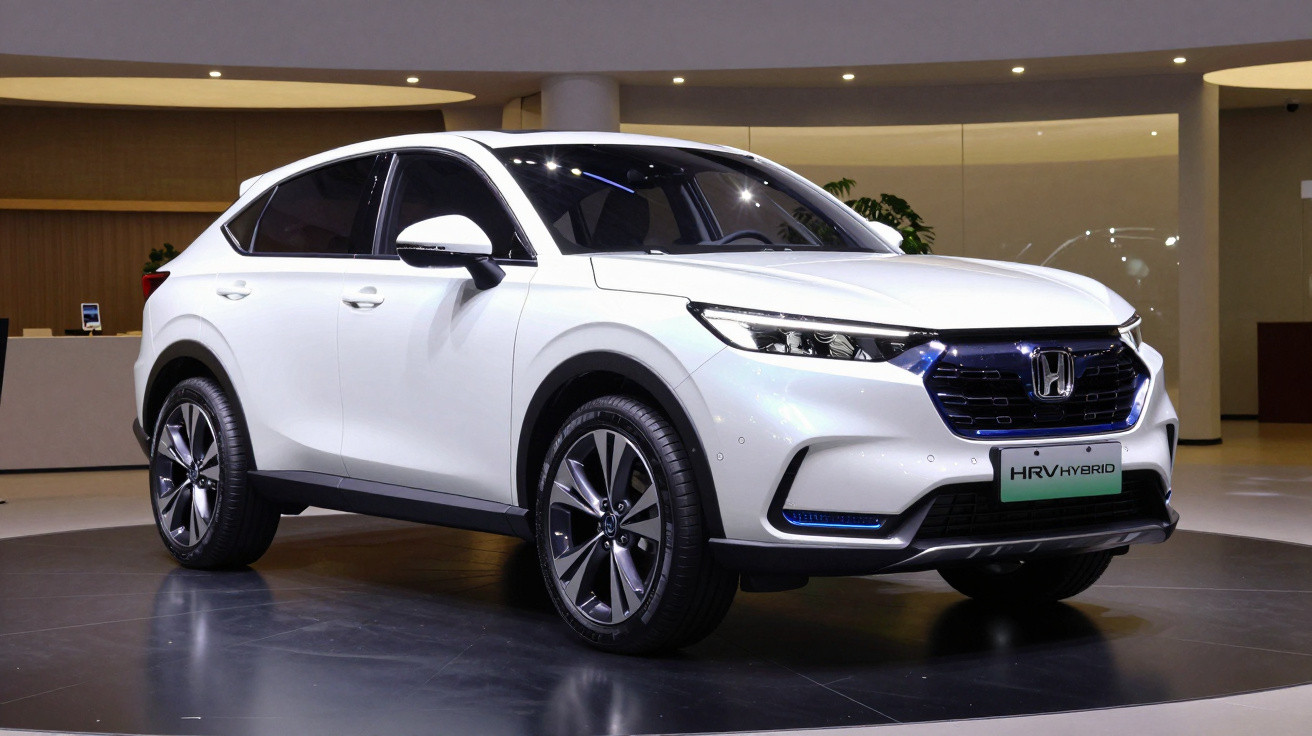
The new Honda HR-V Hybrid continues the Japanese manufacturer’s electrification drive and is positioned as a key element of the brand’s European strategy, a market in which Honda aims to have a fully electrified range by 2022.
The recently unveiled Jazz and Crosstar also play a prominent part in the brand’s electrification plans, alongside the CR-V, helping hybrids account for 65% of Honda’s total European sales. However, the real “flagship” of its electrification programme is the Honda e, the Japanese brand’s first production electric car.
Having sold more than 3.8 million units worldwide since its 2013 launch - when it was called the Honda Vezel in Japan - the new HR-V Hybrid, its official name, is an important calling card for Honda.
Coupé-inspired styling
With a simpler, more elongated and horizontal design, the new Honda HR-V Hybrid is clearly distinct from its predecessor. Honda says the overall shape of this crossover drew inspiration from coupés.
Its lower roofline, reduced by 20 mm compared with the previous model, makes a major contribution to that look. At the same time, the move to 18-inch wheels and a 10 mm increase in ground clearance reinforce the model’s more rugged stance.
At the front, the new body-coloured grille incorporating the brand badge stands out, while the previous generation’s large chrome surround has disappeared altogether. Other notable details include the slim Full LED light signature and the more steeply raked A-pillar.
Along the side, a horizontal crease emphasises the waistline, while the rear now features a full-width light bar connecting the lamps.
Clean-lined interior
Built on the GSP (Global Small Platform), also used by the new Honda Jazz, the HR-V Hybrid retains the external dimensions of its predecessor while providing more room inside.
As with the exterior, the cabin is defined by horizontal forms and a more refined appearance, following the direction already seen in the Jazz and Crosstar.
A 9-inch central dashboard display runs the HMI system, enabling smartphone integration through Apple CarPlay, which does not require a cable, and Android Auto. Behind the steering wheel sits a 7-inch digital instrument panel displaying the information most relevant to the driver.
Also noteworthy is the new Air Diffusion System, whose L-shaped vents are fitted at the upper corners of the dashboard. These direct air along the front windows, forming an air curtain around and above the occupants. According to Honda, this system avoids blowing air directly at passengers, creating a more comfortable environment.
The front seats use a new support structure and closely resemble those in the new Jazz. They also provide a driving position 10 mm higher than before, giving the driver a wider field of vision.
Greater emphasis on passenger space
In the second row, there is an extra 35 mm of legroom - the existing HR-V was already among the roomiest vehicles in its segment - as well as seat recline of up to two degrees and Honda’s well-known Magic Seats. Also fitted to the Jazz and Crosstar, this arrangement allows the seat bases to be lifted towards the backrests so tall objects can be carried upright.
Honda has not disclosed the exact boot capacity, although it says it is similar to that of the previous model (470 litres). The “walk away close” function is confirmed, allowing the tailgate to close automatically when the user walks away.
Hybrid power only…
As its name suggests, the HR-V Hybrid is offered exclusively with Honda’s e:HEV hybrid technology. It combines two electric motors with a 1.5-litre Atkinson-cycle i-VTEC petrol engine, producing 106 PS, for a maximum combined output of 131 PS and 253 Nm of peak torque, sent solely to the front axle.
In normal use, the internal-combustion engine acts almost continuously as a generator to recharge the battery, which is mounted beneath the boot floor and supplies the electric motor. Only at higher speeds, such as on motorways, does the petrol engine drive the wheels directly. Honda says this is the more efficient solution and helps optimise fuel consumption.
Three driving modes are available (Eco/Normal/Sport), together with two regeneration intensity settings. “B” is the strongest level and can be selected using the transmission lever.
Enhanced safety systems
For the first time, the HR-V Hybrid receives the Japanese brand’s Honda SENSING system, including a new, wider, higher-definition monocular front camera. Among other improvements, this enhances the pedestrian detection system with night-time automatic braking, which can now also identify cyclists and motorcyclists.
The cross-traffic monitor has also been improved, as has the blind-spot information system. Also new is hill descent control, offered for the first time on the HR-V in Europe, providing better control on steep, low-grip descents.
When does it arrive?
The new Honda HR-V Hybrid will be available in Europe at the end of 2021. Prices have not yet been announced.



Comments
No comments yet. Be the first to comment!
Leave a Comment