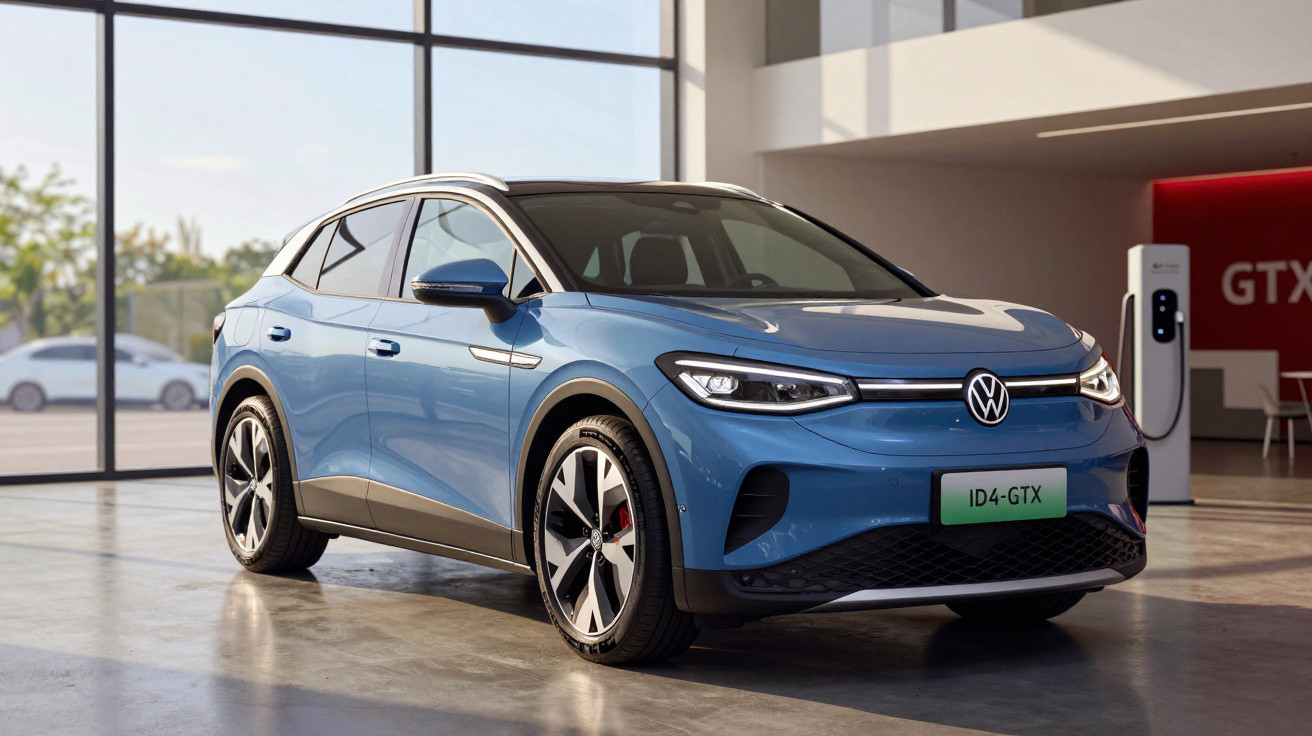
The Volkswagen ID.4 GTX is the first model to introduce a new badge positioned in much the same way as the long-established and revered GTI designation. It will identify the German brand’s increasingly extensive ID. electric-model range’s sportier versions, both visually and in terms of performance.
Its performance comes from an additional asynchronous electric motor on the front axle. Working with the rear permanent-magnet synchronous motor (204 cv or 150 kW), it raises peak output to 299 cv (220 kW) and gives the electric SUV four-wheel drive. As a result, the ID.4 GTX reaches 100 km/h in 6.2 seconds, while its top speed is electronically capped at 180 km/h.
Supplying the system is a 77 kWh battery weighing 486 kg, mounted in the floor of the platform. This arrangement ensures a particularly low centre of gravity despite the vehicle being an SUV, and provides the ID.4 GTX with a combined WLTP range of 480 km.
Volkswagen also states that the battery will retain 70% of its original capacity after eight years or 160,000 kilometres.
Using the standard Mode 3 cable, the ID.4 GTX can charge at 11 kW on alternating current. At a rapid direct-current charger, such as the newer IONITY units, it supports charging at 125 kW, allowing around 300 km of range to be added in roughly half an hour.
Optional chassis upgrades
No dynamic differences from the other ID.4 versions have been mentioned, apart from the available optional equipment.
The optional Sport package lowers the ID.4 GTX by 15 mm and includes progressive steering. A Sport Plus package will also be offered, adding adaptive suspension (DCC).
As standard, it rides on 20-inch alloy wheels, with 21-inch wheels available as an option. The tyres are wider at the rear, measuring 255 mm, than at the front, where they measure 235 mm.
At the front, braking is handled by 358 mm discs, while the rear retains drum brakes, as on the other ID.4 models. This choice is explained by the regenerative braking fitted to electric vehicles such as the ID.4, which can provide deceleration of up to around 0.3 g. Hydraulic brakes are therefore used less frequently, making drums a more economical solution with lower wear and maintenance requirements.
A more distinctive Volkswagen ID.4 GTX
Alongside its increased output and claimed performance, the ID.4 GTX also receives fresh styling details, although visual restraint appears to have been the chosen approach.
Several components, including the plastic protection along the lower section of the doors, are now finished in body colour. Other details lose their metallic finish in favour of black, including the trim directly above the windows that also creates the D-pillar. The air intakes, both functional and decorative, gain a gloss-black finish, while GTX badges appear on the wings and tailgate.
However, exterior lighting may be what sets the Volkswagen ID.4 GTX apart most clearly from the remaining ID.4 range. The GTX comes as standard with IQ.LIGHT LED matrix headlamps and receives a distinctive light signature through two sets of three additional LEDs, integrated into the recesses at the outer edges of the front bumper.
At the rear, the lighting is also a highlight, with 3D LED light units made up of nine separate fibre-optic cable elements.
Inside, the changes are limited to an exclusive colour scheme. A dark shade called Soul dominates, joined by a dark blue tone (X-Blue) across the upper dashboard and leather-like door trim. This contrasts with red inserts, while further components - the steering wheel, steering column, instrument panel and door inserts - are finished in gloss black.
The GTX name is equally prominent in the cabin, appearing on the steering wheel, door sills and the front-seat head restraints. The pedals are stainless steel and repeat the “Play & Pause” motif used across the rest of the ID. family.
When will it arrive?
The new Volkswagen ID.4 GTX is expected to arrive next summer, although prices for Portugal have not yet been announced.



Comments
No comments yet. Be the first to comment!
Leave a Comment