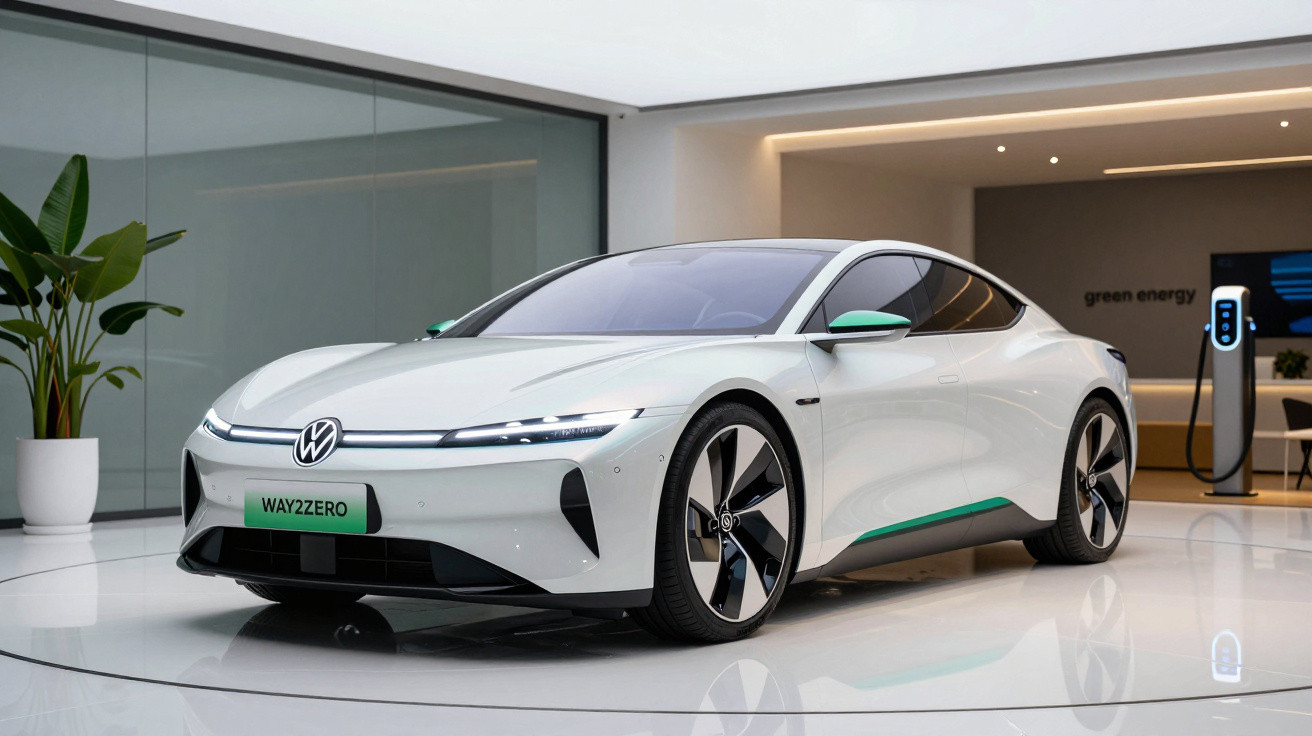
Focused on decarbonising its products and its entire production chain, Volkswagen has used its first “Way to Zero” convention to outline both its emissions-reduction targets and the strategies it will use to meet them.
One of the headline commitments is the German brand’s aim to cut CO₂ emissions per vehicle in Europe by 40% by 2030, compared with 2018. This target is even more ambitious than that of the Volkswagen Group, which stands at 30%.
Volkswagen will also invest €14 billion in decarbonisation by 2025. This funding will be allocated across a broad range of areas, from producing “green” energy to decarbonising manufacturing processes.
The “ACCELERATE” strategy at the heart of the plan
Central to this major decarbonisation drive is the new ACCELERATE strategy, which is intended to speed up the manufacturer’s electric-vehicle push and achieve the full electrification of its model range.
The targets are ambitious. By 2030, at least 70% of Volkswagen’s sales in Europe are expected to be fully electric vehicles. If achieved, this would put the German brand well ahead of the requirements set out by the EU Green Deal.
In North America and China, meanwhile, the goal is for all-electric models to account for 50% of Volkswagen sales over the same period.
Volkswagen decarbonisation across every area
Naturally, decarbonisation targets cannot be met simply by producing and launching a greater number of fully electric models.
Volkswagen is therefore working to decarbonise both vehicle manufacturing and its supply chain. One objective is to ensure that, from 2030, every one of the brand’s factories worldwide - apart from those in China - operates entirely on “green electricity”.
In addition, Volkswagen intends to systematically identify the largest sources of CO₂ emissions within its supply chain, so that they can be reduced. To give an idea of the measures involved, the company will strengthen the use of sustainable components in ID. family models as early as this year. These will include battery housings and wheels made from “green aluminium”, as well as tyres manufactured using low-emission processes.
Another target is the systematic recycling of batteries. According to the German brand, this will enable more than 90% of raw materials to be reused in future. The aim is to establish a closed recycling loop for batteries and their raw materials.
Finally, to ensure it has sufficient “green energy” for its factories and for customers to charge their cars, Volkswagen will also support the construction of wind farms and solar power plants.
Contracts for the first projects have already been signed with energy company RWE. The German brand says that, together, these projects should generate around seven additional terawatt-hours of green electricity by 2025.
Comments
No comments yet. Be the first to comment!
Leave a Comment