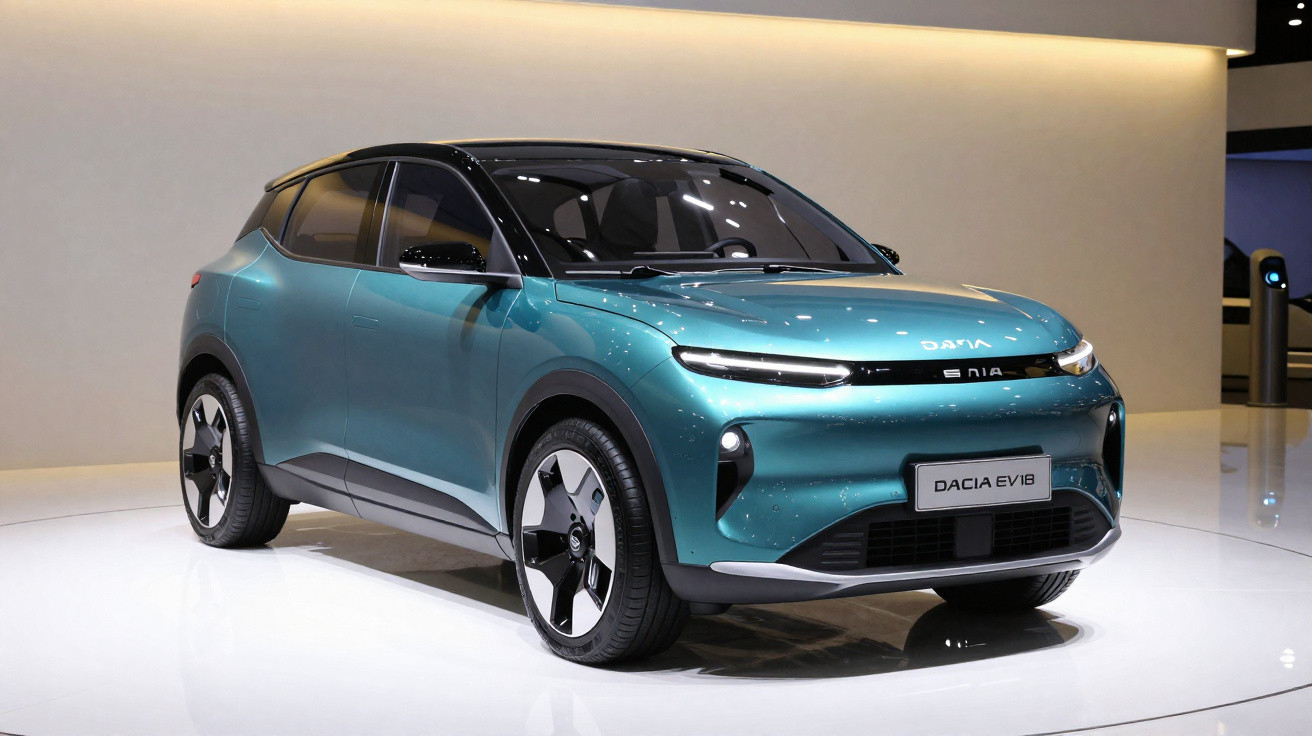
Romania’s budget champion is turning its strategy on its head while retaining one key promise: affordable cars for everyone.
Dacia is using the Renault Group’s new future plan to make a major move forward itself. The brand has announced no fewer than four fully electric models, with a new entry price of well below €18,000 under discussion. Dacia is therefore targeting precisely the area where most rivals are struggling: genuine electric mobility for modest budgets.
Dacia steps up: four electric models by 2030
Until now, Dacia’s range has included just one all-electric car: the Spring city car. It has performed respectably, with a price that suited many households, but its technology remained fairly basic and Chinese production excluded it from certain incentive schemes.
The brand is now marking a clear turning point. As part of the group’s “futuREady” plan, Dacia has officially confirmed that it intends to offer four EVs by 2030. These models will cover a broad range across the small-car and compact segments, prioritising practical, straightforward vehicles rather than luxury features.
Dacia is aiming for around two thirds of its sales to come from electric powertrains by 2030 – while retaining its characteristically keen prices.
This puts the manufacturer on a similar path to many competitors, although its approach differs: less showmanship, more usefulness, and a determined push towards lower prices.
New Dacia electric city car for under €18,000
The first element of the offensive has already been outlined. Dacia will introduce a compact city-car version based technically on the upcoming electric Twingo generation. It is intended to carry Dacia’s familiar DNA: sturdy, simple, functional and, above all, affordable.
The manufacturer is making a strong statement with its entry price. The new model is expected to start below €18,000, at least in its home market and the most important European countries. Depending on local incentive schemes, it could become considerably cheaper in some areas.
In markets with an environmental bonus, the effective price of the new electric Dacia could fall below €15,000.
Another decisive factor is that the car will be built in Europe. This gives it a good chance of qualifying for government support in several countries again – unlike the Spring, which is imported from China and is therefore excluded by some funding rules.
What will happen to the Spring, Sandero and Duster?
The Spring stays, but will face strong in-house competition
The current Spring EV will remain in the line-up for the time being, even though it cannot access certain support schemes. It will continue to be the cheapest route into Dacia ownership, especially for drivers covering very short distances or looking for a second car.
However, Dacia may be able to offer many prospective buyers a more modern and better-equipped package with its new European electric city car, while still providing attractive prices and potential incentive eligibility.
An electric Sandero is almost certain
A fully electric version of the best-selling Sandero is highly likely. Although official technical specifications have not yet been released, an LFP battery configuration is considered the leading option behind the scenes. This battery technology is cheaper, durable and designed for everyday suitability rather than maximum range.
- LFP batteries are considered particularly long-lasting
- They require fewer raw materials than many other cell types
- They are generally less sensitive to heavy use and numerous charging cycles
That makes the technology an ideal fit for Dacia’s philosophy: no record figures, but dependable engineering without unnecessary frills.
The Duster will initially retain petrol and hybrid power
Dacia is initially drawing a clear line with its popular Duster SUV: it will not immediately arrive as a pure electric vehicle. Instead, the car is likely to continue with internal-combustion engines and electrified versions, such as hybrid and mild-hybrid powertrains.
This is strategically logical. Larger, heavier vehicles need bigger batteries, which drives up costs. Dacia is first concentrating on smaller EVs, where its cost-saving approach can be implemented more easily from a technical perspective.
Pricing strategy: electric mobility without a luxury premium
Dacia stresses that its fundamental positioning will remain unchanged. The brand still wants to offer the cheapest, or one of the cheapest, choices in every segment. This includes leaving out unnecessary equipment and limiting costly high-tech extras.
The central promise is simple: as much car as possible for as little money as possible – with a battery instead of a fuel tank, too.
This can already be seen in several areas:
- European production to reduce transport costs and improve the CO₂ footprint
- A streamlined model range to simplify development and manufacturing
- Hard-wearing, relatively simple interiors instead of premium styling
- A focus on everyday-suitable ranges rather than headline-grabbing marketing figures
How the planned Dacia models compare
| Model / plan | Status | Target starting price | Production location | Key features |
|---|---|---|---|---|
| Electric city car based on new Twingo technology | Announced | Under €18,000 | Europe | Good chance of environmental bonus eligibility |
| Spring | Already on sale | Varies by market | China | No access to certain incentive schemes |
| Fully electric Sandero | In planning | Not yet confirmed | Not yet confirmed | High likelihood of an LFP battery |
What does this mean for customers in Germany, Austria and Switzerland?
For buyers in Germany, Austria and Switzerland, Dacia’s electric offensive is likely to create new options at the lower end of the market. In particular, people who have previously hesitated because of high list prices or uncertain residual values may be drawn to an EV costing under €18,000.
For commuters travelling 20 to 50 kilometres each day, smaller batteries will be entirely sufficient in many cases. Those with charging available at home or at work will also benefit from lower electricity costs compared with petrol or diesel.
It will be interesting to see how insurance costs, servicing intervals and resale values develop for the new models. Dacia has traditionally been strong with simple, easily repairable cars; with electric technology, the cost of spare parts and workshop labour will matter even more in future.
What prospective buyers should consider now
Anyone considering an affordable EV over the next one to two years faces a familiar choice: wait for a new model or choose a vehicle that is already available.
Several points can help with the assessment:
- The incentive situation in your own country: are bonuses likely to change soon?
- Actual space requirements: is a small city car genuinely sufficient?
- Everyday charging infrastructure: a private wallbox or public charging?
- Intended ownership period: around 3–4 years or substantially longer?
Those who are flexible and do not urgently need a vehicle can follow Dacia’s upcoming model announcements and wait for the first test drives. For many buyers, the crucial question will be whether the brand can maintain its reputation as a price disruptor in the electric era too.
One thing is certain: the announcement of four EVs and a new entry price below €18,000 is bringing noticeable momentum to a market segment long shaped by expensive compact and mid-sized electric cars. If Dacia follows through consistently with its concept, it will place fresh pressure on every manufacturer that has so far treated affordable electric mobility as a peripheral issue.

Comments
No comments yet. Be the first to comment!
Leave a Comment