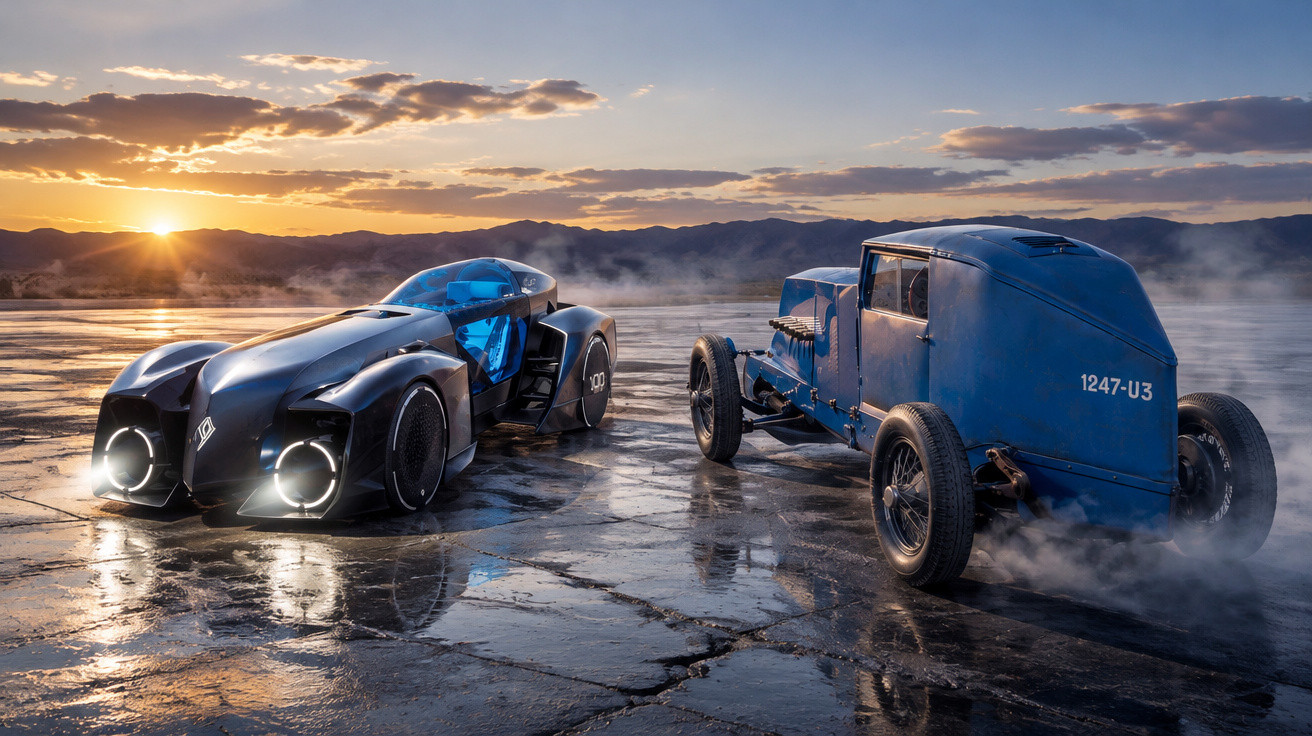
The Renault Filante Record 2025 is about as removed from an ordinary Clio as it is possible to be. Resembling a mash-up of the Michael Keaton-era Batmobile and a Star Wars pod racer, Renault calls it “a laboratory on wheels for testing new technologies, materials and innovations”.
Yet the Filante Record 2025 is intended to be more than a mobile test bed. As its name implies, Renault plans to use the wild-looking single-seater to chase world records for “power consumption and range with an 87kWh battery”. Yes, it is electric, and the first record attempts are scheduled for the first half of this year.
Renault says it has “always seen motorsports and records as a way to validate its innovations, before applying them to production models”. Accordingly, this concept draws heavily on the company’s most extreme record-breaking machines of the past.
Photography: John Wycherley
Renault Filante Record 2025 and its record-breaking predecessors
Here is a brief history lesson. Speed records were hugely popular during the roaring 1920s, and Renault wanted its biggest luxury model, the 40 CV, to claim a share of the action. Even with a new 140bhp 9.1-litre straight-six engine and a specially streamlined, if not especially handsome, narrow body created by engineers Ellery Garfield and Robert Plessier, Renault knew it could not challenge for the outright land-speed record. For years, that prize had passed between the wildly ambitious British drivers Malcolm Campbell, Henry Seagrave and JG Parry-Thomas, all using aircraft-engined machines. Instead, the French company chose to focus its newly named 40 CV des Records on endurance and average-speed achievements.
On 11 May 1925, Garfield and Plessier drove an open-topped Type ML 40 CV des Records around the Montlhéry oval. They established new records for average speed over three hours, average speed over 500 km and average speed over 500 miles. However, the modified, tin-topped Type NM delivered the car’s greatest achievement. Garfield and Plessier returned to Montlhéry in July 1926, joined by a 14-strong pit crew and a third driver, Paul Guillon, to set a record for the distance covered in 24 hours: 4,167.578km at an average of 173.649kph [107.900mph]. By then, the car’s front brakes had been removed to reduce weight.
The Étoile Filante, meaning ‘Shooting Star’ and providing part of the new car’s name, was just as dramatic. Its highly streamlined form, polyester body and 270bhp jet engine positioned beside the driver’s head helped it secure four records at the Bonneville Salt Flats in late 1956. It recorded 306.9kph [190.7mph] over one kilometre, 308.9kph [191.9mph] over five kilometres, 307.7kph [191.2mph] over one mile and 280.8kph [174.5mph] over five miles. Renault, then, has form in this particular field.
“We came up with an idea in the design team to do a homage to the 40 CV des Records on its 100th birthday,” says Sandeep Bhambra, director of advanced design for Renault.
“Of course, we wanted to do a stylistic homage, but beyond that we thought about setting some records in the electric era because these endurance records are super relevant today, especially when a lot of people are still suffering with range anxiety on electric cars. We wanted to see how far we could push the envelope with current EV technology and some new developments.”
After only a year of development, involving Renault’s engineering and aerodynamics departments as well as substantial input from prototype racing-car specialist Ligier Automotive, the result is effectively a 21st-century fusion of the 40 CV des Records and Étoile Filante. Renault is already embracing retro-inspired styling with the new 5 now on sale, while the 4 and Twingo are still to arrive.
“The main silhouette of the Filante Record 2025, the side view of the car, is inspired by the 40 CV des Records,” says Bhambra. “But that makes sense, this part of the car was very aerodynamically efficient. The fenders are more inspired by the Étoile Filante. Why is that? Because we know today that open wheeled cars are too aerodynamically punishing. So, this car sits between the two in terms of inspiration for us.”
Aerodynamics, size and the Filante Record 2025 cockpit
Aerodynamics are central to the project. Wind-tunnel testing has yet to happen, so Renault has not released official figures, but it is targeting an exceptionally low drag coefficient between 0.20 and 0.25. There is little frontal area to force through the air, either, meaning total drag should be extremely low. That is positive news for range.
So were Garfield and Plessier right, 100 years ago, to give the 40 CV des Records its tightly compressed shape and distinctive pinched rear end?
“Yes, they were correct in the 1920s,” says Bhambra. He adds, however, that the new car’s tail had to be stretched further rearwards, with bodywork tapering away at a gentler angle, to make it still more aerodynamically efficient.
“In aerodynamics of cars, normally you hear about 16 or 17 degree angles of approach. Here we are trying to achieve eight to 13. It’s about allowing the air to go gently to the point at the end.
“That’s what we’ve tried to correct from the 40 CV, but it’s a big constraint because if you start from that point at the rear and then draw lines forward at those angles, it doesn’t give you much space to put a person in the middle.”
With the new 5 on sale, and the 4 and Twingo coming, Renault is on a retro roll
In person, the Filante Record 2025 is also unexpectedly compact-looking. It is 5.12m long, only slightly shorter than a Mercedes S-Class, which is useful for managing airflow around the vehicle. Despite its wheels sitting apart from the body, it measures only 1.71m wide. It is also just 1.19m high and weighs less than 1,000kg. More on that latter figure shortly.
First, the cockpit. That description is entirely justified: it is designed to appear as though it has been lifted from a fighter jet or spacecraft, while the visible fasteners in the bodywork are said to take inspiration from aircraft-building methods. The driving position recalls that of an F1 car, allowing the stacked batteries to sit beneath the driver’s feet. The seat itself uses tensioned canvas supported by slender carbon-fibre blades. Renault says it is “similar in style to a hammock”. It sounds wonderfully comfortable - perhaps something for the next-generation Clio.
The driver will not use conventional acceleration and braking controls, either. Instead of pedals, every function is operated by hand through games-console-style triggers mounted on the rear of the yoke. This is enabled by steer-by-wire and drive-by-wire technology, which Renault could genuinely introduce on a production car.
“We had to use steer by wire on this car, because there’s no way of having a steering column and a battery pack up front, so it was a good idea for packaging, but also for saving weight,” said Bhambra. “We also lighten the car because with hand controls we don’t have the pedal structure around the feet. It liberates a lot of space in the interior. It’s something that we are looking at and exploring for future cars, but it’s not that easy to put something so innovative in a production car so quickly.”
At the middle of the Filante Record 2025’s yoke sits another item that could reach production: a slim, flexible display wrapped around a cylinder, showing speed, range and other essential information. Even the ventilation arrangement has been designed specifically to contain as few components as possible, so it consumes less battery power and cuts weight.
Lightweight construction and the 87kWh battery
Weight reduction has clearly been a major priority, offering hope for lighter production EVs. The Filante Record 2025 has a tubular chassis made primarily from carbon and aluminium through its central section. Its front and rear subframes are steel, but Ligier developed them to be as light as possible. The entire body is carbon fibre, using material only half the thickness normally found on concept cars.
Renault has also 3D-printed intricate components from Scalmalloy, a high-strength aluminium alloy. It says it used ‘topology optimisation’ to minimise the material in areas not exposed to particular mechanical loads. This apparently made a significant contribution to reducing overall mass.
That sub-one-tonne kerb weight is even more striking given that the reworked 87kWh battery, sourced from the Scenic, weighs 600kg on its own with all accompanying electrical hardware. It uses a new carbon-fibre casing and places cells directly within the battery pack, without intermediate modules. Renault has not disclosed the motor powering its potential record breaker, though it has confirmed it is mounted at the rear, making the car rear-wheel drive. Special narrow 19in Michelin tyres reduce rolling resistance, while Renault is looking to assemble a driver team for the long-distance record attempts.
The only problem? Every driver must weigh under 50kg if Renault is to meet its uncompromising weight target. We will put our CVs away for the moment, then...


Comments
No comments yet. Be the first to comment!
Leave a Comment