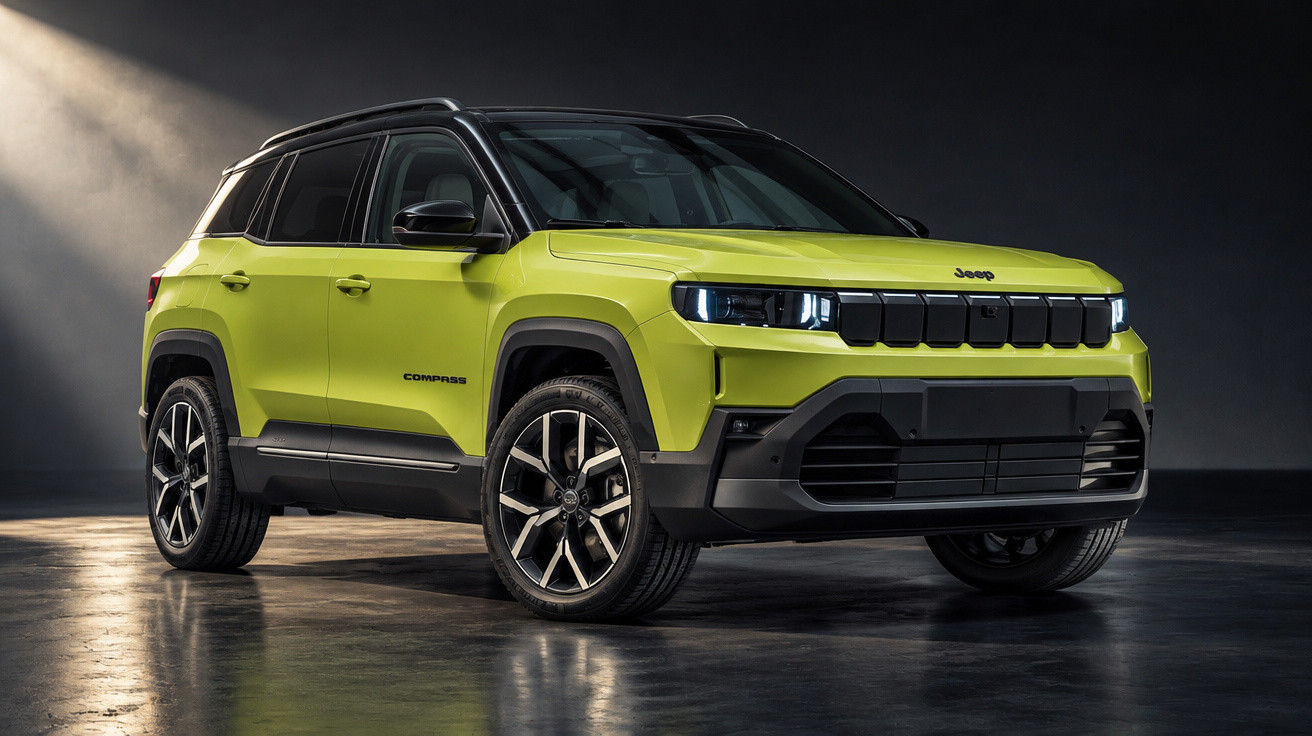
The new Jeep Compass is far more than a token facelift. Jeep has loaded it with extra equipment, additional exterior presence, a roomier interior and, crucially, more powertrain options. The line-up includes three fully electric models offering up to 403 miles of range, alongside two hybrid alternatives.
Jeep Compass electric powertrains and charging
The EV range offers a choice of 74kWh and 96kWh batteries. The larger pack delivers the headline 403-mile range, while the smaller battery still manages a respectable 310 miles from a single charge.
Both battery sizes can be paired with front-wheel drive. The 74kWh model produces 210bhp, whereas the 96kWh version develops 229bhp. That larger-battery model can also be specified with four-wheel drive, adding a second electric motor to produce a frankly excessive 370bhp and, remarkably, up to 2,380lb ft of torque through a 14:1 reducer. That is a lot of torque.
Every electrified Compass has an active grille shutter built into the front bumper, wheel-mounted air ducts and a completely flat underbody to improve aerodynamic efficiency. Rapid charging at up to 160kW is supported, allowing a 20-80 per cent top-up in 30 minutes.
Other versions of the updated Jeep Compass include a mild hybrid, known as e-Hybrid in JeepSpeak, and a plug-in hybrid. The latter is no longer badged ‘4xe’, instead carrying the name 'e-Hybrid Plus'. Both hybrids offer more power than previously: the mild hybrid develops 143bhp, while the PHEV produces 192bhp.
Jeep Compass design and off-road ability
Taking cues from the smaller Jeep Avenger, this rugged SUV features the brand’s familiar seven-slot grille, pronounced wheel arches and LED matrix headlights. Jeep has moved the vehicle radar physically to reduce the risk of it being damaged in confined spaces, strengthened the bumpers and fitted a protective shield to help prevent paint scratches.
A revised suspension set-up brings new springs, dampers and an anti-roll bar. With up to 200mm of ground clearance, a 20-degree approach angle, a 15-degree breakover angle and a 26-degree departure angle, it should be suitably equipped for the UK's worst potholes. Should it have been raining - as it surely will have - the Compass can also wade through water up to 470mm deep.
Choosing the all-wheel-drive model improves the approach angle to 27 degrees, the breakover angle to 16 degrees and the departure angle to 31 degrees. Hill descent control comes as standard on AWD versions.
More cabin space and standard technology
Jeep has reshaped the interior to create more than five extra centimetres of legroom, increase boot capacity by 45 litres to 550 litres, and provide an additional 34 litres of front storage. The company is also making much of the comfort on offer.
A 16in central touchscreen is fitted as standard, accompanied by a 10in driver display, with both benefiting from over-the-air updates. A head-up display and driver-assistance systems, including semi-automatic lane changing, are standard too.
Jeep will begin with the Compass First Edition, finished in lime green, which is available with either the mild-hybrid powertrain or the 210bhp front-wheel-drive EV.
This trim includes slightly larger 20in wheels, LED matrix headlamps and an electric tailgate. Inside are heated seats, multiple terrain drive modes and an extensive suite of driver-assistance systems, all of which can be upgraded. Prices for the Jeep Compass First Edition start at £35,700 for the e-Hybrid and £39,200 for the EV. Jeep has not yet confirmed PHEV pricing, although order books open in the summer. More as we get it.






Comments
No comments yet. Be the first to comment!
Leave a Comment