You might think there is no easier way to extract a little extra money from a sports car: make a stripped-out, striped, track-bred limited edition. It sounds like an idea almost as old as the motor car itself – as though Karl Benz stepped out of his Patent-Motorwagen and announced that it needed an adjustable rear wing and a suede-trimmed steering wheel.
But no. It is difficult to state with certainty who began the rush, although, as with plenty of automotive bright ideas, the answer is probably German. It probably had its engine behind the driver, too. You can see where this is heading: the 1973 Porsche 911 2.7 RS.
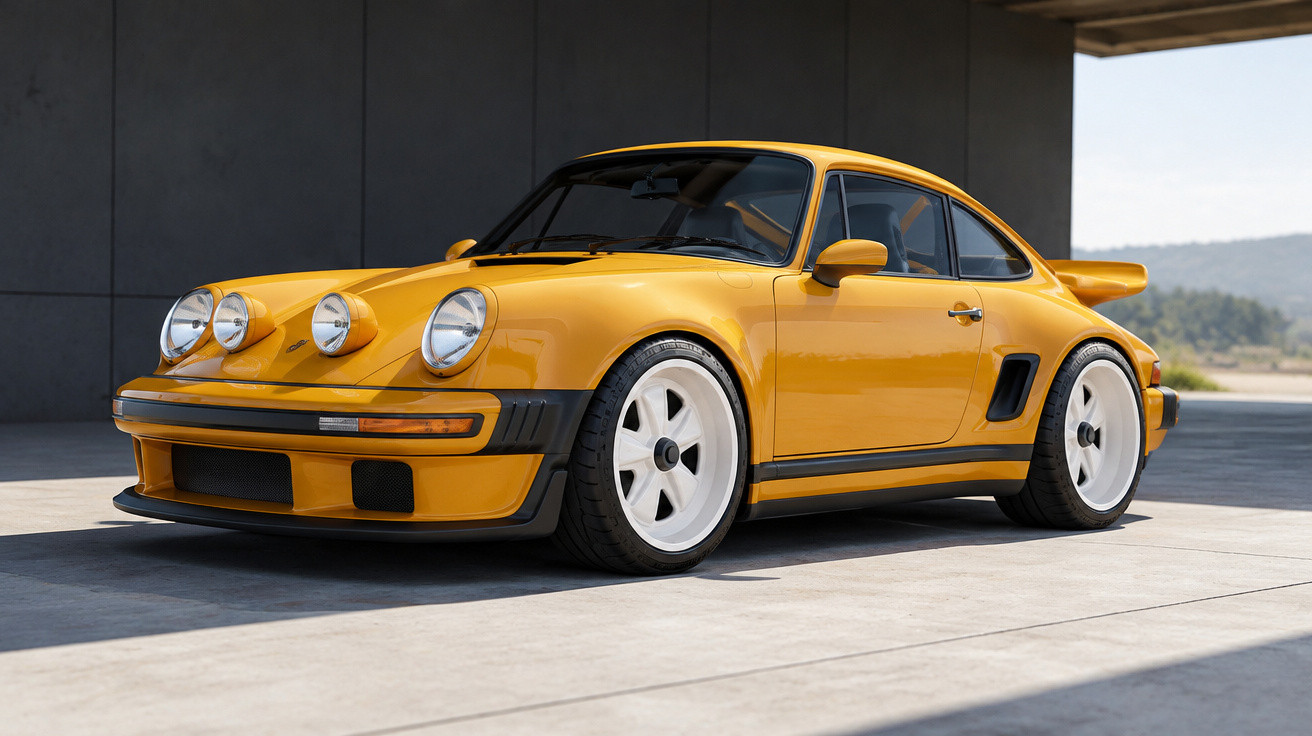
It had every ingredient: an aero package – modest by current standards – capped by the ducktail spoiler’s first outing. There was firmer Bilstein suspension, broader tyres and swollen bodywork made from thinner-gauge steel. Sound insulation went in the bin, while the raised engine lid concealed more power. As with today’s GT3, customers could select either the more usable Touring (1,075kg) or the harder-core 960kg Sport.
Porsche forecast sales of 500, enough to meet racing-car homologation requirements and prove to the FIA that its new competition 911 remained connected to a road car. The RS took the firm by surprise, however, as demand reached three times the initial allocation. You might expect the floodgates to have opened, yet they did not. The remainder of the 1970s and the whole of the 1980s were a wilderness for track refugees.
Porsche 911 RS and the first track specials
The RS badge did not return to a 911 until 1992, when it appeared on the 964-generation model. It lost 120kg, gained a few horsepower and did without air conditioning, power steering and even the cabin courtesy lamp; it also gained a roll cage and a ride height barely above the road. Yet the proposition of paying more for less, combined with the RS’s outright harshness, failed to convince. Reviews were brutal and sales faltered. Of course, a 964 RS is now a £250k unicorn – roughly half the price of the 2.7 forefather.
BMW spies the opportunity to play on its heritage and resurrects three iconic initials: the E46 M3 CSL is quite possibly peak M car
As Porsche nursed its scorched fingers, the Italians moved in. Surely this was the point at which the lightweight track special would take hold for good? The Ferrari 348 Competizione should have launched the Speciale lineage. Its huge 200kg reduction was achieved partly through an unusually early adoption of carbon-fibre panels. A fuller-sounding exhaust extracted another 10bhp from the 3.4-litre V8, although the shorter final drive made the performance feel more dramatic still.
Why did it not become the springboard? Ferrari had the formula right but got the sums wrong. Just 50 Comps were made, while their exotic panels pushed the 348’s list price above that of the prettier new F355, which had already arrived to ruin the celebration.
At about this stage, the condensed history of stripped-and-ripped supercars reaches a dead end: the road-going Le Mans special. McLaren marked its extraordinary 1995 Le Mans 24-hour victory with five F1 LMs, while regulations obliged Porsche and Mercedes to offer road-legal versions of their vast endurance racers. This created the outrageous 911 GT1 Street Version and CLK AMG GTR. They were certainly circuit-bred versions of road cars, but they approached the idea from the opposite direction: competition cars made fit for roads, rather than street supercars given a drizzle of motorsport flavour. No matter – the CLK’s supremacy killed GT1 racing, and that was the end of it.
Ferrari, Porsche and the modern track special
Then came 2003, a landmark year. Ferrari and Porsche faced one another with their respective special editions, creating two bloodlines of track-day heroes. The 360 Modena became the Challenge Stradale, while the 996 developed into its final roll-caged fighting form as the 911 GT3 RS.
Porsche offered its contender solely in white; Ferrari asked thousands extra for a white stripe. The 911 came only with a manual gearbox, whereas Ferrari chose F1 paddle shifts. Crucially, though, both found enthusiastic buyers willing to embrace the sound, stiffness, sweat and profoundly inconvenient harnesses. This was the birth of the modern track special, and other manufacturers were watching with euro signs in their eyes.
The appeal was not confined to the supercar aristocracy. BMW spotted a chance to exploit its heritage and revive three celebrated initials: the E46 M3 CSL, perhaps the definitive M car. Famously, the £58,000 CSL was fitted as standard with an automated manual gearbox, plus a courteous warning that its semi-slick Michelin tyres could be somewhat unsettled in wet weather.
Whatever BMW had been drinking at the time filtered down to Mini. With the 2006 John Cooper Works GP, Mini beat the Renault Megane R26.R to the stripped-out track-day hot hatch concept by a couple of years. Mini lost its direction after the brilliant GP2, but Renault’s Trophy-R models progressed from strength to lap-record-smashing strength. Sadly, that family now seems to have run aground.
Meanwhile, 2007 brought Lamborghini’s literally named Gallardo Superleggera, while Mercedes’ Black Series arguably peaked prematurely with the magnificent CLK63 Widebody – another German super-coupé sold alongside a grubby-weather ‘take care’ letter.
If you want to make a car go quicker, it’s cheaper and easier to add power than subtract mass
Until this point, the concept had largely been Europe’s preserve. America got it right at the first attempt with the Dodge Viper ACR, an improbable lap-record star. The equation was straightforward: 600bhp + 68kg of downforce – 36kg = major improvements. Simpler days.
Right then, the global financial crisis threatened to halt the fun. Fortunately, carmakers instead pushed the boundaries beyond the map’s edge. Ferrari applied the treatment to a front-engined V12 for the first time, producing the controversially named yet magnificently savage 599 GTO.
Bugatti subsequently demonstrated that even the world’s quickest car could benefit from more power, less weight, grippier tyres and revised aerodynamics, even if the 267mph Veyron Super Sport was far from what anyone would call a track car.
Soon afterwards, Porsche had no more 911s left to put on a diet, so it turned its suede-clad attention to its mid-engined pair, creating the Boxster Spyder and Cayman R. Another niche within the niche then emerged: the track-only hypercar. We received the McLaren P1 GTR, while the LaFerrari transformed into the FXXK.
British track specials and lighter weight cars
Yet the central business of extreme evolutions of already rapid cars continued to thrive. Nissan carried the Japanese flag once flown by the NSX Type R and its gramme-saving gearlever gaiter, setting internet forums ablaze with the GT-R Nismo N Attack. Nissan called it ‘road legal’ for its Nürburgring lap record; others were less persuaded. Life is too short to fret over it. The British were on their way.
And, cor blimey, did we mean business. Within little more than 12 months, Aston Martin produced not one but two winged beasts: the Vantage GT12 and GT8. Our ears are still ringing. McLaren’s first move into longtail territory delivered the excellent 675LT, while Jaguar’s Special Vehicle Operations skunkworks layered D-type cool over the F-Type-like Project 7. It may be overlooked now, but could it soon surge in value – along with the Project 8 – as the final flourish of old-school muscle-car Jaguar?
We could not see it at the time, but that may have been the track special’s high point. What prospect is there of another Jaguar ‘Project’, or a Nürburgring-master Megane now Renault’s hatchback is an electric crossover? Cars have kept growing in both dimensions and mass: the current M4 ‘CSL’ is actually heavier than the ordinary full-fat M4 it superseded. And, thanks to the instant shove of an electric motor, adding power is a great deal cheaper and simpler than removing weight if you want a faster car – before even considering fitting a six-point, fertility-crushing harness.
So we return to where it started. Porsche’s GT division was never entirely content with the 2016 911 R, prompting boss Andreas Preuninger to revisit the idea for the 911’s 60th birthday and create the GOAT: the lighter still, though strictly track-prohibited, 911 S/T. Company founder Ferry Porsche once said “the last car built on Earth will surely be a sports car”. It will probably wear stripes and stickers, feature seatbacks that punish your backside, and use magnesium wheel nuts. Long live the light(er)weights.


Comments
No comments yet. Be the first to comment!
Leave a Comment