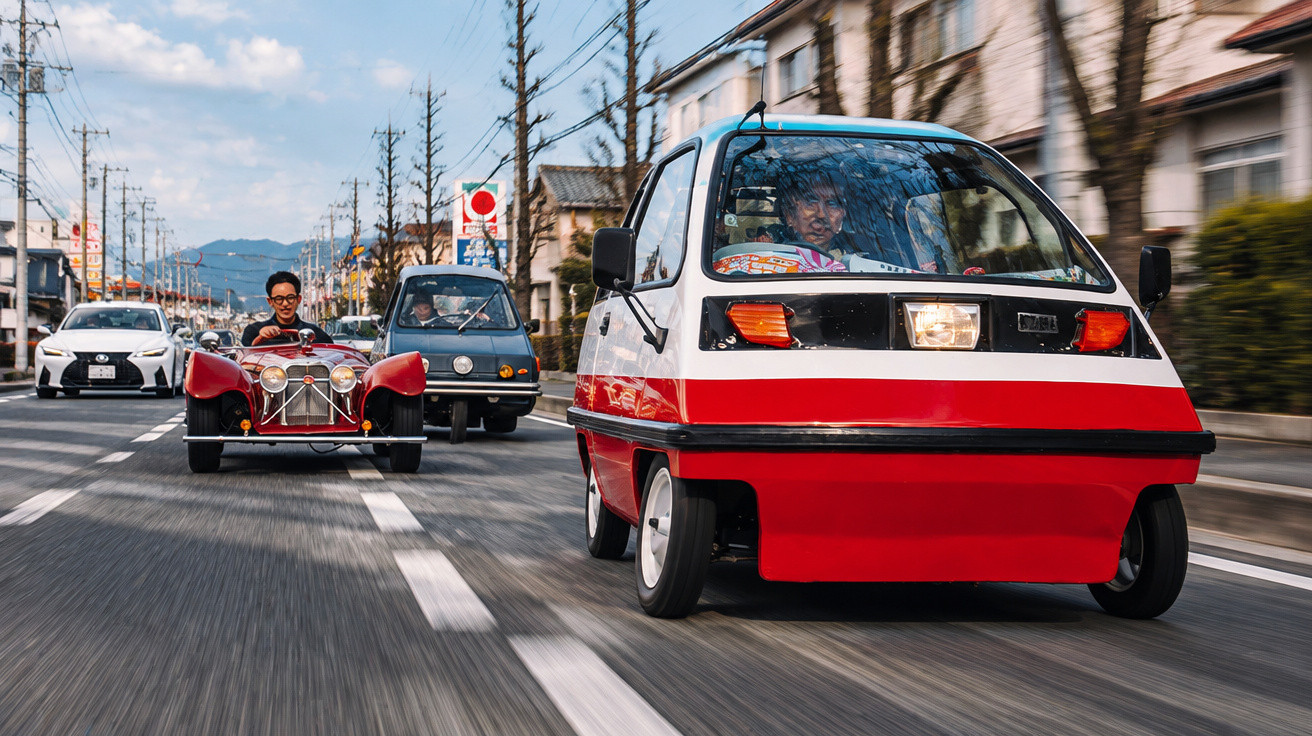
Japan has a vast road system, with around 1,207,000 km of tarmac spanning its extensive terrain. That sounds substantial, yet it must accommodate roughly 82 million vehicles every day, including in some of the planet’s most densely populated cities. By rights, the country ought to be permanently gridlocked. Since the 1950s, however, Japan has had a small advantage in reserve.
Kei-jidõsha – more widely called the kei car – is the smallest motor-vehicle category allowed on Japanese roads and motorways. For decades, this class has delivered some of the strangest-looking vehicles found anywhere, using motorcycle-sized engines and tyres small enough for a wheelbarrow. At a time when the automotive world is more oversized and heavy than ever, the Japanese kei car looks like the cheat code needed to overcome the problem.
The category arrived in 1949, following the Second World War. Japan needed to get the country moving again, but constrained resources and a fragile economy placed conventional passenger cars beyond the means of most buyers. The new ‘light vehicle’ category filled that gap: at first, it was restricted to a 150cc four-stroke engine, or a 100cc two-stroke, before the ceiling rose to 360cc in the mid-1950s. It was not until 1958 that the first truly popular kei car emerged in the form of Subaru’s 360, which accommodated four people despite being less than three metres long.
Photography: Mark Riccioni
By the 1990s, permitted engine capacity had increased to 660cc. Manufacturers then began using forced induction to improve both output and efficiency, producing some of the most celebrated kei cars yet, including the Suzuki Cappuccino, Autozam AZ-1 and Honda Beat. There was no formal power maximum, although a gentlemen’s agreement limited output to 63bhp. Their dimensions, meanwhile, have not changed since 1998: they can be no more than 3.4m long, 1.48m wide and 2.0m high.
Kei cars are not required to meet the same safety rules as non-kei models, which also explains why they are seldom officially sold beyond Japan. That does not make them inherently unsafe, but it is easy to imagine the Euro NCAP team taking a dim view of your shins becoming part of the front-end crumple test.
Kei cars are so popular that they represent more than a third of all vehicle sales in Japan. Yet before the category’s boom years, another trend was appearing – one that made even the tiniest kei cars seem Hummer-sized by comparison. It was a class of vehicle that did not even require a driving licence, because the 1970s introduced the stranger world of Japanese micro cars. The company that drove this movement will already be familiar to anyone interested in obscure, alien-looking machinery: Mitsuoka Motor.
Mitsuoka and the rise of Japanese micro cars
Long before Mitsuoka began turning K11 Micras into AI-generated Jaguar Mark IIs, the company’s work focused on importing and servicing European cars for customers throughout Japan. Its founder, Susumu Mitsuoka, had always wanted to build his own vehicles, but the chance did not arrive until the late 1970s. A customer brought an Italian micro car, a Casalini Sulky, in for repair, but Mitsuoka-san could not source the components needed to mend it. Instead of abandoning the job, he took the optimistic Top Gear approach and declared, ‘How hard can it be?’. A few years later, in 1982, Mitsuoka completed its first full vehicle: the BUBU Shuttle-50.
Describing it as a car by current standards may be a stretch, although it did have doors, wing mirrors and a windscreen. A 50cc engine drove one rear wheel, while the two front wheels handled steering. This was not weirdness for its own sake, though. Mitsuoka’s aim was to give all Japanese people mobility, and the BUBU Shuttle-50 could legally be used on the road with only a moped licence. Its 50cc engine, together with handlebar-operated steering, throttle and brakes, made that possible. Its rear-opening door, fitted with fold-out ramps, also allowed people with disabilities to use it through the hand controls. It was even narrow enough to pass through a doorway, so owners did not need the luxury of a garage or off-street parking.
Later that same year, the BUBU Shuttle-50 was joined by the BUBU 501, a smaller and sleeker machine that retained the 50cc engine and three-wheel layout but gained a steering wheel. Three years afterwards, Mitsuoka added the BUBU 505-C, styled to resemble a quarter-scale Morgan Roadster. Although the firm moved into full-sized vehicles from the late 1980s, its micro car idea remained in the range until 2007.
Every one of these vehicles, obscure even by Mitsuoka standards, fulfilled an important purpose that kei cars could not. They were even more suitable for Japan’s often narrow roads, while obtaining a moped licence cost considerably less than gaining the comparable car licence. Sales never became enormous, but the micro car market continued to strengthen until the end of the 1980s, when a regulatory change effectively decided its fate. Safety had become rather more important, and micro cars would now require their drivers to hold a full licence, sharply reducing their appeal. Decades later, one man based in Wakayama has made it his life’s work to continue the legacy of this peculiar chapter in Japanese motoring: Kaoru Hasegawa.
They're unlike anything else you’ll see on the roads, and their intrigue is one that captivates just about every age and generation
“I got my first micro car nearly 30 years ago,” Hasegawa-san proudly states. “I have always enjoyed small vehicles, and I was actually given my first micro car. It had been abandoned in the corner of a car shop out in the countryside, so I spent time restoring it and started driving it around. It was so much fun, and the reaction from other people was amazing. I knew I wanted another micro car, so shortly after I started looking around and researching the history of them.”
Kaoru Hasegawa’s rare micro car collection
Although thousands were sold across Japan, finding a sound, operational example has become as challenging as tracking down a rare supercar. Most buyers regarded micro cars as simple, immediate transport rather than vehicles to treasure or collect. For Hasegawa-san, that is also part of their attraction. The BMW Isetta and Peel P50 are familiar to many people, and both were sold in far greater quantities across Europe, but the Japanese models are more compelling because they were smaller and scarcer still. Hasegawa-san’s collection now contains more than 10 models, and even after 30 years of enthusiasm he is still searching for further additions.
“When they were new, micro cars could be driven with a moped licence, so they sold very well,” he adds. “Especially among housewives, as they had been designed to allow people to move quickly with luggage or shopping in all weather conditions. They were much cheaper than a car and could be stored in a normal house easily. But when the new law was passed meaning that owners needed a driving licence to run them, the sales stopped and dealers turned their attention towards kei cars instead.”
Hasegawa-san is not merely a collector of these curiosities. He has spent years sharing his affection for them on social media, and before long messages were arriving in volume from fascinated car fans attempting to work out what they were seeing. Other micro car enthusiasts, in many instances, had assumed that the early Mitsuoka BUBU models would never appear again. His collection is not restricted to Japanese machines, either. Among his prized vehicles are an Italian Casalini Sulky and an All Cars Snuggy Charly – and those genuinely are their names. As international interest in his modest collection grew, Hasegawa-san decided to establish a proper museum. It might sound like a huge and costly undertaking, until it becomes clear that the entire collection fits comfortably inside an ordinary ground-floor garage.
“I created the WAZUKA Micro Car Museum because of the messages I kept receiving on social media from people wanting to see the real things,” he adds. “There are many car museums in Japan, but there is no museum anywhere that specialises in micro cars! So, I thought I would make one myself. All of the cars on display are in good, original condition while also being the models produced in the least numbers. I have travelled all across Japan to find them, and the friends who are gathered here with me were all enthusiasts met along the way.”
Inside the WAZUKA Micro Car Museum
Appropriately, the WAZUKA Micro Car Museum sits on a narrow street, squeezed into a small terraced house, while the upstairs living space is scattered with tiny pieces of memorabilia. It looks entirely unremarkable from outside, yet its appeal matches that of the unusual vehicles waiting behind its wooden slatted garage door. Hasegawa-san nevertheless regularly arranges micro car meets, inviting friends and fellow enthusiasts including Sinchirou Kubo with his Morgan-like BUBU 505C; Kai Kuramochi, who has lengthened his Casalini Sulky to carry passengers; and Takayuki Teramura, whose Casalini Sulky sits so low that it will ground itself on any speed bump unless he approaches quickly enough.
My goal is to tell everyone about the museum and show them the history of the micro car
These four owners and their vehicles attract more curiosity and craned necks on any street than even a fire-spitting Lamborghini could hope for. All four can occupy a single 7-Eleven parking bay and, provided they stay away from motorways, their top speeds range from 64 km/h to 80 km/h according to the wind direction and road gradient. They are unlike anything else on the road, with a fascination that grips almost every age group and generation.
“We don’t get many tourists down here!” Hasegawa-san laughs, hardly surprising when the museum is a seven-hour drive from Tokyo and two hours south of Osaka. “But my goal is to tell everyone about the museum and show them the history of the micro car. I am always looking for more cars to add – it is half the fun with micro cars, because they often end up in the most obscure and unusual places. So to bring as many together as possible – and keep them in good usable condition – is a dream for me that I will continue to live out as long as I can.”
Kaoru Hasegawa’s WAZUKA Micro Car Museum can be found in Kainan, in Japan’s Wakayama prefecture. To arrange a visit, send him a message via @kaoru.bubu on Instagram.



Comments
No comments yet. Be the first to comment!
Leave a Comment