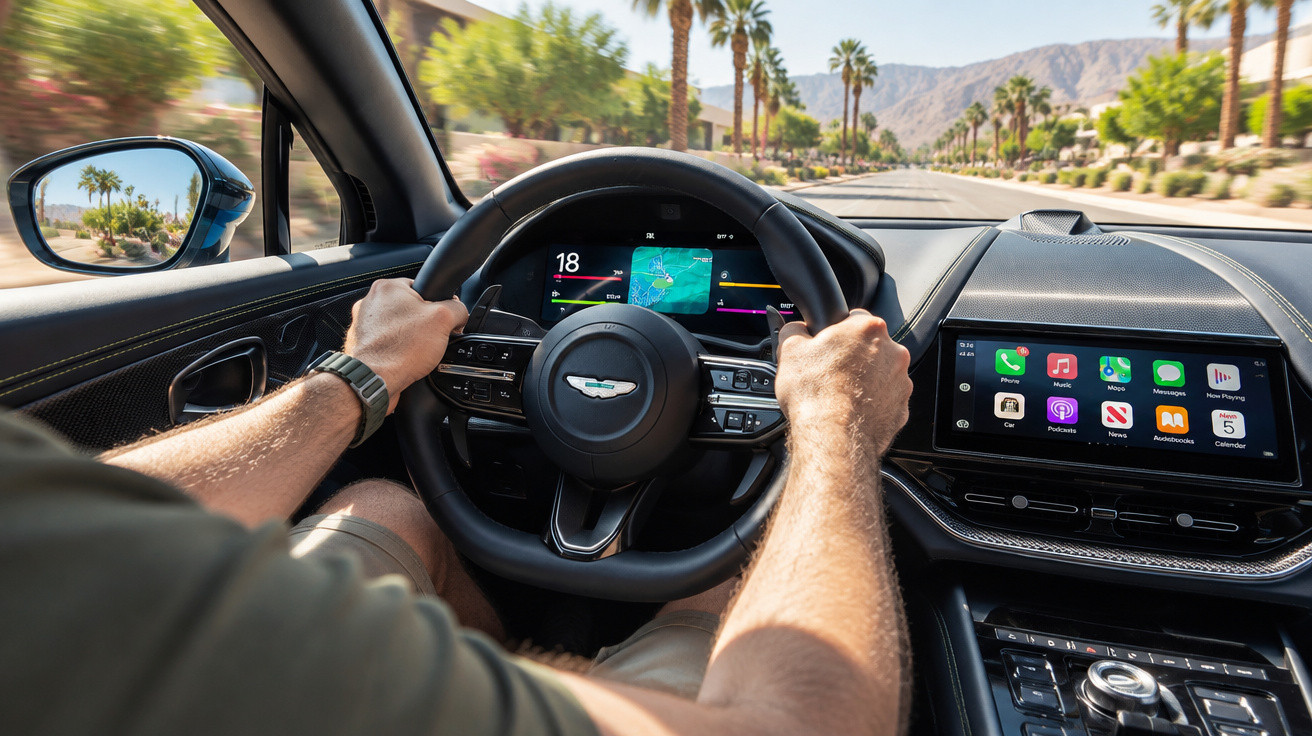
If you have an iPhone and your car is not a hand-me-down from your grandparents, you will probably be well acquainted with Apple CarPlay: the now widespread software that puts your smartphone on the car’s infotainment display, giving you a familiar, straightforward way to use navigation, podcasts, music, messages and more. That is now officially yesterday’s technology, however, as the next-generation CarPlay – CarPlay Ultra – has arrived, and we have tried it.
Apple originally revealed it was developing a next-generation CarPlay system back in 2022. Little more was heard until its 2024 Worldwide Developers Conference (WWDC), when two videos provided a closer look at its appearance and operation. Now, in spring 2025, we have finally experienced it for ourselves… in an Aston Martin DBX 707.
We explain the new functions below, why Aston Martin was first in line and when you will be able to try it. First, though, it is worth understanding what makes this system different. The former version simply mirrored your phone and a selection of its apps: you connected by cable or wirelessly, your phone handled all the processing, and the car acted as a display. This time, considerably more is happening.
Some content is still mirrored and processed by the phone, but it is now combined with what Apple calls ‘local UI’: information pulled directly from the vehicle, including fuel level, speed and climate controls, then presented in Apple’s characteristically uncluttered, easy-to-read interface. There is also ‘punch-through UI’, which permits elements of the car’s native system to appear within CarPlay, such as the reversing-camera feed.
The objective is a smoother experience, without the need to keep switching between the Apple CarPlay interface and the car’s own system. Everything is gathered within one unified visual layer across every display in the vehicle, regardless of their size or number. Our initial drive was in an Aston Martin DBX 707, which has a comparatively modest 10.25in central touchscreen and a digital instrument cluster. Here is what we discovered.
18 minutes 32 seconds
CarPlay Ultra starts instantly
When you first pair your phone with a CarPlay Ultra-equipped car, you will need to connect wirelessly or via a cable. Every time you enter that same car afterwards, though, it starts immediately, effectively making CarPlay Ultra your default interface in that vehicle. After our phone had paired, the instrument cluster showed Aston Martin and CarPlay logos, while the central screen displayed a sweeping “hello” message – recognisable to anyone who has recently set up a new iPhone or iPad.
It takes control of the instrument cluster
This is the crucial distinction between the new system and its predecessor. Alongside the central display, it controls the instrument cluster, offering a choice of dial designs and layouts created jointly by Apple and Aston Martin. Apple essentially supplies Aston Martin with a toolkit of graphics and apps, which Aston Martin then tailors completely to suit its car.
Using the steering wheel’s thumb pad, swiping left or right changes the dial layout, rather like moving between Apple Watch faces. Options run from a traditional racing-green twin-roundel design that echoes analogue instruments – closer to the Aston Martin end of the scale – to coloured horizontal bars with a more Apple-like appearance. You can also give the map the full display, reducing speed and engine-rev information to the bottom of the screen.
Swipe up or down on the thumb pad and the central square can be changed to show maps, audio details, tyre pressure, trip data and so on, all in the clear, legible visual language that has become central to Apple’s products.
CarPlay Ultra offers customisation
Head into the settings app and you can adjust the colours of the instrument-cluster layouts as much as you like. Unfortunately, the layouts themselves cannot yet be altered: they are fixed, although additional ones may arrive through future over-the-air updates.
Every function is integrated
This is another central benefit. Previously, changing climate settings, turning on seat heating or selecting another radio station meant leaving the CarPlay interface. Those controls now sit within the CarPlay system and have been designed with a simple, distinctly Apple appearance.
You therefore have a choice: operate the car through the CarPlay interface, use the vehicle’s physical controls, where fitted, or ask Apple’s Siri voice assistant. Siri is now linked to the voice-command button on the steering wheel.
Punch-through UI can retain native screens
Certain specialist pages from the car’s own interface can now appear as normal within the CarPlay environment. The DBX we drove, for instance, was fitted with the range-topping Bowers and Wilkins sound system. It includes a dedicated page that lets audiophiles fine-tune their settings. You access it through the audio settings, but it looks and operates exactly as it does in Aston Martin’s in-house software.
It recognises where you are from
This was an entertaining detail. Although the test was conducted in California, connecting our UK-registered iPhone made the system recognise that we were British. It changed the climate-control temperature units from Fahrenheit to Celsius and used the spelling ‘favourites’ in the radio app. Much appreciated.
Aston Martin is first, but other manufacturers may go further
From today (15 May), every new Aston Martin sold in the US includes CarPlay Ultra as standard, although buyers can still choose the older-style system if they prefer. Owners of Astons bought during the past couple of years with the latest-generation infotainment system can visit a dealer for installation. Aston Martin will introduce the system globally over the next 12 months, while numerous other manufacturers have also confirmed that they will offer it shortly, including Ford, Volvo, Renault, Porsche and Hyundai.
As noted above, every manufacturer will collaborate with Apple to create a version of the CarPlay Ultra ‘toolbox’ suited to each individual model. That will account for whether it is petrol or electric, whether it has a passenger-side display, and the size and shape of its central screen. As a result, the system in an Aston Martin should look markedly different from the technology used in a Honda.
Not every manufacturer is fully on board
When Apple first said its software could assume control of every screen and interface in a car, not all manufacturers welcomed the prospect.
Mercedes-Benz chief executive Ola Källenius said publicly in 2024 that handing the entire instrument cluster and passenger display to another company was a big fat no for him. Oddly, Mercedes-Benz still appears on Apple’s confirmed list of brands adopting the technology. In any case, Apple has been working away – which helps explain the lengthy development period – to provide enough scope for customisation to satisfy every individual manufacturer.
What you need for CarPlay Ultra
Using CarPlay Ultra requires a car with a digital instrument cluster and the relevant software installed. You will also need an iPhone 12 or newer running at least iOS 18.4. Once activated, CarPlay Ultra works entirely through a wireless connection. Perhaps it is time to replace that steam-powered iPhone X.
The verdict on CarPlay Ultra
Anyone who already enjoys CarPlay is likely to enjoy this even more. It removes the need to jump in and out of the CarPlay interface, saving time and making the whole experience far slicker. The system is fully integrated and infused with Apple’s familiar clarity – an area where car makers’ own software can be notably inconsistent.
I am keen to see how other manufacturers, particularly those with screens measured in acres, make use of the toolkit Apple provides. The Apple Car has finally arrived! In a fashion…








Comments
No comments yet. Be the first to comment!
Leave a Comment