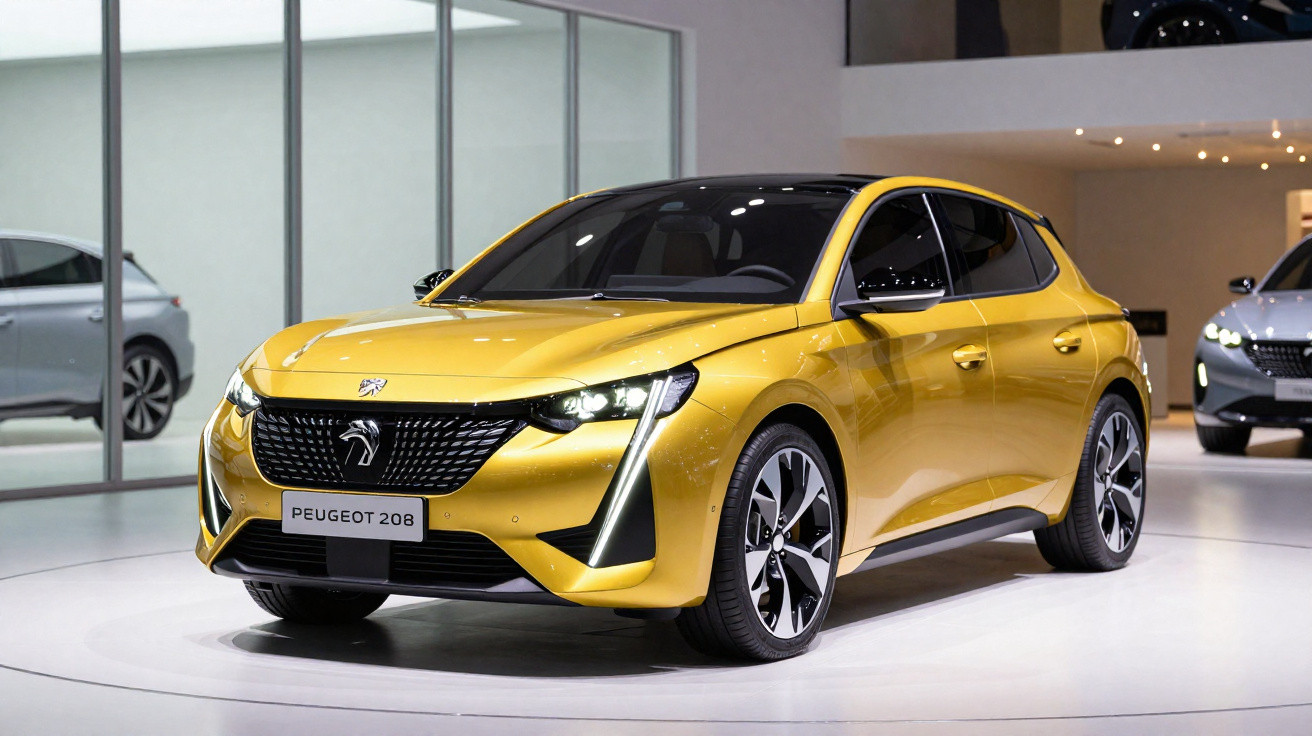
The B-segment is heating up with the arrival of the new Peugeot 208. One of Portugal’s best-selling models now faces its rivals in completely renewed form.
It sits on a new platform, has refreshed engines, and offers a higher-quality, roomier interior. Everything is new.
As for the exterior, you can see it for yourself in this image gallery, photographed in Portugal, the country selected for the 208’s international press launch:
I had the chance to drive every engine offered in the Peugeot 208 range and, having also seen the full equipment list for Portugal, I picked my preferred specification - which I will reveal at the end of this article. Let’s begin with the most modest version.
Peugeot 208 1.2 PureTech 75 hp Active
I have a current-generation Peugeot 208 with this engine in my garage - alongside the car you already know - so I was particularly keen to make a proper comparison between the two.
In the new Peugeot 208, the 1.2 PureTech engine has lost 7 hp, falling from the previous 82 hp to the current 75 hp because of the introduction of WLTP regulations. Behind the wheel, however, that reduction in power is not noticeable.
It is an adequate engine for the Peugeot 208. Acceleration is not especially lively, but it is enough in most circumstances. It is the only engine still paired with a five-speed manual gearbox, and that is its main handicap. It is perfectly acceptable in town and even pleasant on country roads, but it does not shine on the motorway.
In terms of fuel consumption, expect averages of around 6.2 l/100 km.
Since I mentioned the previous Peugeot 208 - in which I have covered more than 66,000 km to date - this is a good opportunity to address engine isolation and cabin soundproofing. Both have improved enormously. It is the same engine, yet fewer vibrations and less noise reach the occupants.
On versions fitted with 16-inch wheels and higher-profile tyres, the 208’s handling benefits. Compared with the previous generation on equivalent wheels and tyres, the improvement is substantial. The suspension deals far more calmly with imperfections in the tarmac.
From a dynamic perspective, the step forward is less obvious. In this respect, the Peugeot 208 has not advanced as much as it has elsewhere. The steering weight is right and the suspension performs well, but it never becomes truly exciting.
In equipment terms, consider the Active trim, which is the model’s entry-level version. The Like version, the cheapest of all, will only be available to order, priced at 16,700 euros.
In Active trim, the Peugeot 208 will cost 17,600 euros - 900 euros more than the Like - and it already comes with a very comprehensive equipment list.
Among other features, Active trim includes traffic-sign recognition, LED daytime running lights, a gloss chrome grille, 16-inch PLAKA wheels, the 3.5-inch PEUGEOT i-Cockpit®, Bluetooth radio with a 7-inch capacitive touchscreen, an electric parking brake, single-zone air conditioning, keyless start, 4 USB ports, and more.
Want to know more? Click the button and compare the standard equipment fitted to every version:
But back to what matters. Definitely forget the Like version. As for the 1.2 PureTech 75 hp engine, there is no reason to be wary of it. It does the job without standing out, but it does the job.
Peugeot 208 1.2 PureTech 100 hp Allure
If you want a Peugeot 208 with a higher equipment level, you will have to give up the 1.2 PureTech 75 hp engine. You will therefore need to choose one of these versions:
- 1.2 PureTech 100 hp 6-speed Manual STT - 20,800 euros;
- 1.2 PureTech 100 hp 8-speed Automatic - 22,400 euros;
- 1.2 PureTech 130 hp 8-speed Automatic - 23,750 euros;
- 1.5 BlueHDi 100 hp 6-speed Manual STT - 24,600 euros;
- electric e-208 - 31,350 euros.
Let’s make one thing clear. If you can afford the additional 1,600 euros for the eight-speed automatic gearbox, it is an essential extra. Not because the six-speed manual is bad - it absolutely is not - but because the automatic is better.
Now that I have covered the gearbox, let’s move on to the engine. Which one is best?
The extra 30 hp in the more powerful 1.2 PureTech engine is only really apparent when you decide to extract everything the new Peugeot 208 can offer. Otherwise, the 1.2 PureTech 100 hp is the most balanced petrol engine in the range. It suits the ambitions of a supermini best.
Let’s look at the figures: 11.9 seconds from 0-100 km/h versus 8.7 seconds; and 188 km/h versus 208 km/h for top speed. Fuel consumption was virtually identical, with averages of 6.4 l/100 km.
So, at the end of the day, it is mainly a financial decision: 1,350 euros for an extra 30 hp. Is it worth it? If you enjoy driving, yes; if you are buying the Peugeot 208 simply to handle everyday household duties, stick with the 100 hp version.
Peugeot 208 1.5 BlueHDi: yes or no?
The 1.5 BlueHDi 100 hp is the only Diesel engine in the 208 range. It is a shame this type of engine has been demonised - it really is, and I have written about it here before.
It is a flexible, pleasant engine to use and very economical. Unsurprisingly, the best consumption figures came at the wheel of the 1.5 BlueHDi.
Between Lisbon and Herdade da Comporta, I recorded fuel consumption of 4.4 l/100 km. That was without making major concessions to my pace.
In day-to-day use, the 1.5 BlueHDi stands apart from the 1.2 PureTech by offering slightly greater willingness at low revs. Financially, it stands apart because it costs 3,800 euros more. Those are the key differences.
Using a calculator - and hoping the sums add up, because I am terrible at maths - while taking into account the price gap between petrol and diesel and the differences in consumption, we will need to wait for roughly 110,000 km to recoup the investment in the Diesel engine.
GT Line version (but it could be called Sexy Line)
It is in GT Line trim that the Peugeot 208 design reveals itself in all its glory. There are Full LED lights, 17-inch wheels, tinted windows, an exclusive front grille, black door-mirror caps, and other details that further enhance the French supermini’s lines.
Open the door and the differences continue in the finer details. There is customised interior lighting, aluminium pedals, a compact GT Line perforated-leather steering wheel, front parking assistance, a reversing camera (Visio Park 1), and, above all, magnificent sports seats that deserve lavish praise - without tearing anything, of course…
What is all of this worth? An additional 1,950 euros.
Is it worth it? That depends on your personal taste. Cars are not all identical because we allow ourselves to fall in love with them. And if we let emotion take over, it will be the Peugeot 208 GT Line that comes home with us.
Looking at its appearance, it is worth every argument you may have with your other half.
Right then. If you have not given up on this article yet, you are clearly willing to spend a little more money, so loosen the purse strings and see the price of every option for the new Peugeot 208:
Finally… the Peugeot e-208
It is undoubtedly a very interesting model, but - you could see that “but” coming… - Peugeot asks 32,150 euros for it in Active trim.
As I have written here before, the Peugeot e-208 is equipped with a 50 kWh battery pack, giving it a range of up to 340 km, according to the WLTP (Worldwide harmonised Light Vehicles Test Procedures) homologation protocol. In power terms, the electric unit drives the front axle with 136 hp.
But you already know all that, because you have read our article on it. What you really want to know is how it behaves on the road.
Dynamically, it is a few steps behind its combustion-engined siblings. It is heavier and you can feel it, although it is never dramatic. Put another way, the Peugeot e-208 handles well, but the other 208 models handle even better.
In comfort terms, what is lost through the adoption of slightly firmer suspension tuning is gained acoustically.
Conclusion: which Peugeot 208 should I buy?
Easy. I am not going to say, “it’s up to you”. After spending 20 minutes of your life reading this article, you do not deserve a generic answer.
Seven years ago, when I bought my Peugeot 208 - there is no point explaining now why I chose the 208 over other models - I selected the 1.2 PureTech 82 hp in Allure trim.
If I were buying today, I would choose the 1.2 PureTech 100 hp version in Active trim, which is available from 18,750 euros. In other words, I would choose a more powerful engine and a lower equipment level. Here are the reasons why.
I cover a lot of motorway miles. The 75 hp engine is not bad at all in town, but it lacks a more… long-legged gear on longer trips. The gearbox only has five ratios and the engine feels restricted.
In the 100 hp version, thanks to the addition of a turbo and the resulting increase in maximum torque (118 Nm versus 205 Nm), it feels as though there is far more engine available under your right foot. More than the additional 25 hp would suggest.
As for equipment, Active trim already provides everything essential - and even a little more. If your budget has room, you can aspire to the better-equipped versions, but you will not be poorly served by Active trim.
Now I want to know your opinion. And you, which one would you choose?




Comments
No comments yet. Be the first to comment!
Leave a Comment