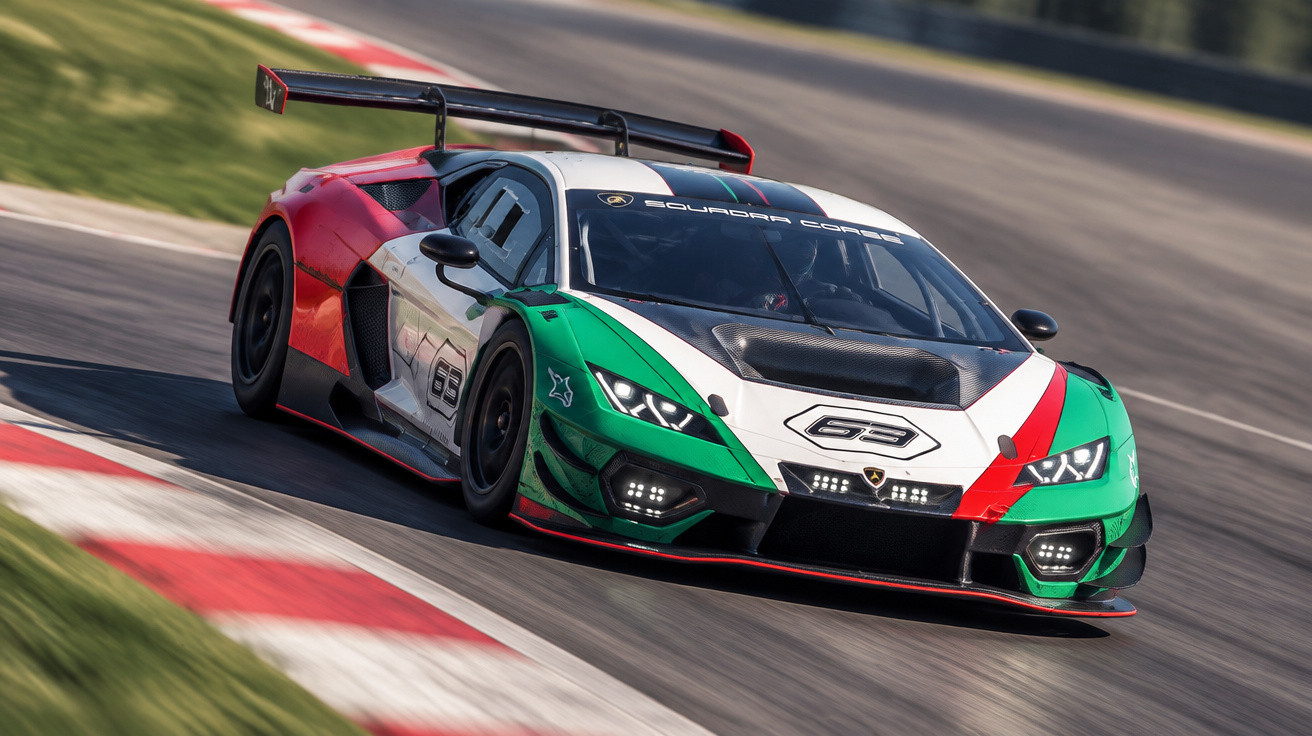
Lamborghini may have created and engineered this competition car entirely at its Sant’Agata factory for the first time, but it follows a brief history of wild customer racers. Meet the new Temerario GT3.
Made for well-heeled drivers wanting to take on one of motorsport’s most entertaining racing series, the Temerario GT3 takes plenty from its road-going counterpart. That includes the new 4.0-litre twin-turbo V8, which was conceived with motorsport very much in mind.
Lamborghini Temerario GT3 V8 powertrain
Naturally, Lamborghini has removed the hybrid system, as GT3 regulations do not permit it. The all-new V8 receives several further changes too: smaller turbochargers and compressors, a revised airbox, and a reduced output. Power falls from the road car’s 800bhp to a more manageable 550bhp, subject to balance of performance.
It will nevertheless spin to a suitably unhinged 10,000rpm, while its calibration is intended to spread its considerable performance over a wider rev range. Lamborghini has also fitted a bespoke Capristo exhaust, which should be worth listening for.
The GT3 is equipped with dedicated KW dampers, quick-change suspension, 18-inch Ronal AG wheels, a bespoke hydraulic steering rack, upgraded electronic architecture, fresh software and new cabin controls. It also gains a “more complete” data logger and a steering wheel developed with contributions from Lamborghini factory and customer drivers.
Carbon bodywork and race-ready aerodynamics
It looks rather sensational as well, particularly in its striking tricolour livery. Lamborghini says the carbon-composite body panels “reduce the base weight of the car as far as possible”. No weight figure has been disclosed, although that too will be governed by BoP. With none of the hybrid hardware from the standard car, it should be substantially lighter.
Aerodynamics have, inevitably, been central to the design - most visibly in the enormous rear wing - improving both downforce and cooling for the engine and brakes. The front and rear sections are each formed as single pieces, while the rear diffuser, engine cover and bonnet use quick-release fixings.
The floor is split into four sections for clear practical reasons. Lamborghini’s pit crews will also be able to refuel more quickly, thanks to revisions to the tank itself. As expected, the car has a roll cage, plus front and rear subframes designed for rapid removal and refitting in the pits.
Temerario GT3 follows the Huracán GT3
There is plenty resting on the Temerario GT3’s rear wing. Over its career, the Huracán GT3 that came before it secured 96 championships worldwide. “The Temerario GT3 is the first racing derivative of the Temerario project, further emphasising Lamborghini’s strong belief in motorsport as a key tool for promoting our road cars,” said Lambo boss Stephan Winkelmann.
Technical chief Rouven Mohr believes it will be quick immediately - and straightforward to run, much like the road car. “We are confident that it will be competitive in terms of lap time, while also nice to drive in a wide range of conditions, including at night and in the rain,” he said.
“The development team has worked hard to ensure the car has a wide operating window, and that the teams are better able to work on it.”
















Comments
No comments yet. Be the first to comment!
Leave a Comment