Steer-by-wire is not a new idea. Commercial aircraft have relied entirely on electronic inputs for decades, while Infiniti introduced the technology to road cars with the Q50 in 2014. It felt odd, however, and buyers were unconvinced.
Infiniti itself was not wholly persuaded either, fitting a conventional physical metal steering column as well. Y’know, just in case. Unsurprisingly, it failed to outsell the BMW 3 Series.
Yet the steer-by-wire era has now properly arrived. Lexus is using it, the Tesla Cybertruck notoriously relies on extremely rapid computations to turn driver inputs into left or right turns, and Mercedes-Benz – the inventor of the motor car, no less – has concluded that computers should now control changes of direction.
Mercedes-Benz steer-by-wire rethinks the wheel
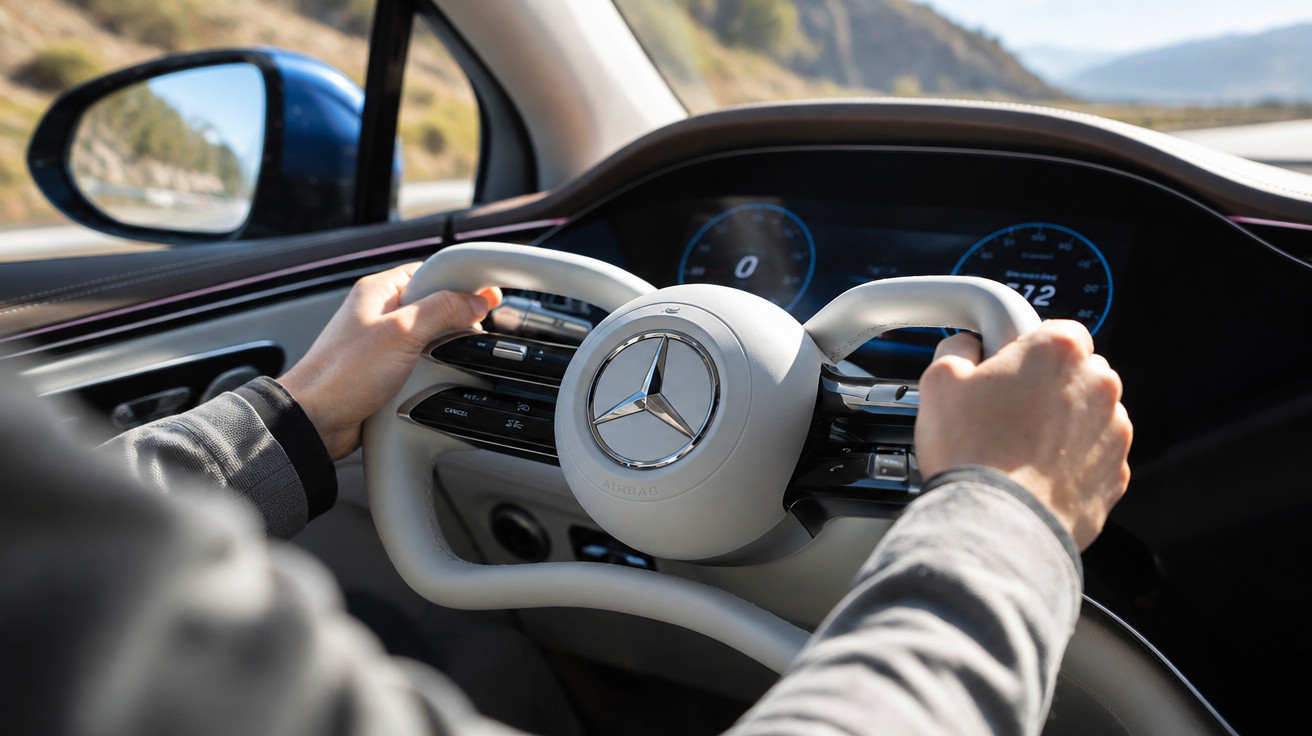
That decision lets Mercedes literally reinvent the wheel. Just look at its steering, er, object. A yoke? A controller? Call it what you like: it has a flat upper edge and curved lower section, giving the driver a clearer, less obstructed view of Mercedes’ latest ‘Hyperscreens’. The dreadful haptic controls appear to be staying, though, so changing direction could still mean accidentally changing the radio station.
Never mind: you might be asleep. Mercedes says the yoke “makes getting in and out of the car easier because the flattened underside creates more room. In combination with future automated driving systems, the driver could have a new, even more relaxed position in the long term". Relaxed already?
The steer-by-wire set-up will not be fitted across the Mercedes range immediately. It will first appear next year in the refreshed EQS electric luxury saloon. Mercedes also says it will deliver greater refinement, arguing that “vibrations caused by uneven road surfaces, which were previously transmitted to the driver via the steering wheel as disturbances, can now be almost completely prevented".
Variable steering and gaming potential
A variable steering ratio is claimed to make parking simpler. The company’s engineers are also enthusiastic about “the opportunity for immersive gaming when the driver stops for a break". That should eliminate the need for dry-steering during charging, as in those gamified Teslas.
It is undeniably clever, but everyone has experienced a computer crash or a frozen phone. Performing an off/on hard reset is considerably more alarming when you are guiding a two-tonne superbarge. So how is Mercedes addressing safety?
Redundant systems for Mercedes safety
According to Mercedes, the unsettling steering system has already covered more than one million kilometres in laboratory tests, plus another million km on test tracks. As with fly-by-wire aircraft, redundancy is built in: every sensor and control unit is duplicated. Should one system fail, a duplicate back-up running from a separate power supply and using different code takes over. But there is more.
Imagine both computers catch a cold. “Even in the most unlikely event of a complete failure”, Mercedes tells us, “lateral guidance is still possible thanks to rear-axle steering and targeted wheel-specific braking interventions via ESP.” That is, of course, still more computers.
Mercedes is right to treat the issue with such seriousness. In part, that is because it has previously put a yoke in a production car: the AMG One, with its F1-inspired steering device.
More importantly, while Mercedes-Benz invented the modern motor car, it did not initially equip it with a steering wheel. The earliest Benz used a tiller, like a canal boat. A Frenchman seeking an edge in a motor race was the person who devised the circular steering ‘wheel’.
Now that steering is being entrusted to strings of ones and zeroes, Mercedes really has to get it right – or left – at the first attempt…
Comments
No comments yet. Be the first to comment!
Leave a Comment