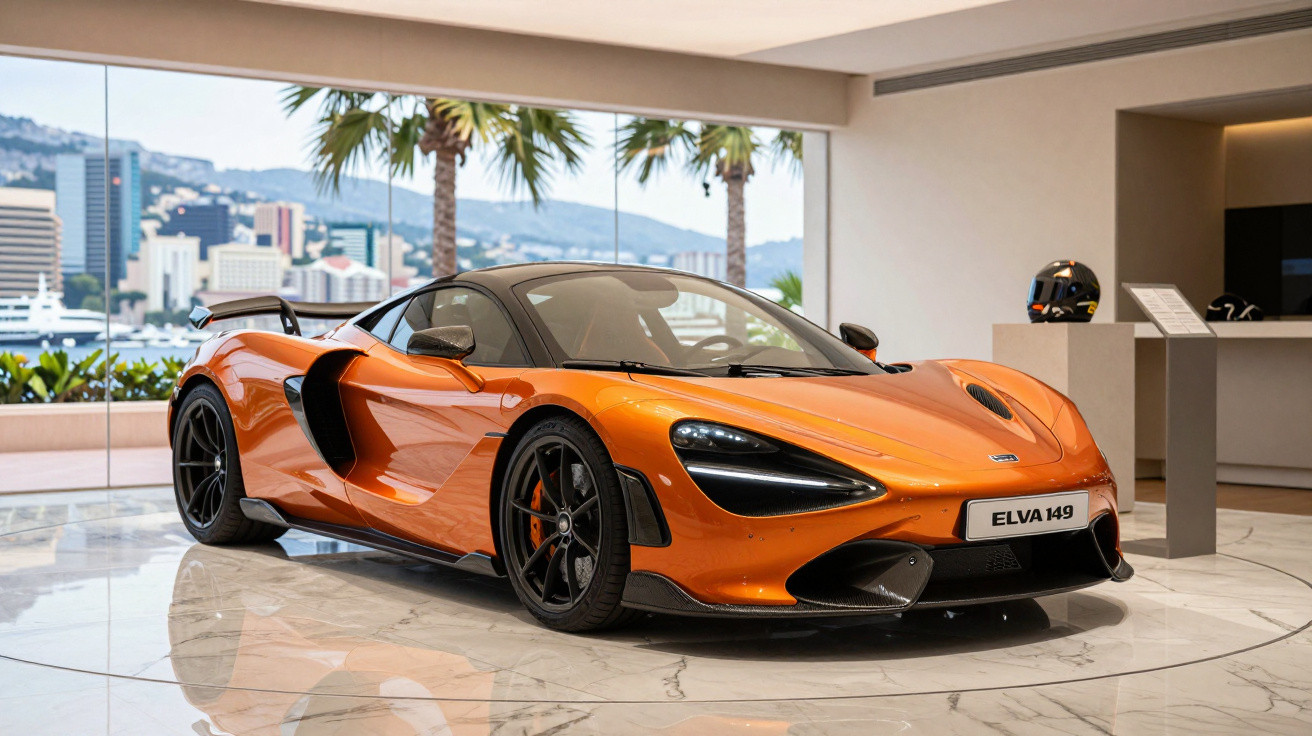
The 149-unit production run of the McLaren Elva pays homage to Elva, the company that built customer versions of McLaren racing cars in the 1960s. It also brings to mind Elvis Presley, who won over cinema audiences behind the wheel of a McLaren Elva M1A in the 1966 film Spinout!.
That brush with the King of Rock ’n’ Roll’s celebrity is something you can borrow when driving this €1.7 million car through the glamorous Principality of Monaco.
Who does not feel nostalgic when looking at black-and-white images from an era in which racing drivers chased their dreams in rudimentary machines, without even the most basic safety provisions, as safety gave way to the prospect of glory? Not that needlessly risking one’s life should be praised, but there is something romantic about the heroic instinct that led every one of them to take far greater risks than common sense would ever recommend.
After Bruce McLaren began making his mark in motorsport with the M1A in the early 1960s, the first orders for road-going versions began to arrive, helped further by the model’s appearance in Spinout!. Between two rock ballads, Elvis Presley collected victories on the tarmac and female hearts with equal speed.
As McLaren’s racing team had no more than half a dozen people and lacked industrial production facilities, it commissioned the private-customer versions from small British manufacturer Elva Cars. Working by hand, the company assembled 24 cars, all of which quickly found buyers.
815 PS, 0-100 km/h in 2.8s, 327 km/h
Jump forward 56 years and, in 2021, McLaren Automotive started delivering the reborn model, aptly named Elva, to 149 customers worldwide. Like its predecessor, it has no windscreen, side windows or roof, while retaining the broad principles of the original.
Its featherweight status begins with an all-carbon-fibre construction, some of it strikingly exposed, which allows it to claim the title of the lightest road-going McLaren ever made.
It also retains a mid-engined layout and delivers extraordinary performance, aided by an abundant 815 PS and 800 Nm - even more than the version of this V8 fitted to the Senna. Combined with its mere 1148 kg dry weight, the figures are otherworldly: 0-100 km/h in 2.8s, 0-200 km/h in 6.8s and a 327 km/h top speed.
Only 149 units will be built
These are figures worthy of an elite McLaren. The Elva belongs to the British marque’s Ultimate Series and is only its fifth member, following the F1 (1994, 106 units in total), P1 (2013, 375 units), Senna (2018, 500) and Speedtail (2020, 106).
McLaren had originally intended to make 399 Elvas, but the pandemic devastated the British company’s plans and finances. Sales fell by more than 60% in 2020, resulting in redundancies, the sale of a stake in its motorsport division and what amounted to a mortgage on the facilities at its Woking headquarters. The total was therefore revised to 149.
The reduction also reflects the substantial investment being directed towards engine electrification, which will consume a large part of research and development funding over the coming years, as chief executive Mike Flewitt acknowledges:
Air, sound and emotion… all unfiltered
For this dynamic experience in the McLaren Elva, there could scarcely be a more fitting place than Monaco, where Bruce McLaren stirred passions at the wheel of his M1A. It serves, at least, as the starting and finishing point for a route through the mountains of the French Riviera.
Once the initial rush prompted by its majestic bodywork has passed - formed from just three enormous panels that could almost be described as sculptures, with the side sections measuring three metres long - the first surprise comes as soon as you climb aboard.
After opening the dihedral doors, as is customary for the brand, you stand up before lowering yourself into place with help from the steering-wheel rim. Seat adjustment abandons the usual directional system - up, down, forwards and backwards - and instead reaches the desired position in one movement: as the cushion lowers, the backrest reclines slightly.
The carbon-fibre-shell bucket seats, with integrated head restraints containing speakers for each occupant, are trimmed in a four-layer material designed to remove moisture and prevent heat build-up. This matters in a completely open car; aniline leather with a protective coating is also available.
The seats are shorter than usual so occupants can place their feet ahead when getting in and out. Behind the seatbacks are concealed roll-over protections which deploy vertically to protect occupants’ heads if an imminent rollover is detected.
Ahead of the driver sits a digital instrument display that moves with the steering column when its height is adjusted. Its information is supplemented by the central 8-inch touchscreen, naturally mounted on a carbon-fibre bracket, which includes further data and numerous applications: circuit telemetry, a reversing camera, navigation mapping and more. It also allows selection of one of 15 drift-tolerance settings.
One helmet can be stored or secured in the passenger footwell, while the other can go beneath the body panel behind the cabin. In the latter case, however, the modest 50 litres of the only space faintly resembling a boot in this car is lost.
That panel extends back to the engine and then the vast rear diffuser, next to the broad mesh panel through which engine heat escapes, the four exhaust outlets - two pointing upwards and two rearwards - and the active rear air deflector.
As in other McLarens, this changes height and angle to act as an air brake under very heavy deceleration. Here it also has the extra task of offsetting changes at the Elva’s front end caused by the raised deflector of the AAMS (Active Air Management System), which diverts air away from the cockpit, as we shall see, to preserve the car’s aerodynamic balance.
Press the ignition button and the V8 answers with an opening growl, drawing attention during the first kilometres through the heart of the Principality. It is not so much the sound it makes - this region is hardly short of engines with plenty of cylinders - but rather the Elva’s bewildering silhouette.
In town, it is easier to enjoy the contact with the elements and the unobstructed view. This can even be done without much embarrassment from comments by reserved, aloof Monegasques, who prefer to glance from the corner of their eye or after the car has passed. Elsewhere in the world, though, the Elva’s extravagance may inspire envy and remarks that are all too audible in the absence of filters. That same lack of filtering means every suspension movement and every inhalation and exhalation of the car’s breathing apparatus can be heard in full detail.
Controls move position
Set into the surround of the digital instruments are the two controls - Handling on the left and Powertrain on the right - used to select the Elva’s “mood” through three programmes: Comfort, Sport and Track. In previous McLarens, these were always positioned on the console between the two seats.
In town, where the lack of wind protection means you can only travel at up to 50 km/h before your eyes begin streaming uncontrollably, the gentlest of the three is the appropriate choice. It delivers damping that protects occupants’ bones from excessive impacts while keeping the “soundtrack” civilised. The suspension, incidentally, is the same as that of the Senna, here too bolted to the carbon monocoque: a multi-mode hydraulic system capable of offering a sufficiently broad range of damping characteristics.
A few minutes later, we reach the entrance to the wonderfully twisting Corniches that seem to “fly over” Monaco, leading to some of the legendary roads used by the Monte Carlo Rally on the routes towards Menton and the Col du Turini.
No windscreen at speeds that defy both logic and, perhaps, the Highway Code? Yes, please. To prevent the light breeze from becoming a Category 5 cyclone on the Saffir-Simpson scale, or from tearing the head off this astonished Elva driver, McLaren designed a retractable system to direct the swirling air away from the cockpit. Air enters through the radiator at the front of the car, is channelled and accelerated, then exits behind this barrier to create, together with the air deflected by it, a bubble of air above the Elva.
Special racing helmets
McLaren’s engineers say it is possible to hold a conversation without shouting - merely raising your voice - at up to 120 km/h. This experience, however, made that sound overly optimistic, although there is no denying that it diverts a large proportion of the airflow away from occupants’ heads.
The standard setting is switched off, but if the driver activates it between 0 and 70 km/h, the deflector rises automatically at 45 km/h and lowers below that speed. It remains active until 200 km/h, the maximum speed allowed with AAMS engaged. Without a helmet, though, anything above 100 km/h starts to feel somewhat reckless, even with the photochromic-lens glasses in anodised aluminium frames. They cost €500 and are included as standard equipment.
At 200 km/h, the deflector lowers and retracts into the front bonnet, beneath which there is no small luggage compartment. Air can then reach the engine with less obstruction for cooling purposes. Only the helmet jointly developed with Bell, with its full visor but open front designed to avoid violently pushing the wearer’s head sideways when the wind becomes truly fierce, permits speeds beyond that point. Even then, it is more turbulent than on many motorcycles, however deeply you try to sink into the seat.
Alongside this unusual exposure to the elements, the performance figures mentioned earlier, firmly in ballistic territory - including reaching 200 km/h one second sooner than the already supersonic Senna - had already suggested the fizzing emotions available aboard the Elva.
On roads defined by bends of every kind, straights become brief pauses between corners. There is barely time to straighten the steering, with McLaren’s usual surgical precision and rapid responses, before preparing to enter the next bend.
Fortunately, the chassis’s capability is beyond question. It is the sort that reassures because it is genuinely there to help rather than create extra difficulty amid the challenges posed by speed and physics. Everything unfolds naturally and intuitively: point the car at the corner, hold the steering angle and exit while increasing pressure on the accelerator progressively, so as not to unsettle the bodywork. On some of these narrow sections, instability could produce a few cold sweats.
Although the airflow would dry them quickly…
Exceptional precision
Before joining the motorway for the return to Monaco, there was time to explore the different stability-control levels and discover that the Elva also enjoys having fun. In the most “tolerant” setting, it will loosen its rear end, yet it permits easy, intuitive corrections that steadily build the driver’s confidence as the kilometres accumulate.
As impressive as the steering precision and the restraint of lateral body movements - especially in Sport mode, and also thanks to the Elva’s exceptionally low height - is its braking ability. This comes from the most advanced system ever fitted to a road-going McLaren: it uses the same sintered carbon-ceramic discs, which dissipate heat more effectively and can therefore be smaller in diameter, but here the brake calipers use lighter titanium pistons.
The result is braking distances almost as short as those of the Senna, a track car licensed to reach circuits on public roads under its own power. Although it is around 50 kg heavier, the Senna has a vastly greater aerodynamic arsenal: the Elva can stop from 100 km/h in just 30.5 m, against 29 m for the Senna, and from 200 km/h in 112.5 m, against 100 m.
If prudence had already suggested wearing the advanced helmet produced by Bell’s “tailoring” department, it becomes essential on the motorway to survive the hurricane created ahead of the car. We were told that even at 300 km/h it will not break the wearer’s neck - a promise we have to trust, as this test did not include circuit driving…
There is additional help from the glasses, similar to those used by United States Army special forces: “they are ultra-light, withstand impacts from fragments, gravel, etc., and the lens colours change according to the level of sunlight to better define contrasts,” explains Andrew Kay, the Elva’s chief engineer.
With helmet fitted and the speed only slightly illegal, the ominous roar of the 4.0-litre V8, the same engine as the Senna’s, “shrinks” before nature’s force. Aerodynamic noise overwhelms everything, even when muffled by the helmet.
The seven-speed dual-clutch automatic gearbox loses the urgency it displayed during Sport-mode shifts, replacing it with smoothness in Comfort. Yet it remains suitably quick for a hypercar of this stature, even if its natural stage is not the racing circuits where its ancestor won glory in Bruce McLaren’s hands during the 1960s.
Technical specifications
| McLaren Elva | |
|---|---|
| Engine | |
| Position | Rear mid-mounted, longitudinal |
| Architecture | V8 |
| Valve gear | 2 OHC/32 valves |
| Induction | Indirect injection, 2 turbochargers, intercooler |
| Capacity | 3994 cm³ |
| Power | 815 PS at 7500 rpm |
| Torque | 800 Nm at 5500 rpm |
| Transmission | |
| Drive | Rear-wheel drive |
| Gearbox | 7-speed dual-clutch automatic gearbox |
| Chassis | |
| Suspension | Front: Independent - double wishbones; Rear: Independent - double wishbones |
| Brakes | Front: Carbon-ceramic discs; Rear: Carbon-ceramic discs |
| Steering | Electro-hydraulic assistance |
| Steering-wheel turns | 2.5 |
| Dimensions and capacities | |
| Length x width x height | 4611 mm x 1944 mm x 1088 mm |
| Wheelbase | 2670 mm |
| Boot capacity | 50 l |
| Fuel-tank capacity | 72 l |
| Wheels | Front: 245/35 R19 (9jx19”); Rear: 305/30 R20 (11jx20”) |
| Weight | 1269 kg (1148 kg dry) |
| Performance and consumption | |
| Top speed | 327 km/h |
| 0-100 km/h | 2.8s |
| 0-200 km/h | 6.8s |
| Braking 100 km/h-0 | 30.5 m |
| Braking 200 km/h-0 | 112.5 m |
| Combined consumption | 11.9 l/100 km |
| CO₂ emissions | 277 g/km |
Authors: Joaquim Oliveira/Press Inform.


Comments
No comments yet. Be the first to comment!
Leave a Comment