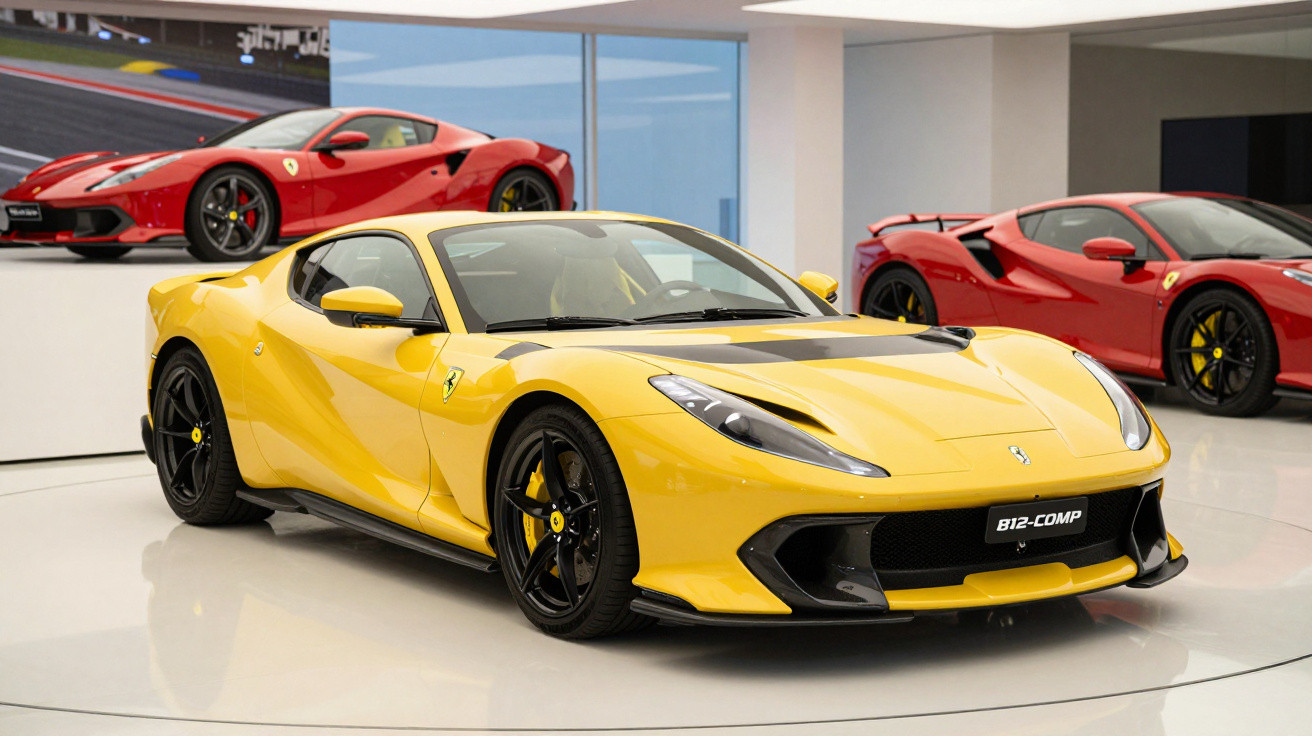
The new, limited-run Ferrari 812 Competizione and 812 Competizione A offer an extraordinary calling card: they are powered by the most potent combustion engine ever to emerge from Maranello, with no turbocharger in sight.
Beneath their long bonnets sits the familiar 6.5-litre naturally aspirated V12 from the 812 Superfast. In the Competizione models, however, maximum output rises from 800 hp to 830 hp, while peak torque moves in the opposite direction, dropping from 718 Nm to 692 Nm.
To achieve this extra power, the celebrated V12 has undergone a number of changes. Most notably, its rev limit has climbed from 8,900 rpm to 9,500 rpm, with peak power arriving at 9,250 rpm. This makes it the fastest-revving road-going Ferrari engine ever - and the changes do not stop there…
It gains new titanium connecting rods, which are 40% lighter, while the camshafts and piston pins feature a new DLC (diamond-like carbon) coating to cut friction and improve durability. The crankshaft has been rebalanced and is 3% lighter, while the intake system, including the manifolds and plenum, is more compact and uses variable-geometry ducts to optimise the torque curve throughout the rev range.
As expected, Ferrari devoted particular attention to the soundtrack of this naturally aspirated V12. Although it now uses a particulate filter, the company says it has retained the characteristic V12 note familiar from the Superfast through a redesigned exhaust system.
The new 812 Competizione models retain the Superfast’s seven-speed dual-clutch gearbox, but it has been recalibrated. Ferrari says this reduces the time between gear changes by 5%.
Rear-wheel drive remains the sole layout, allowing the cars to reach 100 km/h in just 2.85s and 200 km/h in only 7.5s. Top speed exceeds the Superfast’s 340 km/h, although Ferrari has not stated the precise figure. For context, the 812 Competizione laps Fiorano, the manufacturer’s own circuit, in 1min20s: 1.5s quicker than the 812 Superfast and just one second behind the brand’s 1,000 hp SF90 Stradale hybrid.
Power is nothing without control
To gain those 1.5 seconds, Ferrari revised both the chassis and aerodynamics of the 812 Competizione pair. The key chassis development is rear-wheel steering that can now operate each rear wheel independently, rather than moving them in synchronisation.
The system delivers an even more immediate front-axle response to steering inputs while preserving “the feeling of rear-axle grip”. This capability required the development of version 7.0 of the SSC (Slide Slip Control) system, which coordinates the electronic differential (E-Diff. 3.0), traction control (F1-Trac), magnetorheological suspension, brake-system pressure control in Race and CT-Off modes, electric steering and rear-wheel steering (Virtual Short Wheelbase 3.0).
Aerodynamically, the changes compared with the 812 Superfast are immediately apparent. The 812 Competizione models receive new bumpers and aerodynamic devices such as splitters and diffusers, designed not only to increase downforce but also to improve the V12’s “breathing” and cooling systems.
On the 812 Competizione coupé, the glass rear screen is replaced by an aluminium panel with three pairs of raised openings that create vortices. Their role is to disturb the airflow and redistribute the pressure field across the rear axle. The panel also produces additional downforce, accounting for 10% of the 812 Competizione’s rear downforce gains.
For the targa-bodied 812 Competizione A, Ferrari introduced a “bridge” between the rear pillars to compensate for the absence of this vortex-generating rear panel. Optimising its design effectively redirects airflow towards the rear spoiler, enabling downforce levels comparable with those of the coupé - the “bridge” effectively acts like a wing.
The 812 Competizione A also has a flap integrated into the windscreen surround, directing airflow further away from the occupants and increasing on-board comfort.
Lighter Ferrari 812 Competizione
The 812 Competizione is also 38 kg lighter than the 812 Superfast, with a final weight of 1,487 kg when dry and fitted with certain options. This weight saving comes from refinements to the powertrain, chassis and bodywork.
Carbon fibre is used more extensively for the bumpers, rear spoiler and air intakes. There is also a new 12 V lithium-ion battery, less insulation, and lighter forged aluminium wheels with titanium wheel bolts. Carbon-fibre wheels are available as an option, removing a further 3.7 kg overall.
A further 1.8 kg has been removed from the brake-cooling system by eliminating the rotating vanes used on the 812 Superfast. In their place is an aerodynamic brake caliper with an air intake, using a system similar to that first introduced on the SF90 Stradale. The new brake-cooling arrangement can lower temperatures by 30 °C.
Limited, extremely expensive and already sold out
The special nature of the Ferrari 812 Competizione and 812 Competizione A comes not only from their modifications over the 812 Superfast and 812 GTS respectively, but also from their restricted production runs.
The 812 Competizione will be built in 999 units, with first deliveries scheduled for the first quarter of 2022. Ferrari announced an Italian price of €499,000. In Portugal, the estimated price rises to €599,000, around €120,000 more than the 812 Superfast.
The 812 Competizione A will be produced in an even smaller run of just 549 cars, with first deliveries due in the final quarter of 2022. Its lower production volume is reflected in a price higher than that of the coupé, starting at €578,000 and estimated to reach €678,000 in Portugal.
Whether there were prospective buyers or not, the fact is that both models are already… sold out.


Comments
No comments yet. Be the first to comment!
Leave a Comment