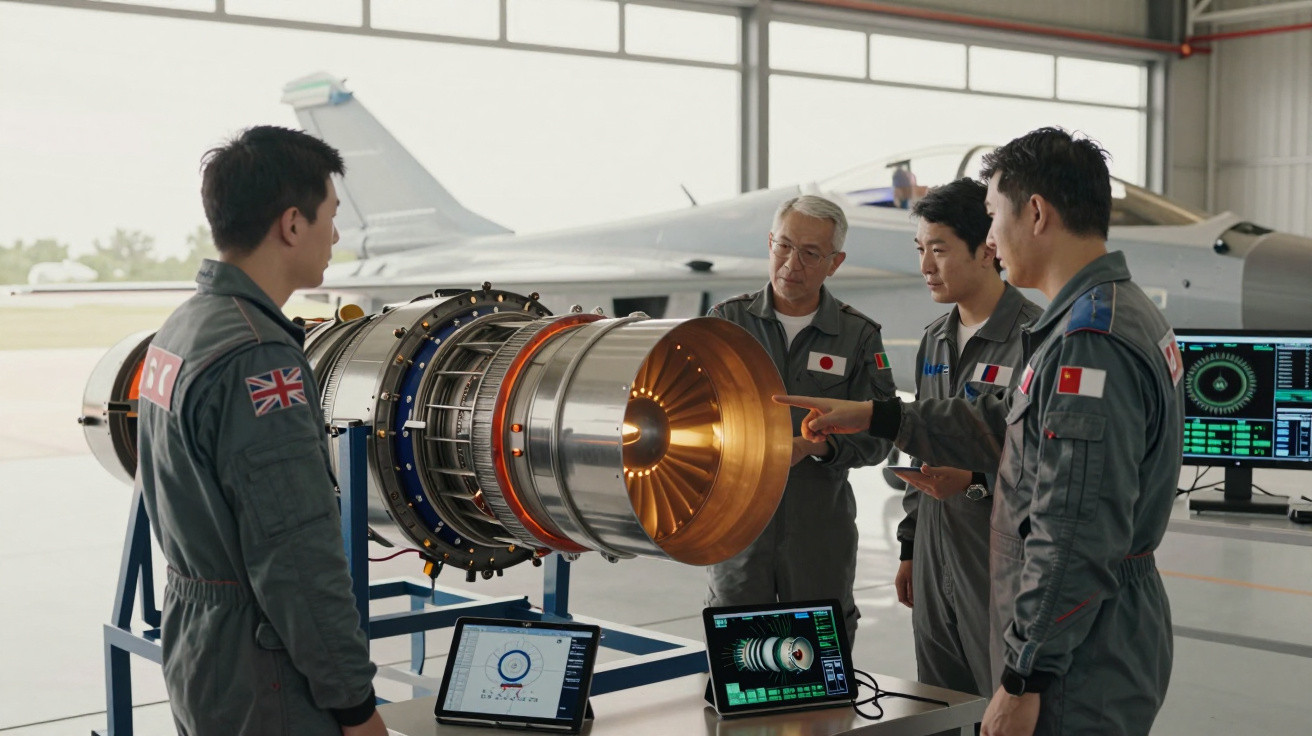
Following significant progress in developing the engine that will power the future sixth-generation fighter of the Global Combat Air Programme (GCAP), the United Kingdom, Japan and Italy have completed another series of design reviews, bringing the programme closer to building and subsequently ground-testing a technology demonstrator. This progress is a crucial step towards validating the architecture of the powerplant that will propel the aircraft.
GCAP engine demonstrator moves closer to ground testing
The work is being undertaken by a consortium comprising Rolls-Royce (United Kingdom), IHI Corporation (Japan) and Avio Aero (Italy), which is responsible for developing GCAP’s power and propulsion system. Having passed the latest technical reviews, the programme is moving towards final approval of the new engine demonstrator’s design, while manufacture of its components continues.
More than one hundred tests have so far been completed on reduced-scale components. Their results will support the forthcoming ground trials and provide critical data for development of the final powerplant.
The demonstrator is vital to reducing the programme’s technological risks before production of the operational engine begins. As well as proving new engineering solutions and the integration of its various subsystems, it will help refine tools, manufacturing processes and working methods, with the aim of shortening the design and development timetable for the future powerplant.
During the past year, the consortium also opened a collaboration centre in Reading, United Kingdom. Specialists from all three companies work there alongside representatives from the GCAP Agency and Edgewing, reinforcing international co-ordination across the project.
A sixth-generation fighter engine designed as a “flying power station”
One of the most notable features of the new propulsion system will be its ability to deliver far more than the thrust required to propel the fighter. As Phil Townley, Rolls-Royce’s Director of Future Defence Programmes, explained, the engine has been designed as a genuine “flying power station”, capable of handling the substantial energy and thermal demands imposed by next-generation sensors, electronic warfare systems and future high-power weapons to be carried by the fighter.
This capability will be decisive in sustaining the planned performance of a sixth-generation platform.
The participating companies also stressed the strategic importance of industrial co-operation. Edoardo Curti, head of Avio Aero’s Defence business, said the progress achieved marks a significant milestone in establishing a long-term partnership between the three manufacturers. Noriyuki Nakamura, Technical Adviser at IHI Corporation, noted that the programme will combine Japanese aero-engine technologies with the experience of its European partners to develop the “heart” of the next generation of combat aircraft, while also promoting specialist talent development and new industrial capabilities.
Edgewing contract supports GCAP’s 2035 target
These advances come only weeks after the governments of the United Kingdom, Italy and Japan awarded Edgewing a second international contract worth £4.6 billion to continue developing the future sixth-generation fighter. The agreement will enable progress on the aircraft’s detailed design over the next 18 months, while various industrial consortiums continue developing its critical components, including the propulsion system.
With the aim of introducing the new aircraft by 2035, GCAP is pursuing parallel development of the platform, sensors, communications and the engine, which must supply both thrust power and the electrical generation capacity required by the combat systems of the future.







Comments
No comments yet. Be the first to comment!
Leave a Comment