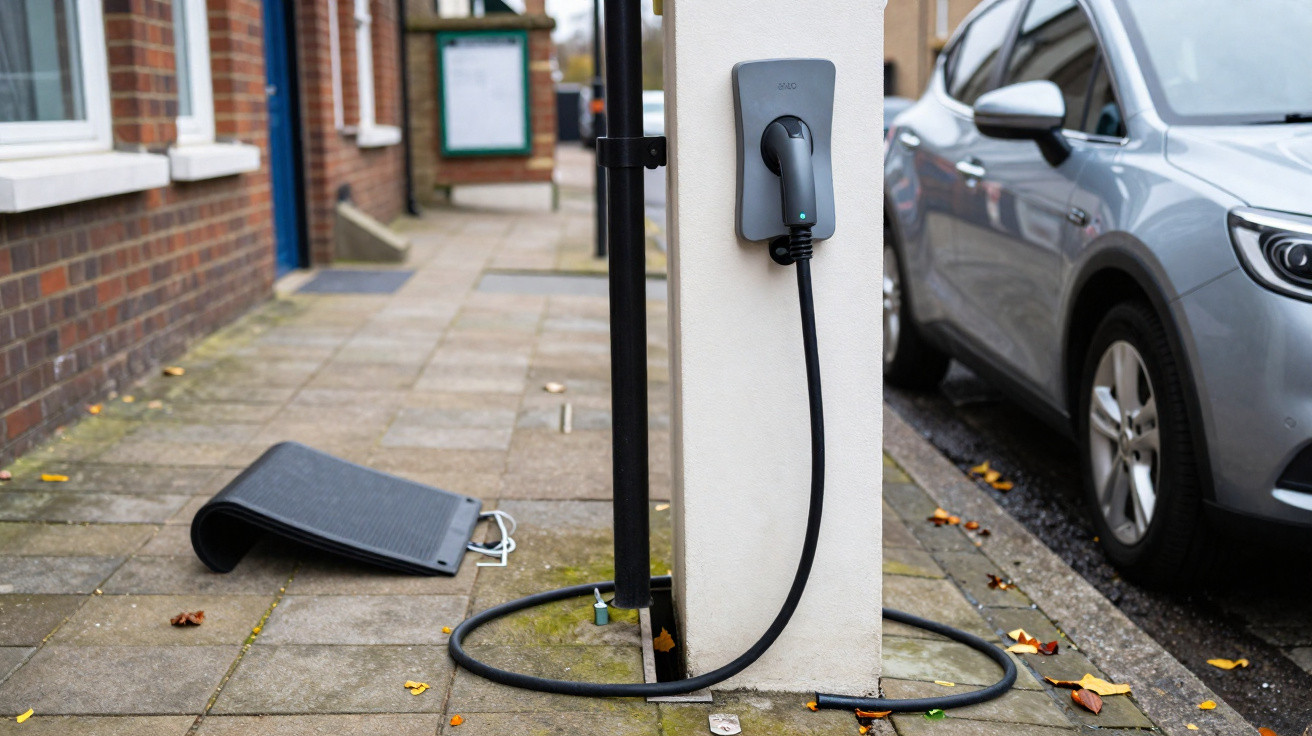
Charging an electric car at home can be convenient, but it becomes more complicated when you park on the road and the cable would cross a public pavement. A loose lead can create a trip hazard, be damaged by pedestrians or vehicles, and cause problems if someone is injured.
A recessed pavement cable channel, often called a cable gully, can appear to offer a tidy solution. The key point is simple: do not cut, lift, drill into or alter a pavement without written approval from the authority responsible for that stretch of highway.
A cable channel is not a fit-first, ask-later project. Local rules, technical standards and permitted use vary between highway authorities.
What is a pavement cable channel?
A pavement cable channel is a narrow, covered route set into a footway. It is designed to hold a charging cable while in use, with the cover sitting as flush as possible with the surrounding surface.
It is not the same as:
- a portable rubber cable ramp placed on top of the pavement;
- a charging cable laid across the footway, even temporarily;
- a public charge point at the kerb;
- a dropped kerb, which provides vehicle access to off-street parking.
The channel may be small, but the location is important. A pavement outside a home is often adopted highway, maintained by a county council, unitary authority or London borough. It is not automatically part of the householder’s land.
Some streets include privately maintained land, unadopted roads or complex ownership arrangements, so establish who is responsible before making plans.
Why you need permission first
Footways need to remain safe and accessible for everyone, including wheelchair users, people using mobility scooters, parents with pushchairs and people with visual impairments. Even a recessed channel can become hazardous if it is uneven, slippery, poorly maintained or positioned on a busy walking route.
There are also services beneath many pavements, including water pipes, gas mains, electricity cables, telecommunications infrastructure and drainage. Unauthorised excavation can damage these services and may be dangerous.
There is no single UK-wide entitlement allowing residents to install a cross-pavement cable channel. Depending on the authority, a council may:
- run a formal application scheme for approved channels;
- assess each request individually;
- require a licence, inspection or maintenance agreement;
- specify the channel design, contractor or reinstatement standard;
- restrict installations on narrow, busy or high-footfall footways; or
- refuse applications altogether.
A neighbour having a channel does not mean a new one will be approved. Policies, road layouts and highway conditions can change.
Check these points before buying a charger
It is worth doing the research before ordering equipment or paying a contractor. A home charge point is of little use for kerbside parking if there is no safe, permitted route for its cable.
1. Identify the highway authority
Search the relevant council website for “cross-pavement EV charging”, “cable channel”, “pavement gully” or “electric vehicle charging”. Your district or borough council may not be responsible for roads, but it should usually direct you to the correct highway authority.
Ask whether the pavement outside your property is adopted highway. If it is private land, different permissions may apply, including rights of way, lease restrictions or approval from a management company.
2. Read the full policy
Do not rely on a short webpage summary. Check the eligibility rules, fees, site requirements, drawings, installation standards, inspections and future maintenance responsibilities.
Some authorities set conditions on the direction of the channel, its distance from boundaries or street furniture, and whether the cover must be closed whenever the cable is not in use.
3. Think realistically about parking
A channel does not reserve the space outside your property. Unless a separate parking arrangement applies, another vehicle may park there.
Never route a charging cable around, beneath or over another person’s vehicle. Consider, too, whether the proposed route would conflict with a cycle lane, bus stop, tactile paving, drainage feature, dropped kerb, pedestrian crossing route or neighbouring driveway.
What the application process may involve
Procedures differ, but a responsible route will often look like this.
1. Ask for written guidance
Contact the highway authority with your address, photographs of the frontage and a brief outline of the proposed charging arrangement. Confirm that an application route exists before arranging any work.
2. Provide the requested details
You may need to submit measurements, a sketch or site plan, product information, photographs, contractor details and evidence of insurance. Fees may apply for applications, licences, inspections or reinstatement.
3. Wait for formal approval
An acknowledgement, informal conversation or verbal indication is not permission. The authority may need to inspect the location, check utilities, assess pedestrian access or consider planned maintenance works.
4. Follow the approved method
If approval is granted, comply with every condition. The authority may require a particular contractor, a specified product or highway permits for excavation and reinstatement.
Work in a public footway is not a normal DIY task. Do not excavate the pavement yourself or use an installer who cannot explain how the highway requirements will be met.
5. Keep the paperwork
Retain written approval, drawings, invoices, photographs and electrical certificates. They may be useful if the pavement is repaired later, the property is sold or the authority asks for evidence of the installation.
Permission for the channel and compliance for the electrical installation are separate matters. Both need to be dealt with properly.
Do not overlook the electrical installation
A cable channel only addresses the cable route. It does not make an unsuitable charging arrangement safe.
A home charge point should be selected and installed by a competent electrician who can assess the consumer unit, earthing arrangement, circuit protection, load management and outdoor cable route. Electrical work in homes must meet applicable safety requirements, including the relevant Building Regulations requirements and BS 7671 wiring standards.
Ask for the appropriate electrical certification after the work is completed. If you are unsure whether work must be notified through a competent-person scheme or building control, discuss this with the installer before it starts.
Avoid using a domestic extension lead for routine EV charging. Unsuitable or damaged leads can overheat, allow water ingress or be harmed by repeated use, vehicles and foot traffic.
Never modify a charging lead, improvise a pavement cover or tape a cable to the footway. Do not use damaged electrical equipment, especially outdoors or in wet weather.
Costs, grants and property permissions
The cost can extend well beyond the charge point itself. Allow for electrical work, possible consumer-unit upgrades, council fees, highway excavation, reinstatement and ongoing repair responsibilities.
Support schemes and eligibility criteria can change. Check current information directly with official government guidance, the local authority and your installer. Do not assume any grant covers highway works or is available to all owner-occupiers.
If you rent, live in a flat, share a driveway or are bound by a lease, obtain written permission from the landlord, freeholder or management company where needed. Properties in conservation areas, listed buildings or locations with unusual frontage arrangements may require further checks with the local planning authority.
Common mistakes to avoid
- Assuming the pavement belongs to the householder. Property boundaries and highway responsibility are not always the same.
- Installing a channel before applying. You may be required to remove it and pay for the footway to be reinstated.
- Buying a generic product too early. A product accepted in one area may not meet another authority’s requirements.
- Assuming parking outside your home is guaranteed. A lawful channel does not create a private kerbside bay.
- Leaving a cable exposed or a cover unsecured. The footway must remain safe when charging is not taking place.
- Using a contractor who only fits charge points. Highway work and electrical work can involve different skills, permissions and responsibilities.
- Ignoring autumn and winter conditions. Standing water, wet leaves, frost and uneven paving can make small defects more hazardous.
Is a pavement channel the right answer?
For some households, an approved cable channel can make home charging more practical. For others, uncertain on-street parking, a busy pavement or local restrictions may make it unsuitable.
Alternatives include public charge points, workplace charging, charging hubs and destination charging at supermarkets, leisure centres or other regular stops. If you are choosing an EV, consider your realistic charging access rather than assuming that a channel will be possible.
The sensible order is straightforward: assess where you park, check the council’s current policy, obtain written permission, and then use suitably qualified professionals. A neat-looking installation is only a good solution if it is lawful, electrically safe and keeps the pavement accessible for everyone.















Comments
No comments yet. Be the first to comment!
Leave a Comment