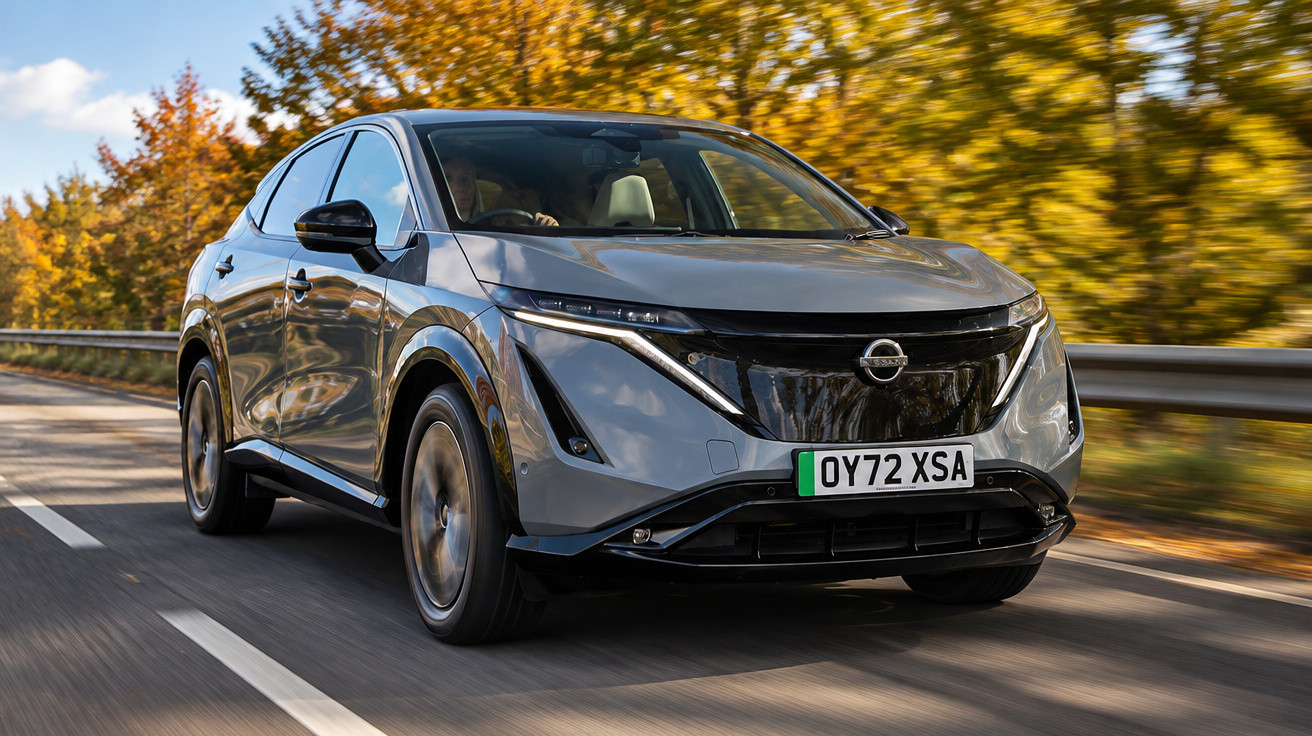
It is plain that plenty of people remain hesitant about switching completely to battery power, leading many in the motor industry to urge the government to bring back incentives.
At SMMT Electrified, Nissan e-micro mobility chief Gareth Dunsmore argued that motorists require 'more carrots and less sticks' before choosing an electric car. The plug-in car grant has been unavailable to private buyers for some time. Moreover, as of April, EVs will also lose their exemption from road tax, on top of buyers receiving no assistance with the cost of a new EV.
Few would challenge the principle that every car on the road should pay road tax, whatever its powertrain. Yet making an already expensive vehicle costlier to own is an unusual strategy for making EVs more attractive.
Expensive Car Supplement raises EV ownership costs
Adding another substantial layer to the proverbial cake, the Expensive Car Supplement (ECS) is an odd element of Vehicle Excise Duty (VED). In effect, it is an additional charge applied to every new car priced at £40,000 or above.
The problem is that, according to Kia's latest calculation, the ECS covers around 70 per cent of EVs, increasing the cost of EV ownership by roughly £600 annually. This is hardly a 'Go buy an EV' message.
Carmakers argue that this is one reason fewer buyers are selecting an electric car. Mike Hawes, chief executive of the Society of Motor Manufacturers and Traders (SMMT), said: "The Expensive Car Supplement established in 2017 at £40,000 would pick up a lot of premium vehicles. We've been subject to inflation over the past few years, so it's catching many more vehicles. As a minimum, they should be raising that threshold to £60,000 or higher, so it's focused on what the name suggests, not working against [electric] vehicles."
Carmakers call for government EV incentives
With the upfront EV price and additional charges failing to display a 'Buy Me' sign, manufacturers cannot depend on charge-point availability or charging costs to persuade people to embrace future mobility either.
They believe they have invested substantial sums in developing electric cars, only to face fines if they do not meet ZEV mandate targets. In their view, that is unfair when consumers receive no carrot-style financial support. Paul Philpott, Kia's UK boss, said: "At Kia, we're pretty good at EVs. EV3 just won UK Car of the Year, EV6 is a former European COTY, EV9 is a World COTY award winner – we should be flying through our mandated target, [but] we scraped there.
"We are all feeling we've got swords held above our heads with £15,000-per-unit fines if we miss these targets. We're incentivising and discounting the very best technology that we've invested billions in. It's just all a bit perverse right now."
BMW UK CEO David George shared that view: "Overall we've put a huge amount into driving the transition and what we feel now is that – despite trying to control everything that's within our control – retail demand really isn't in line with the ZEV mandate."
The pressure ultimately leads back to government. A committee report on EV charging infrastructure, issued on 12 March 2026, said the Department for Transport was not meeting its infrastructure targets. It also found that the £950 million pledged through the Rapid Charge Fund had not been released, while the VAT disparity between home and public charging is excluding many drivers without a driveway for a charge point.
Lisa Brankin, head of Ford UK, said: "If we can generate customer demand for EVs, we could have a roaring success. I'd like to encourage the government to act quickly."
Asked whether they were disappointed by government action, or the absence of it, George repeated Brankin's message: "It's encouraging that the [government is] listening, but we really need some swiftness of decision making."
Notably, SMMT calculations suggest that although each EV would initially cost the Treasury £1,000, EV adoption has generated £2.5 billion in VAT during the past five years. Hawes said: “Manufacturer investment has meant ten times as many drivers are going electric compared with just five years ago. This is great progress but, with the right support for consumers, we can go beyond current expectations to put a total of more than two million new EVs on the road by 2028."
Naturally, it is worth remembering that carrots can also help you see in the dark.








Comments
No comments yet. Be the first to comment!
Leave a Comment